

Iraqi Kurdish people-smuggler earned up to £100,000 a week for transporting hundreds of migrants from France to Britain, prosecutors said
LONDON,— A Kurdish man once described by French prosecutors as one of the most successful people smugglers operating along the English Channel is now living in Britain, reportedly claiming asylum while running businesses in the English Midlands, The Telegraph and BBC reported.
Twana Jamal, 46, an Iraqi Kurd, was sentenced to five years in prison in France in 2016 after police identified him as a key figure in a network moving migrants across the Channel in freight lorries.
French prosecutors said he was earning as much as £100,000 a week charging migrants between £4,500 and £5,000 each for passage to Britain. His nickname in the migrant camps was “Pasha,” a Turkish word for a person of high standing.
The BBC said it traced Jamal to a village in Leicestershire. Reporters observed him running two mini-marts, both called Candy Corner, located on opposite sides of the high street in Blaby.
Under British rules, asylum seekers are not permitted to work while their claims are being processed.
Contacted by an undercover reporter, Jamal said he was based in Leicester and was seeking asylum there. He said he had been in Britain since 2009.
“We know everyone in this city, this city is ours,” he told the reporter, adding that he was making “good money” and that there was work available moving cigarettes from a warehouse.

Jamal also admitted to driving a car without a valid licence. When asked about it, he said: “So what? Did I hit you?” He also said he was not concerned about being investigated. “No one touches us here,” he said. “Even the police won’t stop you.”
When the BBC confronted Jamal at one of the shops, he denied any involvement in people smuggling and denied being jailed in France.
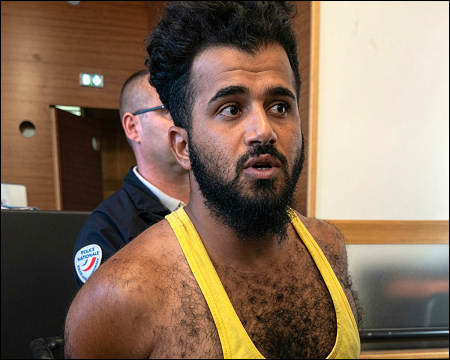
When shown a photograph of him taken inside a French courtroom in 2016, he did not deny it was him. But when told the photo proved he had been arrested, he replied: “I don’t care.”
He also denied working at the shop, even though reporters had seen him behind the counter and moving stock.
According to the BBC, Jamal was connected to a Kurdish criminal network known as the Ranya Boys, which has been involved in people smuggling since the 2010s.
From around 2012 to 2016, he ran operations out of the Grand Synthe migrant camp near Dunkirk in northern France.
French prosecutors noted that Jamal used so many false names that he reportedly wrote his assumed identity inside his baseball cap to keep track of who he was supposed to be. In court, he claimed he had been wrongly identified, but was found guilty. A judge told him he would face deportation to Iraqi Kurdistan upon release.
Despite that ruling, he entered Britain. Anyone jailed for a year or more is normally barred from entering the country.
Lucy Moreton, a professional officer at the Immigration Services Union, told the BBC that since Britain left the European Union, it had become harder to run checks on lower-level crimes committed by people entering from Europe.
The BBC also said it had gathered evidence that 15 other convicted people smugglers were living in Britain under false identities.
Downing Street responded to the reports on Thursday, saying the government shared public concern and was working urgently to establish the facts.
“We will not tolerate abuse of our immigration system, and that is why we are deporting people with no right to be here at the highest rate in nearly a decade,” a spokesman said.
The Home Office said the BBC had failed to provide evidence strong enough to support its claims.
A spokesman said all asylum applicants face mandatory security checks covering identity, immigration history, and criminal background, and that Britain holds agreements with other countries to share criminal records information.
The spokesman added that immigration enforcement activity was at its highest level in British history, with arrests for illegal working up 83 percent and enforcement raids up 77 percent.
Asylum seekers arriving in Britain are fingerprinted and checked against domestic police databases.
However, those systems do not automatically pick up convictions recorded in foreign countries, which can leave gaps in the screening process.
Jamal refused to give his name when approached by reporters, though he said the Home Office and immigration authorities already knew who he was.
(With files from Telegraph.co.uk | BBC)
Copyright © 2026 iKurd.net. All rights reserved.
Related posts:
 The Resurrection (Ba’ath) Party – Before the Iran-Iraq War
 Iraq – The Cynical Swindle
 The Truth About The Saddam Hussein Affair
 Saddam Hussein was a Friend to the West
 Business with ISIS – Updated
 Syria: Revisiting The Caesar Torture Victim Photographs
 Sabotaging Syria
 What makes a good NATO ally? The Case of Turkey
 Kurdish migrant smuggler Anjan Ahmadi sentenced to 5 years in UK
 The Double Cross of Iraq And The Discordant Death of WMD Inspector, Dr David Kelly – The 17th Anniversary