

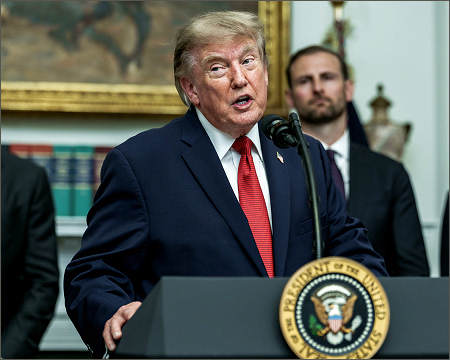
WASHINGTON,— U.S. President Donald Trump said Monday that the United States already has measures for overseeing artificial intelligence companies and prosecuting them, pushing back against warnings from executives about the potential for AI to cause harm.
The public debate has intensified after Jacob Coxon, a researcher at Anthropic, said last week that he had resigned partly because people developing AI genuinely believe the technology could kill everyone by the end of the decade.
Shares tied to AI declined worldwide Monday after executives from leading companies urged a slower approach to development.
Trump wrote on Truth Social that AI did not need additional controls beyond a strong and smart president, saying the United States had one.
He also publicly argued that questioning AI development would benefit China. Trump is due to meet Chinese President Xi Jinping next week in Washington.
Reuters had previously reported that the United States and China were planning another meeting in mid-September on AI risks, with lower-level officials to lead the discussions.
U.S. House Speaker Mike Johnson said Monday that Trump was expected to meet AI executives either this week or early next week.
Johnson said the discussion would examine the companies’ responsibility for safety and whether the government should have a role.
Vice President JD Vance also expressed doubts about calls from AI executives for government regulation.
He said he found it unusual that leading AI companies were approaching the government and asking it to regulate their industry.
Trump described the industry’s demand for regulation as a “hoax” online.
AMODEI’S ESSAY
Anthropic CEO Dario Amodei called for government action in an essay published Saturday. He said Washington should require independent audits of the most advanced AI systems, referred to as “frontier” models.
Reuters reported Monday that three U.S. senators were developing legislation that would require AI companies to show they were taking reasonable precautions to prevent their systems from causing harm. The details of the measure remained under discussion.
Amodei’s essay presented a three-part framework that he said would reduce the speed of AI development and give more time to address risks.
Executives from major AI companies supported the proposal, including Elon Musk, who runs xAI, and OpenAI CEO Sam Altman.
U.S. Senator Mark Warner, a Virginia Democrat and technology legislation leader, discussed AI safety with Amodei and Altman over the weekend, his spokesperson said.
Nvidia CEO Jensen Huang addressed the safety debate Monday at the All-In Summit in Los Angeles. Huang said companies could choose voluntarily to pause or slow their development if they believed their operations were becoming uncontrolled.
During the event, Huang received a call from Trump and placed it on speaker. The call lasted about five minutes. Trump said data centers create wealth for people and states and described them as “the oil of the next 20, 25 years.”
Trump said people opposing AI development were helping those who wanted to stop it, including political figures and China. He said the United States would not allow that, and Huang agreed.
Trump has continued to resist concerns about AI while largely embracing technology companies during his second term. He said safety tools had already been used on Amodei’s Anthropic, but did not explain what he meant.
Trump later wrote that his administration had prevented AI “people” from doing bad or potentially bad things, referring to Dario and Anthropic, and said the administration would continue doing so.
Anthropic’s media team did not immediately respond to a request for comment from Reuters about Trump’s statement.
The Trump administration and Anthropic are also in a dispute over AI safety and battlefield use. U.S. Defense Secretary Pete Hegseth blocked Anthropic from certain military contracts after the company refused to permit the U.S. government to use its Claude AI models for domestic surveillance or autonomous weapons.
Anthropic filed a lawsuit in a California court. A U.S. judge ruled in the company’s favor in one lawsuit on Aug. 27.
(With files from Reuters)
Copyright © 2026 iKurd.net. All rights reserved.
Related posts:
 Iraqi Kurdistan – “Sold Out!” – Part II
 Business with ISIS – Updated
 Iraq – The Cynical Swindle
 Saddam Hussein was a Friend to the West
 The New Great Game: An Impending Danger with Serious Global Implications
 The Resurrection (Ba’ath) Party – Before the Iran-Iraq War
 American Democracy is on Trial!
 Sabotaging Syria
 The Teflon President Donald J. Trump
 Is the BRICS Currency Trustworthy or Just Sophistry?