

After the U.S. Withdrawal, the KRG Has No Option but to Maneuver Politically and Mollify the Ayatollahs
Serwan Zangana | Exclusive to iKurd.net
The Iraqi Kurdish Foreign Minister Fuad Hussein’s statement, “It is the responsibility of the Iraqi government also to protect Kurdistan,” is a plea for protection from the Iraqi government as the region, according to the Kurdish leaders, has become vulnerable after the U.S. withdrawal.
Iran’s involvement in Kurdistan will indeed increase, which could also undermine the Kurds’ status and affect the stability and security of the region. Hussein’s statement reveals the weakness of the Kurdistan Region and its broken government, controlled by the two families of Barzani and Talabani.
In fact, Kurdistan has always been vulnerable, and unfortunately, the ongoing political conflict between the two major parties, the Kurdistan Democratic Party (KDP) and the Patriotic Union of Kurdistan (PUK), has been hindering the advancement of the political process.
The senior Kurdish leaders should have anticipated abandonment by the Americans, as had occurred in the past. However, they failed to connect the past with the present and draw a conclusion that could have helped them prepare for an undesirable outcome in the future.
The Kurdish leaders overlooked these critical links and forgot the catastrophic situations that have been caused by the U.S., and thus, these situations could be repeated.
In addition to the threat of the Islamic State (ISIS), which is the Kurds’ main concern, the Iranian-backed militias are also a threat, as they have conducted drone attacks on Kurdistan without regard for civilian lives.
These militias and groups are established and funded by the Islamic regime of Iran, and the Iraqi government, regardless of its authority, does not have the capability to disarm them.
The government hopes that the militias will willingly disarm and end the existing chaos in the country. However, it is a revolving door: Iran will continue its involvement in Iraq. In fact, the political conflicts in Iraq and Kurdistan and the weakness of the federal and regional governments leave Iraq as fertile ground for Islamic militias’ operations.
Two of the groups, Awfiya Allah and Sayyid Shuhada, agreed to be disarmed, according to Foreign Minister Hussein. It is noteworthy that a few other groups, such as Asa’ib Ahl al-Haq and Kataib Imam Ali, have already agreed to the terms of disarming and restricting their weapons to the government.
However, this will not end the militias’ threat to Iraq’s stability. The Iranian Quds Force commander, Esmail Qaani, outlined the plan after the U.S. withdrawal when he stated, “The children of the resistance maintain a presence in one of the region’s most critical areas, Iraq… as they continue on their path.”
The Kurdish leaders are afraid of doomsday—the end of their power, which stands on a hollow foundation. Kurdistan Region President Nechirvan Barzani’s statement reveals the desperation.
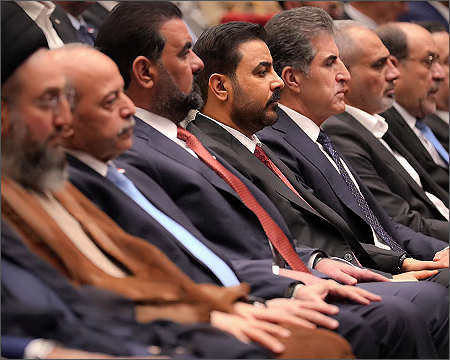
“We in the Kurdistan Region will always be cooperative and supportive of every step that strengthens Iraq’s sovereignty, security, and stability,” Nechirvan stated.
The Kurdistan Region Government (KRG) has no option but to cooperate with the federal government, as the Peshmerga have no capability to withstand external pressures, while Kurdish division has also contributed to the fragility of the region.
In fact, the independence referendum of 2017, which was opposed by the international community, including Iraqi Arabs, and subsequently responded to militarily by the Iraqi government and Iranian-backed Popular Mobilization militias, revealed the inability of the Kurds to defend the region.
However, with the U.S. withdrawal from Iraq, the obstacles will be removed, and Iran’s influence will continue to increase. While the majority of Arab Shia are ideologically aligned with the Islamic regime of Iran, the Kurds generally have a bloody history with the Iranian regimes, including the Islamic Republic of Iran.
Kurdistan’s stability is measured by the demands of the Kurds, and such demands are factors contributing to tension in the region. The region’s hostilities against the Kurds are triggered by the Kurdish goals of self-determination.
It is noteworthy that Abu Alaa al-Walai of the Iran-backed militia Kataib Sayyid al-Shuhada stated, “We assure our brothers in the Kurdistan Region of Iraq that their security and stability are an integral part of Iraq’s security and stability, and that any threat facing the region is a national concern for all Iraqis.”
However, how long will this brotherhood last? Do they call the Kurds brothers only to serve the interests of Iraqi Arabs and Muslim communities? Do the Muslim militias and groups believe in the same rights for the Kurds as for the Palestinians?
The security and stability of Iraq and Kurdistan depend on the interests of the Islamic regime of Iran, and the Iraqi militias are part of Iran’s strategy in Iraq. The militias’ positions in Iraq are clear. As he stated in the past, al-Walai said, “All Americans in Iraq will be hostages if a war breaks out between the U.S. and Iran. Because we will stand with Iran, period.”
Regardless of the small number of Iran-backed militias that have agreed with the Iraqi government on disarmament, they will always remain vital and fueled by Iran. Clearly, the U.S. withdrawal leaves a space for Iran and provides more opportunities to strengthen its proxies in Iraq and focus on a different strategy in post-U.S.-withdrawal Iraq.
Iran’s long-term strategy in expanding the Shii ideology has become even clearer as Commander Qaani said that they will continue their fight across the region and West Asia: “From Afghanistan to Yemen, and from Iran to Gaza and Lebanon,” Qaani stated.
Both Iraq and Kurdistan live at the mercy of Iran, as its influence is entrenched in the country, represents the Islamic Shii ideology, and is spiritually connected to Iraq’s majority Shia population. Ultimately, the stability of Kurdistan, which is tied to the stability of Iraq, is impossible as long as Iran and its proxies operate in Iraq.
However, while Kurdistan’s government is unable to eliminate the threat of Iran’s Islamic regime, it can only maneuver politically in the hope of mollifying the Ayatollahs’ outrages.
Serwan Zangana, a contributing writer for iKurd.net, lives in Virginia, U.S. He serves as a correction officer.
The views expressed are solely those of the author and do not necessarily reflect the opinions of iKurd.net or its editorial team.
Copyright © 2026 iKurd.net. All rights reserved.
Related posts:
 The Resurrection (Ba’ath) Party – Before the Iran-Iraq War
 The Assassination of Abdurrahman Ghassemlou: No Friends but the Mullahs?
 The Suffocation of Iraq Kurdistan
 The Mustashar and the Jash – A View from the Position of ‘Iraqi National Unity’ on the ‘Descendants of Treason’
 Iraq: Revenge and Corruption
 Business with ISIS – Updated
 Saddam Hussein was a Friend to the West
 Iraq in the Shadow of Khomeinism – Part I: Baghdad And Erbil Under Threat
 Saddam Hussein’s Enemies: Paving the Road to the Invasion of Iraq
 Iraq – The Cynical Swindle