

Ali Ashouri | Exclusive to iKurd.net
Film review
The documentary Angels of Sinjar** (Hanna Polak, 2022) transcends the boundaries of reportage. It is not only an account of the atrocities committed by ISIS against the Yazidis; it is a reflection on survival, collective memory, and the politics of the female body in a geography long marked by persecution. By following Hanifa, a Yazidi woman searching tirelessly for her abducted sisters, the film links the personal with the collective, the intimate with the historical, and transforms a story of loss into a cinematic meditation on remembrance.
1. The Yazidis and the history of exclusion
The Yazidis have long existed as the “other” in the Middle East. Their history is punctuated by massacres, forced conversions, and repeated waves of displacement: from the Ottoman Empire and early modern empires to twentieth-century Arab and Turkish nationalist projects. Even within Kurdish Muslim communities, Yazidis were frequently branded as impure or heretical.
The 2014 assault by ISIS on Sinjar—marked by mass executions, forced displacement, and systematic enslavement of women—was not an aberration but the culmination of centuries of marginalization. Polak’s film does not deliver this historical backdrop as narration, but the weight of it resonates through the landscapes, testimonies, and silences. The genocide appears as the most recent link in a chain of dispossession.
2. Women as witnesses of history
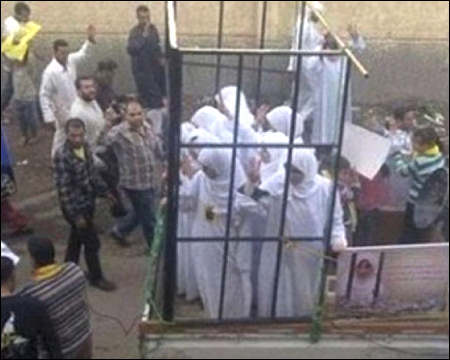
Yazidi women were doubly targeted: as the objects of sexual violence and as symbols of communal endurance. In ISIS’s perverse logic, women were reduced to commodities of war, stripped of humanity. Angels of Sinjar resists this reduction. Through Hanifa, women appear not as passive victims but as active witnesses.
Her body and voice operate as what might be called a living archive: they carry both trauma and testimony. Feminist theories of war often remind us that the female body is a political battlefield where structures of domination inscribe themselves. Yet here, the same body becomes a medium of resistance—reclaiming memory, demanding justice, and refusing erasure.
3. Space as memory
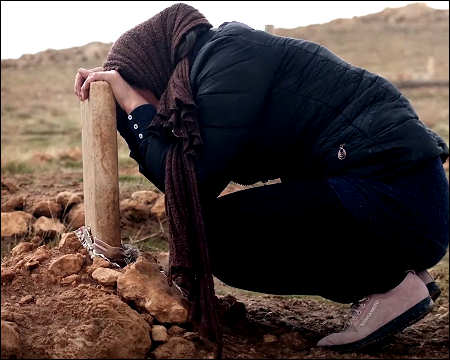
One of the film’s strongest achievements lies in its portrayal of place. The ruined houses of Sinjar, the barren mountains, and the deserted streets do not serve as mere backdrops. They speak. They testify. Maurice Halbwachs’s notion of collective memory helps illuminate this dimension: memory is embedded in places and objects as much as in people.
Polak’s camera dwells on these landscapes of devastation, reminding us that trauma is written not only in bodies but in the geography itself. In this sense, Sinjar becomes both wound and witness.
4. Cinematic language and temporality
Rather than relying on graphic depictions of violence, Polak constructs a cinematic language of silence, repetition, and slowness:
Space: Every ruin is framed as a marker of loss, a visual archive of genocide.
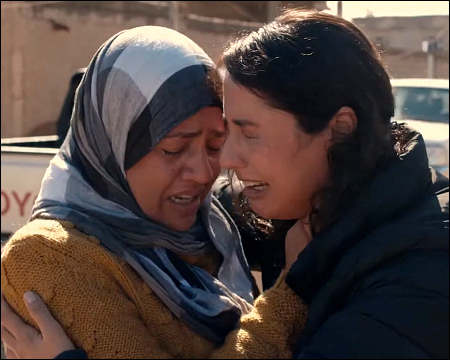
Body: The camera lingers on faces, gestures, and pauses. The female body, neither fetishized nor silenced, becomes a site where trauma and agency intersect.
Time: The pacing is deliberately slow. The film emphasizes waiting, searching, and enduring. Horror is not confined to the past; it is present in the persistence of grief and the impossibility of closure.
This aesthetic decision shifts the film from the register of news reportage to that of lived experience. It implicates the spectator not as a detached observer, but as someone drawn into the ongoing temporality of loss.
5. Toward a new understanding
The significance of Angels of Sinjar lies in its reframing of the Yazidi experience. It refuses to represent them as voiceless victims. Instead, it emphasizes survivors who act, remember, and rebuild:
The female body emerges as both scarred and resilient, a bearer of memory rather than a mere object of violence.
Place is shown as inscribed with memory; ruins are not silent but narrate what has been endured.
Horror is revealed not only in the massacre itself but in the unending aftermath, in the everyday temporality of survival.
Thus, the film functions as more than a documentary of genocide. It reimagines cinema as a medium capable of making the invisible wounds of history perceptible and unforgettable. By weaving together body, memory, and space, Angels of Sinjar transforms testimony into resistance, and survival into a form of political presence.
** Footnote:
The name of the region known as Şingal in Kurdish and Sinjar in Arabic and Persian has both linguistic and geographical significance. The term Şingal is derived from Kurdish components: şîn (meaning “green” or “blue,” often associated with vegetation and fertility) and gal (meaning “valley,” “place,” or “land”). Together, these elements convey the meaning of “green valley” or “fertile place,” reflecting the region’s lush landscapes and agricultural abundance.

Medieval Islamic sources, such as Yāqūt al-Ḥamawī’s Muʿjam al-Buldān, refer to the area as Sinjar. In this work, Yāqūt describes Sinjar as a prosperous settlement located at the foot of a mountain range with numerous villages and fertile lands, highlighting its agricultural importance.
However, the Arabic form Sinjar does not carry an intrinsic meaning and is a phonetic adaptation of the original Kurdish name. The persistence of the name Şingal in Kurdish oral tradition underscores its indigenous origin. The variation between Şingal and Sinjar exemplifies a broader historical process in which Kurdish toponyms were reshaped under Arabic orthography and pronunciation, while their deeper etymological roots and semantic resonances remained alive in the local vernacular. By :
Ali Ashouri SanDieg
References:
Halbwachs, Maurice. On Collective Memory. University of Chicago Press, 1992.
Butler, Judith. Frames of War: When Is Life Grievable? Verso, 2009.
Das, Veena. Life and Words: Violence and the Descent into the Ordinary. University of California Press, 2007.
Nichols, Bill. Introduction to Documentary. Indiana University Press, 2017.
Scarry, Elaine. The Body in Pain: The Making and Unmaking of the World. Oxford University Press, 1985.
Ali Ashouri, a contributing writer for iKurd.net based in San Diego, California, U.S.
The views expressed are solely those of the author and do not necessarily reflect the opinions of iKurd.net or its editorial team.
Copyright © 2026 iKurd.net. All rights reserved.
Related posts:
 “Angels of Sinjar”: Film Screening Review with Q+A
 Business with ISIS – Updated
 Iraqi court issues warrant for Yazidi commander Qassim Shasho for Islam remarks
 Yazidi woman kidnapped by IS rescued in Gaza by joint Israeli-US operation
 The Iraqi-KDP agreement overrides Yazidi interests
 Yazidi woman rescued from IS in Gaza arrives in Germany
 Swiss parliament recognizes Islamic State crimes against Yazidis as genocide
 Powerful, yet are they Useless?
 Understanding the Yazidis of Kurdistan
 IS woman charged in Sweden for enslaving Yazidis in Syria