


Dr. Amir Sharifi | Exclusive to iKurd.net
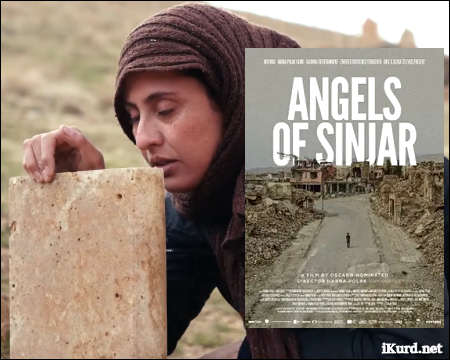
Womensvoicesnow.org will be screening “Angles of Sinjar” on September 21, 2025 at 1:00 PM in Los Angeles at Renberg Theater.
Directed by Academy- and Emmy-Award nominee Hanna Polak, Angels of Sinjar is more than just a film; it’s a testament to the unbreakable human spirit. When a solemn promise to a dying father becomes an impossible mission to rescue five sisters from ISIS enslavement, one woman’s journey exposes a forgotten genocide. The film is a call to action, a testament to what happens when ordinary people do extraordinary things, and proof that even in humanity’s darkest moments, love and courage can light the way forward.
Hanna will be joining us in-person from Poland and will be in conversation with Maha, Awad, Arab American TV Host, Creative Producer, and Voice Actor, and Dr. Amir Sharifi from California State University.
3rd Annual Leslie J. Sacks Grand Prize Film Screening and Q&A, the culminating event of the annual Women’s Voices Now Film Festival.
“Women’s fight for equal rights is essentially a humanist and peaceful struggle for true democracy, and a higher form of civilization.” – Leyla Zana
Film Review: Angles of Sinjar
Many revealing films have been made about the trauma and genocidal campaigns to which Yazidis have been subjected. These movies whether feature or documentary converge on themes of invoking narratives of lived experiences of the victims and survivors who have experienced and fought the ferocity and savagery of genocide.

However, Angles of Sinjar, made by the Polish director, Hannah Polak and shown is superbly and effectively shot to give us an insight into the collective memory and ethno-religious identity of a Yazidi young woman, Hanifa and her untiring search for her five sisters abducted by the Islamic State of Iraq and Syria (ISIS) in 2014. Polak’s film uncovers the multilayered discourses as it plays an active and engaging role both in the community’s visibility and intervention to foster decisive and concerted action in countering genocide.
Genocide films approach the subject from multiple perspectives, In a film such as Mediha (2023) a young girl a survivor uses an armature camera to capture the lived experiences of her family members and as the search for her missing family members across Iraq, Turky, and Syria continues.
On Her Shoulder (2018) documents the afflictions of Nadia Murad, an iconic figure in the fight against Genocide. 10 Years of Darkness: ISIS and the Yazidis (2025) casts light on the genocidal war in 2024 and its consequences and what survivors reveal during interviews and what global actions should be taken. If the Dead Come Home( 2024) depicts the starkly tragic lives of survivors in search of their lost ones in mass graves and how finding a loved one is helpful in healing the survivors. Defenceless People : The Yazidis and their lives after the genocide (2025) is the story of four siblings and their diasporic life in Germany as they attempt to build a new life.
A fundamental difference between Angels of Sinjar and other films is in the collective interlacing effort of multilayered narratives to bring injustice and historical genocide to the attention of audiences at large rather than relying on the plight and struggle of one character to show the depth of the genocide . Another significant message of this film is that genocides, torture, mass execution, or sexual violence will never end easily without intervention otherwise afflictions persist across time and space for generations unless perpetrators are brought to justice.
The director, Hannah Polak sets in motion not only the frightening revelation but captures the mystical and yet gloomy landscape of Mount Sinjar, the sacred site where the core beliefs and practices of Yazidis is conveyed in a voice-over. This mountain is the site of genocide where hundreds of thousands of people fled and took sanctuary as many died of heat, hunger, and disability in 2014.
In a subsequent scene Hanifa, the protagonist is shown mourning on her father’s grave; the father suffered a heart attack after hearing about the tragic fate of his kidnapped daughters, particularly when one of them gang raped called from a hospital in Syria.
It is here that viewers find out a Kurdish fighter, Hamood, helping Hanifa rescue her remaining three kidnapped sisters. Soon after viewers are then taken to the city of Sinjar which had a population of 90000 before the genocide ; after the vicious attack, it is now looted, destroyed, abandoned, many inhabitants executed, women and girls abducted and forced into sex slaves, topics to which the film returns.
The entire area including Kocho, a village about 28 Km form the city of Sinjar with a population of 2000 residents now looks like a ghost town. Saeed, the brother of Nadia Murad, the recipient of 2018 Nobel Peace Prize, reenacts where he and other men were taken to be executed. He recalls “ They shouted “Allahu Akbar” and opened fire. I could feel the bullets when they hit me.
One bullet hit here (showing the side of his left knee) a second one the knee, another one here ( along the abdomen ) another bullet above it. I was hit five bullets. I got the sixth bullet …whoever was still moving, was finished off with a shot to the head. The shooter approached me and shot me right here (showing the back of his head ) You can still my scars.
He thought he’d killed me. …When they left, I crawled out. I looked around and there were about fifty men dead. I crawled to that house. When I was inside, I could see ISIS bulldozers burying the bodies. Saeed painfully shows photographs of his six brothers and his slain mother posted on a wall among many others. These segments of “monologue” find immediate reverberations in the minds of the audience.
In another intercut footage, Hanifa also in a car nostalgically remembers happy times she had spent with her family; now with horror, she relives and enacts the arrival of DAESH on Til Ezer Far, relating the story of her escape and where men were massacred and women and girls including her sisters were seized and abducted. The magnitude of the mass violence and the fact that Yazidis are still living under the harsh and deplorable conditions is shown in a sprawling tent city of refugees and Hanifa with resilience distributes candies to alleviate the afflictions of surviving children.
A turning point in narratives occurs in an intertwined footage when the film director takes Saeed and Hanifa to Krakow, Poland where Hanifa and Saeed in painful recollection, recall and relate the haunting memories of mass killings and kidnappings of ISIS to a UN conference on genocide.
Culminating in Nadi Murad’s impassioned speech in Oslo City Hall, Norway, upon receiving the 2018 Nobel Peace Prize for all her efforts on the part of the Yazidis to end sexual violence and calling for accountability of perpetrators; she addressed the audience as a survivor for all Yazidis and their ancient culture and religion; her speech brought tears to the eyes of many when she spoke of how ISIS ferociously murdered six of her brothers and captured one ; she also took the audience to places where the genocide took place as she yearned for the lost home. Her discourse not only re-echoes her brother’s lamenting account, but brings together memories and episodes of diverse global communities to prevent such tragedies.
The film’s narrative resumed in diaspora, a fragmented and dispersed community where Hanifa’s family is still traumatized in Germany. Hanifa has rescued her seven year old and 17-year-old sisters. Another episode before Hanifa returns to Kurdish Region in Northern Iraq to look for her remaining sisters, depicts the simple joy and yet predicaments of life in diaspora.
The simple joy of unwrapping gifts reminds the mother of the tragic loss of her husband which she reenacts vividly “I saw Wadha put her doll in our bag. After the girls were captured, their father kept the doll’s hat in his pocket He kept it there till the day he died.
He would not let any one touch it. He held it and cried and would not let anyone near that hat; it was her sister’s toy. He was tormented by the fate of his daughters. I’ll never forget it. He died from shock and a broken heart.” This fleeting moment of joy and play is intercut with agony as the mother tearfully cries out “that is why, I don’t want to see any dolls or toys.”

The film clearly shows Hanifa and her own probing and testimony gathering methods, her youngest sister’s account when she was seven, is haunting “We were told to become Muslims and { they said, we} won’t harm you. An]{if you} practice our religion. They took us to the swings to stop us from crying …they said if you become Muslims, we will take you back to your mothers They lied as they took all women to Syria. The ISIS women kept saying the forbidden word to us {Satan}. They used the word to refer to us. And they kept humiliating us. None of the children’s parents were with them They were two or three years old; they urinated on us and cried all night …a woman came and read the Qur’an to us and told us to repeat after her ..if we did not ; they’d make us get “married” There were pieces of glass from a broken window. Two my friends and I cut our wrists, but nothing happened They took us to the doctor right away…then they took us to a large room; each one in a room. She hesitates to continue as the sister urges her on. Moments of pause and her wondering eyes “Hanifa, that’s enough and I cannot do it anymore.” Both embrace in shame.
Yet another horrific footage is the testimony given by Haifa’s older sister “ … I thought I would be able to escape, but nobody could escape them . Before this, the men would examine the girls. They dressed you in hijab, and women’s clothing and examined us to see if we were virgins or not . They gathered us together and based on our looks = they created a lottery. They drew lots as to who would win: younger or older, shorter or taller, pretty or plain, with eyes a certain color. They did not leave anything out We smudged our faces with ash to not look attractive, but nothing helped; we were scared to death. I tried to electrocute myself in the bathroom by pulling electrical plugs from their sockets in the shower. I thought this would kill me but I only fainted. … My nine-year-old sister, who is now eleven, and still captive tried to hide behind me. They pulled her hair to take her away. In the end they got her even though I begged them to leave her alone. She was screaming as they dragged her away . Both the older sister sitting next to the sobbing mother hid her faces in her hair, both hid their tears from the gaze of the audience.
With help from Hamood, Hanifa reembarks on a dangerous and daring and daunting search to find through intermediaries her sisters ( the pictures of two of whom she has). Viewers find out the youngest one called her “mother” because she had taken care of her. “ I love her more than I love myself.”
This is where we have a convergence of discourses : a young Yazidi girl and her longing for peace and justice is also present in Hanifa’s quest and Yazidi women’s lamenting rhythmic clad in black, chest beating in a monumental representation of a history of mourning against genocide of all ages.
The film becomes more articulate and more collective once Hanifa’s voice joins Nadia’s and other women who are struggling to set free more than 3000 women who remain in captivity of ISIS. Angels of Sinjar is empowering in this sense rather than simply being a compassionate and persistent portrayal of Hanifa, it is indeed collective and collaborative effort through the focused presence, courage, and strength of women like Hanifa to tell the harrowing stories of genocide under the gaze of cameras.
The final scene occurs through framing as after a long delay and unexpected challenges faced by Hanifa and Hamood, Hanifa succeeds in rescuing one of her sisters from the captivity of ISIS. The final sequence in a car amid crowds in the dusty alleys shows Hanifa’s emotional outpouring, gracious generosity, the ubiquitous happiness, the boundless love for her sisters and her sister’s embrace. This final scene constitutes an unforgettable and unrepeatable dramatic imagery in the face of terrorism, torture, and genocides of all types against humanity .
Dr Amir Sharifi, a lecturer at California State University, Department of Linguistics, Long Beach.
The opinions are those of the writer and do not necessarily represent the views of iKurd.net or its editors.
Copyright © 2025 iKurd.net. All rights reserved
Related posts:
 Angels of Sinjar: Body, Memory, and the Afterlife of Genocide in Cinema
 Business with ISIS – Updated
 Understanding the Yazidis of Kurdistan
 Iraqi court issues warrant for Yazidi commander Qassim Shasho for Islam remarks
 Yazidi woman rescued from IS in Gaza arrives in Germany
 The Truth About The Saddam Hussein Affair
 Swiss parliament recognizes Islamic State crimes against Yazidis as genocide
 A Film Review of The President’s Cake (Le Gâteau du President)
 Yazidi woman kidnapped by IS rescued in Gaza by joint Israeli-US operation
 Turkey: Nato’s Islamic State Member