

Aram Rafaat | Exclusive to iKurd.net
Translated by iKurd.net from Kurdish Hawlati newspaper
(I challenge all Kurdish academics and historians to prove otherwise regarding what is presented here.)
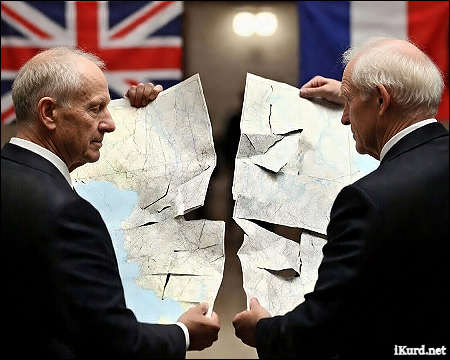
Most Kurds say that it was the British and the French who divided Kurdistan.
This claim is the biggest historical lie, the most widespread, longest-lasting, and most ignorant lie in the Kurdish world.
Kurdistan was divided twice, in two stages. The division of the Kurds among the four fascist entities of Iraq, Iran, Syria, and Turkey is the result of these two stages.
The first stage was the Battle of Chaldiran, and the second stage was World War I.
In both stages, it was not the British or the French who divided Kurdistan, but four Muslim nations: Persians, Turks, Arabs, and Kurds.
Among these four nations, the role of the Kurds in dividing themselves among those four fascist entities was decisive.
First Stage:
The first division of Kurdistan happened in 1514, during the Battle of Chaldiran between the Ottoman Turks and the Safavid Persians.
The battle took place on Kurdish land, and at that time the Ottoman Turks were not yet present in Kurdistan.
Those who brought the Ottomans into Kurdish lands were Sunni Kurdish tribes.
Those who caused the war to take place on Kurdish land were also Kurdish tribes and emirates.
A large portion of the fighters and resources on both sides of the war were Kurds.
On the Ottoman side, most of the northern Kurdish emirates played a major role in the war, while on the Safavid side, the Ardalan emirate also participated, though to a lesser extent.
The first division of Kurdistan into Safavid and Ottoman parts was the result of this battle.
These two parts were later officially established in the Treaty of Qasr-e Shirin in 1639.
Even today, the artificial border that separates the east from the south and north is, more or less, the same border drawn at Chaldiran and Qasr-e Shirin.
Now judge for yourself, with your own awareness, how much of the blood of Kurdistan was shed not only by the swords of the Safavids and Ottomans, but also by the swords of the Kurds themselves.
A sword that stood alongside the rusted swords of the Turks and Persians in creating this wound, the division of Kurdistan into two parts, a wound that has still not healed.
And in 1515, there was nothing called the British Empire or France as colonial powers.
On the contrary, at the time of the Battle of Chaldiran, both France and England were small and insignificant kingdoms, not stronger or larger than the emirates of Ardalan or Botan.
Second Stage:

The second division happened after World War I.
In this stage, Safavid/Qajar Kurdistan remained as it was.
This part was not affected by the post–World War I division and remained under Persian control, which continues to this day.
In this stage, only Ottoman Kurdistan was divided among the fascist entities of Turkey, Syria, and Iraq.
Most of those who, for a century, have insisted, out of falsehood or ignorance, on the role of Britain and France in dividing Kurdistan use the Sykes-Picot Agreement as evidence.
But relying on Sykes-Picot is itself false, misguided, and weak, for four reasons:
First,
Eastern Kurdistan (Qajar Kurdistan) was not included in the Sykes-Picot map at all.
Second,
Sykes-Picot was signed in 1916 but was effectively dead at birth, or more accurately, it died with the Russian October Revolution of 1917.
In short, it was never implemented.
Third,
Neither the current map of the three occupied parts (north, south, and Rojava), nor the maps of Turkey, Iraq, and Syria match the Sykes-Picot map in any way.
To make it easier for the reader, I will focus on how Kurdish cities and regions would have been divided under Sykes-Picot.
If it had been implemented, Kurdistan as a whole would have been divided into three regions:
- Russian zone:
Including Van, Bitlis, Erzurum, and part of Hakkari. - French-controlled zone (directly or indirectly):
This would have been the largest part, including Sulaymaniyah, Erbil, Mosul (with Duhok), most of Rojava, and in the north, Mardin, Diyarbakir, and Urfa. - British influence zone:
The smallest part, including Kirkuk and Garmiyan.
As you can see, the current division of Kurdistan does not match the Sykes-Picot map at all.
The reason is simple: the agreement was never implemented.
The largest part of the claim, that Britain and France divided Kurdistan after World War I, still remains unaddressed.
In fact, the opposite is true: after World War I, three opportunities for Kurdish independence were presented.
First opportunity:
From the Americans.
On January 8, 1918, Woodrow Wilson (the U.S. president at the time) announced his famous Fourteen Points for reorganizing the world after World War I.
Point 12 addressed the Ottoman territories and clearly stated that nations under Turkish rule should have the right to self-determination and autonomy.
At that time, the Kurds were the only nation still under Ottoman rule.
In Kurdish history, Wilson’s Point 12 is the first international document that recognizes the Kurdish right to independence or autonomy.
But the Kurds, especially tribal leaders and sheikhs, were living in a different world.
Not a world of independence and building a Kurdish state, but a world of defending the Ottoman Caliphate, religious brotherhood with the Turks, and jihad against Christian “infidel” Britain and France.
The only exception was Sheikh Mahmud Barzanji.
He saw Wilson’s Point 12 as a source of hope and a promise for independence in southern Kurdistan and the creation of a state.
Second opportunity:
The great powers allowed the establishment of a Kurdish administration in southern Kurdistan under Sheikh Mahmud.
On November 17, 1918, the British recognized Sheikh Mahmud as the governor of the Sulaymaniyah region.
With this step, the British even broke their own rule of punishing any leader involved in the killing of British soldiers.
Sheikh Mahmud had participated, encouraged by the Turks, in the Battle of Shu’aiba in 1915, where about 400 British soldiers were killed.
His rule was the first experience of governance in modern Kurdish history.
The fate of his governments was shaped by difficult conditions, including:
- Arab ambitions in Iraq to occupy Kurdish areas.
- Turkish interference and efforts to damage relations between him and the British through Kurdish agents.
- Conflicts among British officials in Baghdad and Sulaymaniyah.
- Most importantly, his lack of experience, lack of support, and Kurdish disunity.
Third and final opportunity:
The Treaty of Sèvres.

Articles 62, 63, and 64 clearly provided the Kurds with the right and opportunity to establish an independent state in the north, with the possibility of uniting with the south.
But the Kurds discovered something they saw as greater than Sèvres: Mustafa Kemal Atatürk.
In May 1919, Atatürk launched the Turkish national movement.
In July 1919, he held the Erzurum Congress with Kurdish tribal leaders and sheikhs.
There, he declared that “Kurds and Turks are like flesh and nails,” inseparable, and presented his movement as a jihad against unbelievers.
The Kurds, influenced by the spirit of jihad and this idea of unity with the Turks, later opposed Sèvres from all sides.
Hundreds of telegrams and messages were sent in the name of the Kurds rejecting Sèvres and independence, treating it as forbidden.
At Lausanne, both Atatürk and his Kurdish allies achieved their goal: they buried Sèvres and, with their own hands, opened the gates of hell for the Kurds, a fire that still burns them in all parts today.
This article was originally published in the Kurdish language in Hawlati Newspaper on March 22, 2026.
The opinions are those of the writer and do not necessarily represent the views of iKurd.net or its editors.
Copyright © 2026 iKurd.net. All rights reserved.
Related posts:
 Behind the Veil of Turkey’s ‘Zero Problem’ Policy – A Kurdish Perspective
 Turkey’s Continuous Trail of Terror and Genocide
 The Resurrection (Ba’ath) Party – Before the Iran-Iraq War
 The Truth About The Saddam Hussein Affair
 The Madness of Turks
 Business with ISIS – Updated
 The Double Cross of Iraq And The Discordant Death of WMD Inspector, Dr David Kelly – The 17th Anniversary
 The Dersim massacre: Turkish destruction of the Kurdish people in Dersim region
 The Syrian Problem is Turkey – Part II
 Iraq: Revenge and Corruption