

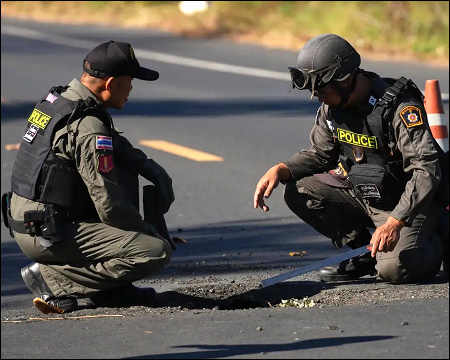
MONGKOL BOREY,— Heavy fighting between Thailand and Cambodia entered a second week on Monday, with Cambodia claiming that Thai airstrikes struck deeper into its territory and disrupted areas housing displaced civilians, according to the AP.
Cambodian authorities reported that Thai F-16 fighter jets dropped bombs near camps sheltering residents displaced by earlier fighting in Oddar Meanchey and Siem Reap provinces.
One of the strikes in Srei Snam district, more than 70 kilometers from the Thai border, reportedly targeted a bridge. Cambodia’s government expressed concern for civilian safety and infrastructure.
Thailand’s air force spokesperson, Air Marshal Jackkrit Thammavichai, confirmed that air operations had taken place but emphasized that military targets are defined by their function rather than distance from the border.
He said Thailand’s forces act in accordance with international law and do not target civilians. Independent verification of claims from both sides remains difficult due to restricted access to conflict zones.
The fighting centers on disputed sections of the 817-kilometer border, where centuries-old temple sites overlap with contested land. More than half a million people have been displaced, and officials report at least two dozen deaths since fighting intensified earlier this month.
Thai military officials released estimates of Cambodian losses since a Dec. 7 incident that wounded two Thai soldiers. They said Cambodia had lost 12 tanks, 10 armored vehicles, four anti-aircraft artillery systems, seven artillery pieces, five anti-drone systems, 175 drones, five communication hubs, and one BM-21 mobile rocket launcher.
Thai forces also said Cambodian troops fired thousands of rockets from BM-21 truck-mounted systems, capable of launching up to 40 projectiles at a time.
Thailand reported its first civilian death from the conflict on Sunday, a 63-year-old villager killed by a Cambodian rocket attack.
Cambodian authorities said at least 15 civilians have been killed and 73 wounded by Thai operations.
Thailand has acknowledged the deaths of 16 of its soldiers, while Cambodia has not released military casualty figures and has rejected Thai estimates.
The conflict has extended beyond the battlefield to logistics and supply routes. Thailand said it had stopped fuel shipments through the Chong Mek border crossing with Laos after intelligence indicated supplies were being diverted to Cambodian forces.
Rear Admiral Surasant Kongsiri, a Thai defense ministry spokesperson, said the restriction aimed to cut off military support to Cambodia while minimizing impact on the Lao government and civilians. Laos did not immediately respond to requests for comment.
Thai authorities also said fuel and weapons would no longer be allowed to transit through other key land checkpoints near Cambodia and that Thai vessels in designated high-risk areas of the Gulf of Thailand could be restricted.
Officials emphasized that ships from other countries would not be affected. Trade data show Cambodia relies heavily on maritime fuel imports, with Singapore as the largest supplier. Thailand’s energy ministry said there have been no oil exports to Cambodia since July.
Cambodian officials accused Thai forces of using drones, heavy artillery, and increased airstrikes in several provinces, including Siem Reap, home to Angkor Wat.
Cambodian defense spokesperson Maly Socheata said the use of fighter jets and cluster munitions had increased significantly. Thailand, with a larger and more advanced military including F-16 and Gripen jets, said fighting continued at nine locations along the border.
Both countries blamed each other for the collapse of a ceasefire brokered in July with support from U.S. President Donald Trump and mediated by Malaysia.
That truce ended five days of fighting and was later expanded into a broader agreement in October. Trump said last week that both sides had agreed to renew the ceasefire. Thailand’s Prime Minister Anutin Charnvirakul denied making any commitment, while Cambodia said it would continue military operations in self-defense.
A meeting of Southeast Asian foreign ministers scheduled for Tuesday was postponed to Dec. 22 at Thailand’s request, Malaysia’s foreign ministry said.
Thailand also acknowledged that fighting had damaged the Ta Kwai temple, known in Cambodia as Ta Krabey, in a disputed area, and said Cambodian forces used the site as a military position.
Phnombootra Chandrajoti, director-general of Thailand’s Fine Arts Department, said historic sites should not be used for military purposes and that securing and preserving the area remained a priority.
Officials from both sides indicated that hostilities were expected to continue unless a new ceasefire agreement is reached.
(With files from AP | Reuters)
Copyright © 2025 iKurd.net. All rights reserved.
Related posts:
 Cambodia, Thailand exchange heavy artillery fire, thousands flee
 Thailand, Cambodia sign new ceasefire agreement to end border fighting
 Thailand vows to continue fighting Cambodia despite Trump’s ceasefire claim
 Thailand, Cambodia reach ceasefire deal after five-day conflict
 Business with ISIS – Updated
 Iran-backed Shia militias use new guerrilla warfare tactics to drive US out of Iraq
 Sabotaging Syria
 Saddam Hussein’s Enemies: Paving the Road to the Invasion of Iraq
 What makes a good NATO ally? The Case of Turkey
 The Resurrection (Ba’ath) Party – Before the Iran-Iraq War