

A visual masterpiece by Iraq-born director, Hasan Hadi
Sheri Laizer | Exclusive to iKurd.net
The President’s Cake (2025) is the first Iraqi film of quality to be made in decades able to reach an international audience unfettered. The film delicately avoids being propagandist. Set during the UN’s 13-year sanctions on Iraq, the main foes are the cruel effects of these sanctions (the corrupt Oil for Food Programme that left people hungry and destitute) and the constant American bombing that endured until their invasion of the country on 21 March 2003. The narrative spans the two-day preparations until the President’s birthday on 28 April. The actual year is unspecified although one image claims it was his 50th birthday.
Magical realism combines with a well-managed historic recreation of 1990s Iraq visually and in atmosphere. The audio soundtrack reverberates with the screech and thunder of American jet fighters roaring overhead, bombing civilian locations emphasising throughout who the enemy is, to the final moments of the film. The score features simple oud and darbuka pieces along with popular Iraqi songs and the chants of the day like, “Saddam, Saddam, our hearts and souls for you, Saddam.”
The action opens, as we are told, two days before the President’s birthday, which was commemorated publicly every year as a national event with postage stamps issued for each year. School children drew lots as to how they would participate in these celebrations.
The heroine of the story, 9-year-old Lamia of the Marshes draws the lot to bake a cake for the school, but she is a poor orphan living in a reed hut with Bibi, her aged and heavily tattooed grandmother. How is she to achieve such a feat? Well, that is the narrative. It takes Lamia and Bibi into the market quarter of Baghdad with their helpful taxi driver cum errand runner and her schoolfriend, and marshland neighbour, Saeed.
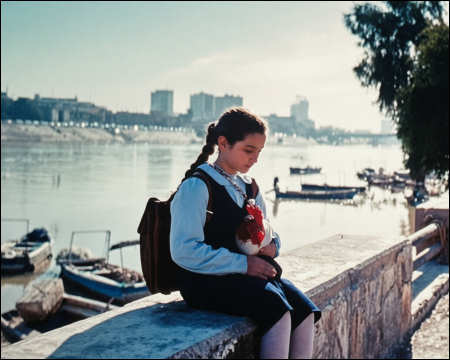
The views of life around them are through the children’s eyes, highlighting how children try to cope with the adult world in difficult times. The director draws from a language of international cinema theory and images, acknowledging the 1950s French film, The Red Balloon, that also starred a young boy in the streets of Paris chasing his red balloon. Lamia’s handsome pet rooster goes everywhere with her in its little harness but while stopping to pray, a thief makes off with it. He is spared the grisly fate that awaits the caged birds in the filthy chicken market.
Hadi’s film enjoyed a glittering premiere in Cannes on May 16, 2005, where it took the section’s Audience Award and the Caméra d’Or. (Golden Camera). It was also selected as Best International Feature Film at the 98th Academy Awards and made the December shortlist. [3] The President’s Cake is to be released in the United States by Sony Pictures Classics on February 6, 2026.
Funding came from the Doha Film Institute’s 2023 round. In 2022, Hadi had received the Sundance Institute NHK (Japan) award. Other contributions came from the Gotham-Marcie Bloom Fellowship, the Black Family Production Prize, the Sloan Foundation Production Award, and the BAFTA Newcomers Program.
Pre-release screening in France
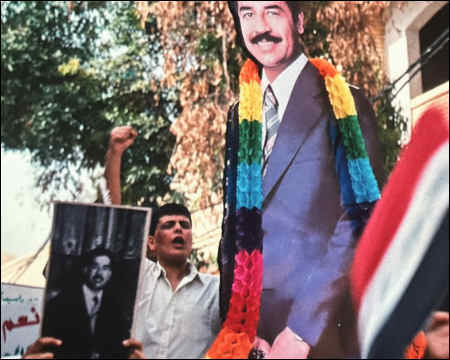
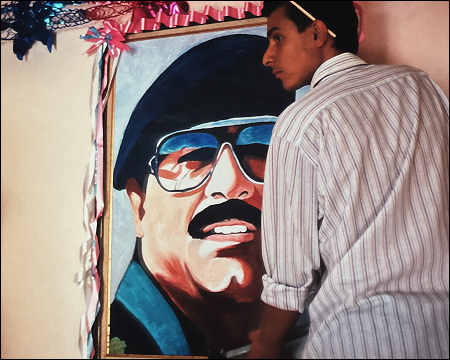
A single screening was listed as part of the French Telerama Festival programme with the film screened in original Arabic with French sub-titles. The costuming was simple and true to the day. The hand painted portraits of the Iraqi President and large photographs of him erected in public places like the hospitals and schools were equally authentic.
As this was the President’s birthday, his smiling face is garlanded with chains of paper flowers, carried aloft by chanting crowds marching through the streets of old Baghdad just as they did back in the day. Old Baghdad with its dusty alleyways, mosques and simple boats moored along the muddy banks of the Tigris emit historic charm.
In the questions session that followed the screening, Hadi explained some of the difficulties of filming in Baghdad:
“I will share this story with you, I have shared it before…When we were doing the parade scene we finished the scene and went back to our hotel production office and my phone started buzzing and I look and its my friend and a bunch of people asking if this was our shoot and it turns out some people, you know, on the street have videotaped the parade and put it on social media and all the news is that Saddam supporters took over the streets in Baghdad so we actually got, you know, it was almost soul threatening because we almost had to shut down everything so it was interesting because it’s like all the news agencies were like talking about Saddam supporters taking over the street, and the parliament was trying to question the government how that happened, you know, all that, but you know we had to explain that this is, here this is the permit we were trying to shoot the film and all that…”

Hadi also noted that some political groups view cinema as the devil’s work. He explained how during the sanctions era, foreign films were banned entry to Iraq claiming the celluloid contained material useful in the production of chemical weapons! Iraq’s fine old cinemas then became warehouses while a few stayed open just to screen adult films.
This was dramatically highlighted when Lamia realises the danger she is in from the chicken butcher who returned ‘Hindi,’ her pet rooster to her, leading her off towards the adult cinema.
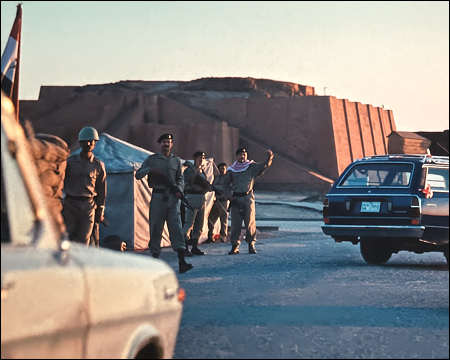
In two other scenes, the director showcases fleetingly how sanctions were impacting on women having to sell their bodies for food. We see a well-dressed woman leaving a soldier’s tent at the checkpoint leading to the ziggurat of Ur and the sensitive road into the Marshes.
In another scene, a young, and heavily pregnant woman barter with the obese shop keeper to give herself in exchange for goods. The act itself brings on her labour while the two children, Lamia and Saeed, innocently stand guard outside the shop having been told not to allow anyone in while the proprietor has his way with the woman. They agree as he promised to give them a missing ingredient for the cake Lamia has to bake for the President’s birthday at her school.
Responding to another question, Hadi replied:
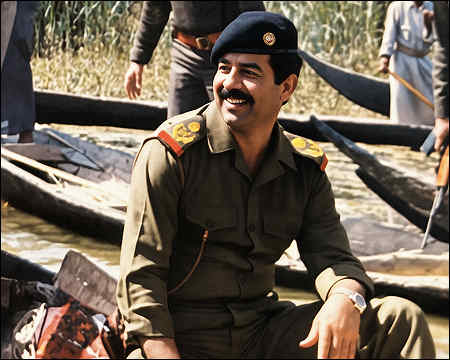
“It is more of to convey what was happening at that time. It tells you what sanctions, what dictatorship, what poverty does to people, which is, it impacts the society, it destroys the moral fabric, it erases the ethics, it changes the red lines for people, it changes the essence of humans and that’s why I also want people to understand that the perception of sanctions as being a diplomatic and harmless tool doesn’t really exist. It can be more destructive than physical destruction that the bomb causes sometimes and the film is an invitation to take a look at that too…”
The Marshes
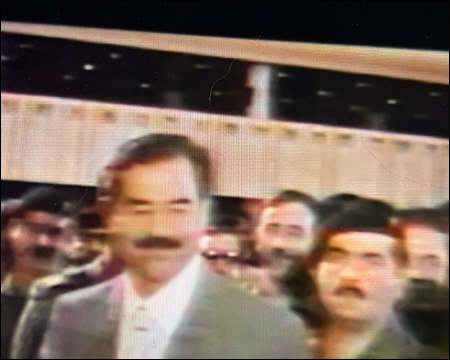
Hasan Hadi said of the inhabitants of the marshes that they were “people that Saddam tried to erase from Iraq’s identity and history”, but that was not so.
In historic accounts, including Saddam’s own responses to international criticism over the ecological devastation caused to the waterlands, the initial draining of marshes had been part of Iraq’s military strategy during the war with Iran to stop pro-Iran Shi’a militia fighters from hiding out there.
Saddam had featured in many photographs celebrating the culture of the marshes and sought to preserve ancient Sumerian and Babylonian antiquities and who identified strongly with ancient Mesopotamia.
Life in the marshes remains precarious today: there is neither sanitation nor running water. Alluring as it appears in Hasan Hadi’s film with its night scenes that he describes as ‘magical realism’ the bobbing lights reflected between the reed huts and boats evoke the life of 5000 years ago.
The Sumerian past is reborn in Hadi’s film with the boats coursing through the marshes with their distinctive, turned-up prows and sterns – but one spark is all it takes for flames to consume a reed house as in the opening scene.
A magnificent journey and significant achievement for a cinema film to be made at all in today’s Iraq.
Sheri Laizer, a Middle East and North African expert specialist and well known commentator on the Kurdish issue. She is a senior contributing writer for iKurd.net. More about Sheri Laizer see below.
The opinions are those of the writer and do not necessarily represent the views of iKurd.net or its editors.
Copyright © 2026 Sheri Laizer, iKurd.net. All rights reserved.
Related posts:
 Iraq: Revenge and Corruption
 The Resurrection (Ba’ath) Party – Before the Iran-Iraq War
 The Truth About The Saddam Hussein Affair
 Saddam Hussein was a Friend to the West
 Saddam Hussein’s Enemies: Paving the Road to the Invasion of Iraq
 The 19th Anniversary of the U.S. Invasion of Iraq, 20 March 2022
 Saddam Hussein…The Hell That is Iraq!?
 The Mustashar and the Jash – A View from the Position of ‘Iraqi National Unity’ on the ‘Descendants of Treason’
 Iraq in the Shadow of Khomeinism – Part III: Iraq is NOT Iran!
 The Suffocation of Iraq Kurdistan