

Nemat Sharif | Exclusive to iKurd.net
Political analysis in light of Iraqi and international developments
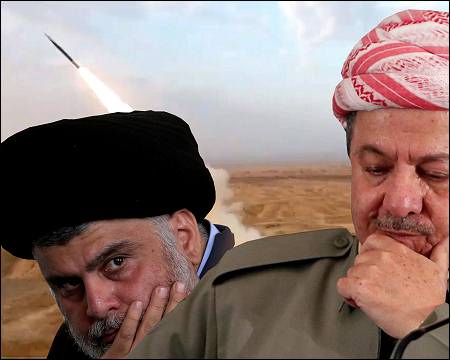
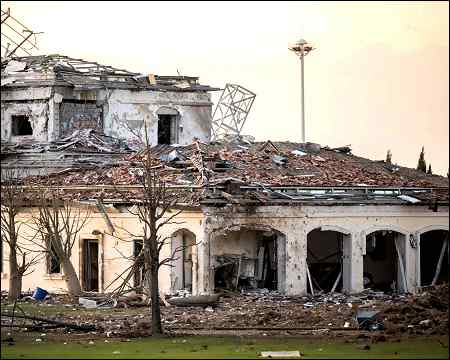
Iran’s “ballistic” missile attack on Erbil [1], the capital of the Kurdistan Region, on March 13, came a few hours after al-Hanana meeting in Najaf between the parties of the Coordination Framework (CF) [Arabic: Al-Itar al-Tansiqi] and Sadrist Movement, and on the day that the Patriotic Union of Kurdistan (PUK) Leadership Council [2] was meeting to discuss the current situation in Iraq, including the nomination to the office of the presidency of Iraq and other important topics.
This is at a time when the Iran-US nuclear treaty negotiations are stalled, and in the atmosphere of the Russian war on Ukraine, where the US administration is exercising restraint, wisdom and caution to prevent its expansion into an all-out war in which no one wins.
Since the victory of the Sadrist Movement and the Kurdistan Democratic Party (KDP) in the recent Iraqi elections and their alliance with Sunnis to form a majority government, Iran has been trying its best to persuade Mr. Sadr to abandon the majority government and return to consensus to ensure its influence in Iraq through faction leaders and other figures [3], and these are the same ones who support the PUK to separate Sulaimani from Erbil and establish a second federated region. [4]
Here it seems the polarization is evident, as the PUK and the armed Popular Mobilization factions (PMF) are supported by Iran, which is allied with Russia, China and the countries in their orbit, as opposed to the KDP’s alliance with the Sadrists and the Sovereignty Alliance (SA) (i.e. Halbusi and Khanjar) to develop the democratic process in Iraq, which is supported by the West, the United States and the countries in their orbit. The hot spots between the two sides are first the war in Ukraine, second the nuclear negotiations between Iran and the West, and third Iraq, which is stretched thin by the influence of neighboring countries and global poles.
The straw that broke camel’s back came at the Meeting of al-Hanana on March 13, 2022, when Mr. Sadr was surprised by the presence of a prominent figure representing Iranian influence in Iraq, and ordered to be escorted out of the meeting in order to continue with his agenda. With the news of the meeting, local and international circumstances were ready for Iran to send a strongly worded message to all concerned parties with Iraqi affairs.
The first message is for Sadr to soften his nationalist stand to allow wiggle room for Iranian influence, and the second is the Kurdistan Democratic Party (KDP) for its alliance with Sadr to end the political crisis in Iraq. The message was to let them know not to ignore its influence in Sulaimani as it can lead to the division of the regional government and the division of Kurdistan. Internationally the message was addressed to the United States despite claiming that it targeted an Israeli base in Erbil and not the US embassy.
Regardless of either case, the Biden administration is working to contain the war in Ukraine to avoid a wider unpredictable conflict. Iran knows these facts well, and its policy and decision makers are of skill and experience to exploit these circumstances to enhance its influence in Iraq and to boost its standing in the world.
Thus came the ballistic missile strike on Erbil. It was the largest number of missiles used by Iran in Iraq so far [5], instead of using drones, which are usually used by factions loyal to them to send messages to Kurdistan and US forces in Iraq. Israelis were concerned that the Revolutionary Guard claimed that they targeted an Israeli base.
Regardless of whether an Israeli post existing in Erbil or not, the USA not responding to the missile attack was more worrisome. Iran has not responded in the past to Israel’s strikes against it and its militia affiliates, particularly in Syria [6]. Israeli concern has led to the dispatch of three of its top officials to Washington to discuss the matter [7].
Iran’s failure in its repeated attempts to convince Sadr and draw up a map of Shiite understandings, especially since the Iraqi political crisis could reach an impasse again, at a time when Iraqi federal court decisions are aimed at reaching a solution that satisfies rival parties. The missile rhetoric is that Iran’s influence is part of Iraq’s political reality and cannot be ignored.
We therefore believe that compromises should give space to all parties with regional and internal influence, including militias representing Iranian influence and the PUK, to save face despite their electoral loss. Both have armed forces backed by Iran.
Therefore, the contentious issues in the Shiite and Kurdish communities, should be controlled including the issue of the presidency of Iraq among the Kurds, and the involvement of al-Maliki in the government in the aftermath of the telephone call between him and Mr. Sadr among the Shiites.
While Iran considered Sadr’s insistence on rejecting its interference in the formation of the Iraqi government, Iran decided to put the dire Iraqi reality on the table for all to see. The 12 missiles targeted Erbil were the strongest message Tehran has ever sent to all parties.
Those who thought that the reconciliation between Sadr and Maliki was an indication of the end of the majority government were disappointed when Sadr tweeted “Neither east nor west…but a majority government.” Ismail Qaani, commander of Iran’s Quds Force, has visited Iraq, including three to Erbil, where the so-called Israeli post is! More surprisingly, Tehran insists on its claims, coming up with a new threat to a repeat if the Israelis are not expelled from Kurdistan. The Kurdistan council of ministers denied the existence of any Israeli post in Kurdistan [8].
In light of these developments, Iraq needs a strong government, more solidarity, cooperation, patience and sacrifice to meet these challenges. Violating Iraq’s sovereignty time and again by neighboring countries goes unchecked.
Even the diplomatic means available are not used. Weakened Iraq militarily, and divided home front do not allow Iraq to take this path in order to defend its sovereignty.
The Iraqi political process is a different experiment in democracy in that Iraq chose elections, parliament and a presidential republican system of government that does not stray far from the so-called constitutional monarchy in that the head of state is ceremonial while the real authority is in the hands of the prime minister.
The other aspect of this experiment is that it is politically consensual and quotas are used in terms of representing religious and ethnic communities hoping that this system will give a degree of social, ethnic and religious parity to all groups of the Iraqi people and thus achieve some fairness in the distribution of wealth and power.
Therefore, we believe that the compromises proposed to be fair and do not betray the voters who cast their votes in the darkest electoral circumstances of suffering and risks must take into account electoral entitlements such as the leadership of the large blocks of government and the participation of other blocs and parties in the second and third ranks, each according to their votes, i.e. there will be no opposition in the usual sense, and everyone will be involved in the government.
Given the large number of parliamentary parties and blocs, it is not easy to please all. Resorting to violence or any hint at using it, or using their foreign allies, is a cause for concern for Iraq’s future and the entire political process.
Elections and the formation of the government are surely Iraqi affairs. Those associated with foreigners can express their opinions within the limits of their posts in the government when such posts commensurate with their votes they received.
Violence or hinting at its use is in stark contrast to the democratic process and is no different from a coup d’état to take power by force, but if they fail to seize power (such as any failed coup attempt, especially if they are found to be linked to foreigners), they should face justice and be punished for attempting to undermine democracy. This requires a solidly principled government, and using wise diplomacy in dealing with others, regional and global states, putting the homeland and the democratic system above all.
Assuming this model is a realistic solution and this is what I believe can be carefully applied. Then, why do the Kurdish and Shiite communities follow this model as well, such as the two main parties in Kurdistan retreating from their hardline positions to unify the Kurdish discourse, i.e. the PUK recommend a candidate other than the current president and cede another position to KDP to withdraw their candidate for the presidency of Iraq, or the opposite, that is the PUK withdraws its presidential candidate in exchange for participating in a sovereign position in Kurdistan.
Moving away a little from the concepts of win and lose and work by consensus in light of the results of the recent elections will go a long way. Non-50-50 consensus that largely cancels out the election results and voids democracy of its meaning.
Consensus gives priority to the first in the elections and others by mutual consent, depending on their electoral size and eliminates opposition, as we know it in other democracies. This applies to the Shiite and Sunni communities as well. In this model, everyone gains in a win-win solution. We hope for a strong government supported by all and work to serve a free nation and a happy people (Iraq).
Sources and notes:
-[1] The Iranian Revolutionary Guard on Sunday (March 13th) claimed to have attacked Erbil with 12 “long-range” ballistic missiles, which landed in the vicinity of the U.S. consulate and Kurdistan 24 TV Station in Salah al-Din resort, resulting in material damage.
[2] The meeting of Hanana (where Mr. Sadr is based) between the CF and the Sadrist movement on March 13, 2022.
[3] The CF consisting of the PMF led by Hadi al-Ameri and the State of Law led by Nouri al-Maliki, both of whom are not well-liked by the Sadrist movement. Hadi al-Ameri was not wanted to be in the meeting of Hanana.
[4] Nouri al-Maliki has said more than once that the PUK should be supported for its cooperation with the government in recapturing Kirkuk and the disputed areas, so they should be supported to establish a second Kurdish federated region in Sulaimani to minimize the influence of the KDP and its president Massoud Barzani in working for the independence of Kurdistan and its separation from Iraq.
[5] Iran fired 11 missiles on 8 March 2020 at Ain al-Assad air base, where 2,000 U.S. troops were stationed in Western Iraq.
[6] Two members of Iran’s Revolutionary Guard, believed to be captains, were killed in an Israeli raid a few days ago near Damascus the Syrian capital.
[7] Sotaliraq.com, March 17, 2022, Israeli concern about an Iranian “escalation” after targeting Erbil. “During talks with U.S. Defense Department officials, three Israeli military and intelligence leaders expressed concern that Washington did not respond to the recent Iranian attacks on U.S. facilities in Syria and Iraq. The three leaders warned that “Tehran understands this failure to respond as an American weakness, which is not appropriate for the United States and its allies and will increase Khamenei’s ambitions for further strikes. Security sources reported yesterday that the head of the Military Intelligence Division of the Israeli army “Aman”, Aharon Halwa, has been visiting Washington for four days, while referring to the return of the head of the General Security Service (Shabak), Ronin Barr, from a working visit in Washington. “The deputy chief of staff of the army, Herzi Helifi, went to Washington on Monday,” she said.
[8] The Kurdistan Regional Council of Ministers, headed by Masrour Barzani, denied that the site targeted by the IRGC in Erbil province was an Israeli post. It was a civilian site, and expressed readiness for any Arab or international investigation. The Iraqi Foreign Ministry also summoned Iran’s ambassador to Baghdad, Iraj Masjedi, and informed him of its protest against the targeting of Erbil, the capital of Kurdistan Region.
Nemat Sharif, a political analyst, a contributing writer and columnist for iKurd.net.
The opinions are those of the writer and do not necessarily represent the views of iKurd.net or its editors.
Copyright © 2022 iKurd.net. All rights reserved
Related posts:
 The Resurrection (Ba’ath) Party – Before the Iran-Iraq War
 The Suffocation of Iraq Kurdistan
 The Assassination of Abdurrahman Ghassemlou: No Friends but the Mullahs?
 Iraq in the Shadow of Khomeinism – Part I: Baghdad And Erbil Under Threat
 The Mustashar and the Jash – A View from the Position of ‘Iraqi National Unity’ on the ‘Descendants of Treason’
 Iraq in the Shadow of Khomeinism – Part III: Iraq is NOT Iran!
 Iraq: Revenge and Corruption
 Iraqi Kurdistan: The Emperors’ New Clothes
 Saddam Hussein was a Friend to the West
 LOSING IRAQ — to Iran