


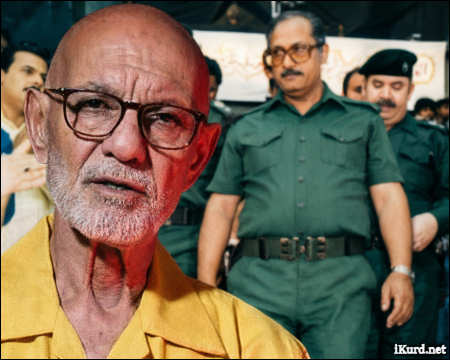
BAGHDAD,— Iraq’s National Security Service said Monday that it carried out the execution by hanging of Saadoun Sabri al-Qaisi, a former senior security official from Saddam Hussein’s government, after he was convicted for his role in the killing of prominent Shiite cleric Muhammad Baqir al-Sadr in 1980.
Iraqi National Security Service spokesperson Arshad al-Hakim said in a statement the sentence was implemented after a lengthy investigation and the completion of all required legal steps.
He said intelligence work and case reviews confirmed al-Qaisi’s involvement in serious crimes.
Al-Hakim said the court found al-Qaisi guilty of committing grave crimes against humanity. These included taking part in the assassination of Sayyid Muhammad Baqir al-Sadr, as well as targeting several scholars from the Hakim family and other civilians who were not involved in any violence.
Security forces arrested al-Qaisi in January 2025 after years of searching for former officials linked to abuses from Saddam Hussein’s era.

Muhammad Baqir al-Sadr, who was born in 1935 in al-Kadhimiya, was a well-known Islamic thinker and religious scholar. He played a major role in shaping the ideas of the Islamic Dawa Party and was widely respected in religious circles across Iraq.
He was also closely connected to other leading Shiite figures. He was the father-in-law of Muqtada al-Sadr and a cousin of both Mohammed Sadeq al-Sadr and Imam Musa as-Sadr, making him part of one of Iraq’s most influential religious families.
Following the execution, First Deputy Speaker of the Iraqi Parliament Adnan Faihan Al-Dulaimi publicly praised the work of the judiciary and security agencies.
In remarks to Iraqi News Agency INA, he said the enforcement of the sentence showed that Iraq’s legal system was serious about accountability.
Faihan said the decision honored the memory of Martyr al-Sadr and other Iraqis who lost their lives under the former regime. He also specifically mentioned al-Sadr’s sister, Alawiya Bint Al-Huda, who was killed alongside him, along with other innocent victims.
The deputy speaker stressed that the ruling proved crimes do not fade with time. He said justice can still reach perpetrators even decades later, as long as evidence exists and legal procedures are followed.
He added that carrying out the sentence strengthened the authority of the state, reinforced the rule of law, and helped protect victims’ rights.
According to his statement, the case sets an important example for future accountability in Iraq.
(With files from INA)
Copyright © 2026 iKurd.net. All rights reserved.
Related posts:
 The Resurrection (Ba’ath) Party – Before the Iran-Iraq War
 Saddam Hussein was a Friend to the West
 Iraq arrests ex-security official over 1980 execution of Shiite cleric Mohammed Baqir al-Sadr
 Iraq: Revenge and Corruption
 The Truth About The Saddam Hussein Affair
 Saddam Hussein’s Enemies: Paving the Road to the Invasion of Iraq
 Saddam Hussein…The Hell That is Iraq!?
 The Mustashar and the Jash – A View from the Position of ‘Iraqi National Unity’ on the ‘Descendants of Treason’
 The Suffocation of Iraq Kurdistan
 Iraq in the Shadow of Khomeinism – Part III: Iraq is NOT Iran!