

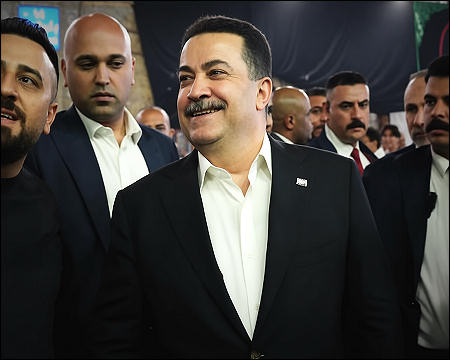
BAGHDAD,— Iraqi Prime Minister Mohammed Shia al-Sudani declared victory Wednesday after early results from Iraq’s general election showed his coalition holding a commanding lead.
Crowds of cheering supporters filled Tahrir Square in Baghdad late into the night, waving flags, lighting fireworks, and playing music in celebration, according to local correspondents.
In a televised address, Sudani described the outcome as a victory for all Iraqis and congratulated citizens for what he called a “new chapter” in Iraq’s political journey.
“Our coalition, Reconstruction and Development, has taken first place,” he said. In a message posted on X, the prime minister thanked voters for their confidence and pledged to continue his government’s agenda of rebuilding and reform.
Al-Sudani’s bloc won significant support, but not enough to rule on its own. The next government will be shaped through talks among the main parties seeking to form a majority coalition.
Iraqis voted Tuesday in an election that unfolded amid an unusual period of calm for a country often caught between regional rivalries.
The results, announced in part by Iraq’s electoral commission on Wednesday, showed Sudani’s list leading with more than 1.3 million votes, around 217,000 ahead of the nearest contender.
The commission said turnout surpassed 12 million of the 21 million eligible voters, despite a boycott call from powerful Shiite cleric Moqtada Sadr.
Officials confirmed that while vote totals were released by province, the final distribution of parliamentary seats will be announced later.
According to election officials, Sudani’s camp appears to have secured the largest share of parliamentary seats, though not enough for an outright majority. Several political sources told reporters that the coalition could hold around 50 of parliament’s 329 seats.
The next step will be coalition negotiations to select Iraq’s prime minister, a process that can take weeks or even months.
Under Iraq’s power-sharing system, the prime minister is chosen from the Shiite majority, the parliamentary speaker from the Sunni community, and the presidency from the Kurdish minority.
Political analysts noted that forming a new government in Iraq typically requires compromise among Shiite factions, Sunni blocs, and Kurdish parties.
An official close to Sudani said before the results were confirmed that his group was “heading toward a clear victory,” according to those familiar with the matter.
Sudani, 53, was first appointed prime minister in 2022 with the backing of the Coordination Framework, an alliance of Shiite parties aligned with Iran.
The coalition became the largest bloc in parliament at that time. However, sources say divisions have recently surfaced within the alliance, particularly with former prime minister Nuri al-Maliki, who may oppose Sudani’s bid for a second term.
Despite Iraq’s relative calm, the country of 46 million continues to struggle with corruption, unemployment, poor services, and decaying infrastructure.
Many Iraqis who stayed away from the polls told reporters they believe elections mainly benefit political elites and foreign powers.
Sudani, however, has vowed to push ahead with development projects, citing new roads, bridges, and tunnels built across Baghdad as evidence of progress. He credits his government with maintaining internal stability while avoiding deeper involvement in regional conflicts.
Iraq remains a focal point in the rivalry between the United States and Iran. Since the 2003 U.S.-led invasion that toppled Saddam Hussein, Tehran has maintained deep political and military influence in Iraq through allied parties and armed groups.
The past year has seen escalating regional tensions, including a 12-day conflict in June when Israel launched strikes against Iran and its allied forces across the Middle East.
As those dynamics continue, analysts say Baghdad faces pressure from both Washington and Tehran: Iran seeks to keep Iraq’s markets open to its goods, while the U.S. urges Iraq to curb Iran-backed militias.
For now, Sudani’s apparent election win signals a measure of continuity in Baghdad’s leadership, though his ability to build a broad-based coalition will determine how firmly he holds power in the months ahead.
(With files from AFP | AP)
Copyright © 2025 iKurd.net. All rights reserved.
Related posts:
 The Resurrection (Ba’ath) Party – Before the Iran-Iraq War
 Iraq: Revenge and Corruption
 LOSING IRAQ — to Iran
 Saddam Hussein was a Friend to the West
 Saddam Hussein’s Enemies: Paving the Road to the Invasion of Iraq
 Iraq in the Shadow of Khomeinism – Part III: Iraq is NOT Iran!
 The Suffocation of Iraq Kurdistan
 Iraq – The Cynical Swindle
 Iraqi Kurdistan – “Sold Out!” – Part II
 The Truth About The Saddam Hussein Affair