

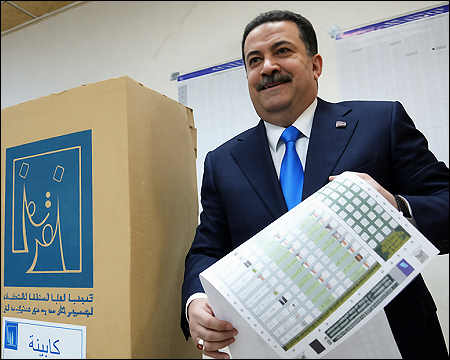
BAGHDAD,— Iraqis began voting Tuesday in parliamentary elections to choose a new 329-member legislature, with polling scheduled to close at 6 p.m. local time (1500 GMT), according to state television.
The vote comes at a crucial moment for Iraq as both the United States and Iran closely monitor the results.
Prime Minister Mohammed Shia al-Sudani is seeking a second term in office. Analysts predict his coalition will likely win the most seats, though it is expected to fall short of an outright majority.
This outcome could trigger months of negotiations among Shiite, Sunni, and Kurdish political blocs to divide government positions and select a prime minister.
Elections in Iraq have been increasingly marked by low voter turnout. Many Iraqis remain disillusioned with a system critics say favors powerful parties with armed loyalists.
Ordinary citizens continue to face high unemployment, poor public services, and widespread corruption. Turnout is projected to fall below the 41 percent recorded in the 2021 parliamentary vote, in part due to a boycott by populist Shiite cleric Moqtada al-Sadr, who commands a large base of supporters.
“This election will not depend on popularity. It will depend on spending money,” former Prime Minister Haider al-Abadi said during a televised interview last month, highlighting concerns that political campaigns still revolve around financial influence rather than voter choice.
The vote includes a growing number of younger candidates seeking to challenge entrenched political networks. Baghdad-based political analyst Ahmed Younis said the election may do little to change the status quo.
He told Reuters that Tuesday’s ballot, for Iraq’s 21 million registered voters, is expected to largely maintain the status quo rather than introduce major political shifts.
Despite these challenges, the vote takes place amid a sensitive regional backdrop. Iraq faces the dual challenge of managing domestic militias aligned with Iran while maintaining relations with Washington.
The U.S. has pushed Iraq to limit the activities of armed groups that answer more to Tehran than Baghdad, and there is pressure to prevent these militias from destabilizing the country.
Iraq has so far avoided the wider violence affecting parts of the Middle East during the Gaza conflict, but U.S. and Israeli authorities have warned that failure to control pro-Iran groups could provoke a stronger response.
Newly elected lawmakers will also confront domestic demands for tangible improvements in everyday life to prevent public unrest similar to the mass protests seen in 2019 and 2020.
Iraq first held elections in 2005 following the 2003 U.S.-led invasion that removed Saddam Hussein from power.
Early ballots were overshadowed by sectarian violence and boycotts from Sunni communities, as the Shiite majority, previously suppressed under Saddam’s rule, began to dominate the political landscape.
Sectarian divisions remain embedded in Iraq’s power-sharing system, in which government positions are divided among Shiites, Sunnis, Kurds, Christians, and other ethnic and religious groups.
By tradition, the prime minister is Shiite, the parliament speaker is Sunni, and the president is a Kurd.
Sunni parties are contesting the election separately, with former parliament speaker Mohammed al-Halbussi among the frontrunners.
In the Kurdistan region, competition continues between the Kurdistan Democratic Party KDP and the Patriotic Union of Kurdistan PUK.
Prime Minister al-Sudani came to power in 2022 under the Coordination Framework, a coalition of Shiite parties linked to Iran. He has emphasized his government’s role in maintaining relative stability and shielding Iraq from regional crises.
Yet, even if his bloc secures the most seats, forming a government will require negotiations with other parties to build a majority coalition.
Iraq continues to navigate a complex position in Middle Eastern politics, balancing the influence of the United States and Iran while managing internal Shiite armed groups.
Washington recently appointed Mark Savaya as its special envoy to Iraq, emphasizing efforts to reduce Iran’s influence in Baghdad.
(With files from Reuters | AFP)
Copyright © 2025 iKurd.net. All rights reserved.
Related posts:
 LOSING IRAQ — to Iran
 The Resurrection (Ba’ath) Party – Before the Iran-Iraq War
 Iraq: Revenge and Corruption
 Iraq in the Shadow of Khomeinism – Part III: Iraq is NOT Iran!
 Saddam Hussein’s Enemies: Paving the Road to the Invasion of Iraq
 The Suffocation of Iraq Kurdistan
 Saddam Hussein was a Friend to the West
 Iraq’s Internal Enemies: Shi’a rivalries and the fallout from the US-led invasion
 The Truth About The Saddam Hussein Affair
 Iraqi Kurdistan – “Sold Out!” – Part II