
Omar Sindi | Exclusive to iKurd.net
Washington
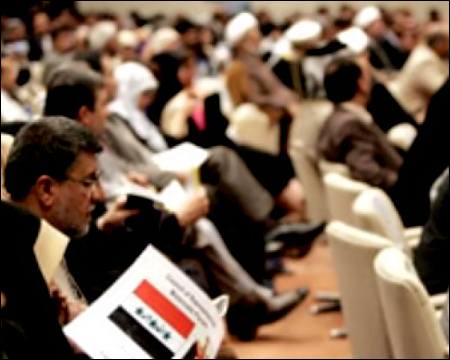
In general, parliament and the parliamentarian members should be the voices of people that they represent for a common goal and national interest, not blindly following the executive power. This kind of policy has become a sort of rubber stamping that is prevalent in most third world countries. In these third world countries, the so called parliament is simply the mouthpiece of an individual politician, and it’s no surprise that this is occurring in Iraq too.
Recently it was widely reported by international media outlets and some national media outlets that the Iraqi parliament has sacked two government ministers, Hoshyar Zebari, finance minister, Sunni Kurd; and Khaled al- Obeidi, defense minister, Sunni Arab. At the same time this narrative should not and must not be considered political bias in defense of any wrong doing (“According to experts, that’s despite repeated promises by the prime ministers, the complaints of Ayatollah Ali al-Sistani, and protests that occur almost every year demanding action on the issue. Current U.S.-chosen Prime Minister Haider Abadi, for example, announced a reform program in August 2015 that was supposed to address corruption, but he was focused more on building up his own base and going after his rivals than actually addressing the problem, and nothing substantive was done…” Taken from ‘Iraq Ranks In Ten Most Corrupt Countries In World, Again’ by Peter Van Buren, March 30, 2016).
There are far more important cases these two ministers, and the Iraqi parliament should have tackled, such as the former Prime Minister current Vice President Nouri al-Maliki’s corruption cases and squandering money during his eight year premiership (“Former Iraqi Prime Minister Nouri al-Maliki had reportedly siphoned off $500bn during his eight-year rule” – Reuters) (“The son of former Iraqi Prime Minister and current Vice President Nouri al-Maliki has reportedly been arrested in Lebanon in possession of more than US $1.5 billion “in cash”. BasNews cites Lebanese media sources as claiming that Ahmed al-Maliki is being detained in a prison on Beirut, and that Nouri al-Maliki has travelled to Lebanon in the hope of securing his release. Security sources in Lebanon claim that Ahmed received the money via an Iraqi bank that transferred it to a Lebanese bank for him, and that the total received since the beginning of 2014 was about three billion US dollars (3.6 trillion Iraqi dinars). ” – by John Lee)
Iraqi Parliament didn’t dare to question Mr. al-Maliki and his son Ahmad on the status of large amounts of money transferred via Iraqi Bank into Lebanon’s bank issue. While large amounts of money were going out of Iraq by the father and son, most of the ordinary Iraqi people didn’t have power during the summer heat to cool themselves. Therefore, if Nouri al-Maliki was forced to resign for alleged squandering of the Iraqi people’s money then, today, sacking Hoshyar Zebari and Khalid al-Obeidi for their alleged acts would have far better national and international reception; Did Iraqi parliament question Hadi Al-Amiri as to why Lebanon’s passenger aircraft was not allowed to land at the Baghdad international airport because his son Mehdi was not on that plane?
Here is an adage from the 19th Century: “When we are in opposition, we demand freedom for ourselves, in the name of our principles; when we are in power, we will deny you freedom in the name of our principles”. It seems the equivalent is quite clear, that many Shia political parties are in dichotomy, which are anchoring and directing a perilous ship in the confused directions of the Baghdad leadership. After removal of the dreaded man Saddam Hussein, his Ba’athist regime, and their abettors by the United States and coalition forces, the Iraqi people expected a far better outcome from Iraqi politicians and parliament; but unfortunately they are just “waiting for Godot” like many other countries’ people.
Alas, monism ramification de-thrive the thread of a society for generations to come; and when a misguided policy becomes an integral part of leadership, it causes ordinary people to pay the price through none, of their fault, and suffering irreversible catastrophic consequences.
Omar Sindi, a senior writer, analyst and columnist for iKurd.net, Washington, United States.
The opinions expressed in this commentary are solely those of the author.
Copyright © 2016 iKurd.net. All rights reserved
Related posts:
 The Terror Instructor – Nouri al-Maliki
 The Resurrection (Ba’ath) Party – Before the Iran-Iraq War
 Saddam Hussein was a Friend to the West
 LOSING IRAQ — to Iran
 Iraq – The Cynical Swindle
 Iraqi Kurdistan – “Sold Out!” – Part II
 Iraq: A State of Surveillance – Databases, Tracking And Corruption
 Saddam Hussein’s Enemies: Paving the Road to the Invasion of Iraq
 Iraq: Revenge and Corruption
 The War of Attrition on Lebanon