


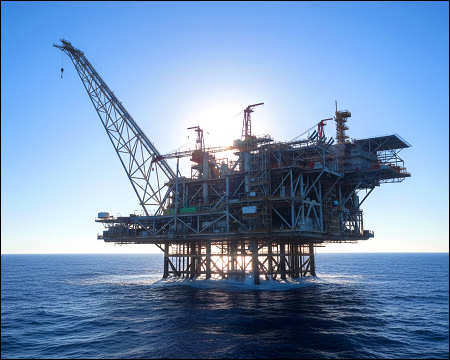
JERUSALEM,— Israeli Prime Minister Benjamin Netanyahu said Wednesday that Israel has approved a major natural gas export agreement with Egypt valued at about $35 billion, calling it the largest gas deal ever signed by the country.
According to Netanyahu, the agreement will allow Israel to export natural gas from its offshore Leviathan field to Egypt over a period of 15 years.
The gas will be delivered by U.S.-based energy company Chevron, which holds a significant ownership stake in the Mediterranean gas reservoir. Israeli officials said roughly half of the revenue from the deal is expected to flow into Israel’s state budget.
In a televised address, Netanyahu said he had formally approved the deal, which totals 112 billion shekels, or approximately $34.7 billion.
He said the agreement strengthens Israel’s standing as an energy supplier in the region and contributes to broader regional stability.
Chevron confirmed it welcomed Israel’s decision to grant a permit allowing exports of natural gas to Egypt. A company spokesperson said the approval clears the way for further development of the Leviathan reservoir.
Chevron previously said in November that it was close to making a final investment decision to expand production at Leviathan but was waiting for authorization from Israeli authorities to export gas to Egypt.
With the permit now approved, the expansion is expected to move forward.
Under the agreement, the Leviathan field, which holds an estimated 600 billion cubic meters of natural gas, will supply about 130 billion cubic meters to Egypt through 2040 or until the full contract value is met, according to a statement from NewMed, one of the field’s partners.
The gas agreement comes amid broader regional developments. Egypt, which shares borders with Israel and Gaza, has played a central role as a mediator between Israel and the radical Islamist militant group Hamas.
Egyptian officials were involved in talks leading up to a ceasefire brokered by the United States in October.
Relations between Israel and Egypt have faced strain during the two-year conflict in Gaza, and analysts say the gas deal could help stabilize ties between the two governments by deepening economic cooperation.
Israeli Energy Minister Eli Cohen had previously held up approval of the deal, saying the terms offered did not give Israel enough advantage or benefit.
His objections led U.S. Energy Secretary Chris Wright to cancel a planned visit to Israel in October.
On Wednesday, however, Cohen appeared alongside Netanyahu during the announcement and said he supported the final version of the agreement.
Israel began developing its offshore gas resources in the early 2000s after discovering large reserves beneath the Mediterranean Sea. It started exporting natural gas nearly a decade ago, first supplying Jordan and later Egypt.
In a separate announcement on Wednesday, Israel’s Defense Ministry said German lawmakers approved an expansion of a defense procurement agreement involving Israel’s Arrow 3 missile defense system.
The revised deal increases its value from $3.5 billion to $6.5 billion, making it the largest defense export agreement in Israel’s history.
Germany has pursued the Arrow 3 system as part of efforts to strengthen its air defense capabilities in response to security concerns linked to Russia.
Meanwhile, Egypt has faced declining domestic gas production since 2022. The downturn forced Cairo to abandon plans to become a regional gas export hub and increase its reliance on Israeli supplies to cover its energy needs.
(With files from AP | Reuters)
Copyright © 2025 iKurd.net. All rights reserved.
Related posts:
 Iraq – The Cynical Swindle
 Iraqi Kurdistan – “Sold Out!” – Part II
 The Resurrection (Ba’ath) Party – Before the Iran-Iraq War
 The War of Attrition on Lebanon
 Iraqi Kurdistan – “Sold Out!” – Part III
 Business with ISIS – Updated
 Saddam Hussein was a Friend to the West
 Internal Revolt Against Hamas in Gaza Was Already Underway
 The 12-Day War: A Tactical Failure, Yet a Strategic Win for Israel
 Ukraine halts gas transit, ending Russian gas era in Europe