


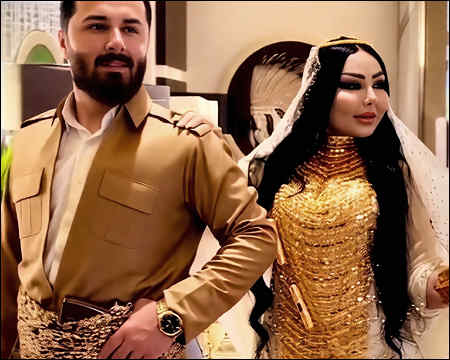
Comments On Chiman Zebari’s Article “When Gold Becomes the Headline and Love Is Forgotten“
Nemat Sharif | Exclusive to iKurd.net
There is no doubt that prevailing social values in any society constitute the backbone of that society and determine its path towards future progress. As for the Kurdish society discussed in Zebari’s article, it undoubtedly shares many values with other Middle Eastern societies, while differing from them in others, especially in terms of materialistic values versus the idealistic values we cherish.
Here, we specifically mention money and jewelry versus love and affection in the formation of the Kurdish family in contemporary Kurdish society. Values do not arise in a vacuum; each value certainly has its social roots, which may extend back for decades, if not centuries. It is undeniable that Kurdish society suffers from excessive tribalism, which sometimes conflicts with the demands of the modernity, generation after generation.
This is also observed in a number of Middle Eastern countries, such as the Kingdom of Saudi Arabia and the Hashemite Kingdom of Jordan, and even in rural Egypt. Some have even dedicated studies to highlighting its advantages and glorifying the tribes that still cling to their outdated customs and traditions.
Writers and travelers who have visited Kurdistan have observed the role of Kurdish women in society, both in their enjoyment of their rights and in their performance of various roles in the fields of work, leadership, and defense, not only of their own rights but also of society as a whole, working hand in hand with their brothers, fathers, or husbands.
Many examples illustrate this, but throughout history, tribal customs have stood against their aspirations in many areas, including their choice of a life partner. Therefore, Kurdish culture and literature, especially the oral tradition passed down through generations, are replete with tragic stories of unrequited love and other similar narratives. These stories are often recounted in folk literature, songs, and other forms of expression.
Thus, we see that the values inherited by the tribes often constitute an obstacle to the progress of society, not only socially but also politically and economically. As in other tribal societies, the Kurdish family still takes pride in or boasts about what the groom offers to win his bride, especially if she is from the family of the tribal chief or his relatives. Undoubtedly, this boasting prioritizes material value over the ideals of love, affection, and mutual respect.
Tribal customs and values are rooted in centuries-old traditions and are therefore deeply ingrained in the hearts and minds of individuals. They can only be changed through education and persistent efforts to instill modern values and human connections. Honor killings and revenge killings between families, even within the same tribe, still persist.
Tribal affiliation constitutes a fundamental problem in Kurdish society, to the point that tribal solidarity challenges the authority of the government, as seen with the Herki tribe. Tribal conflicts are also rampant. This leads us to the concentric circles of social loyalty, which begin with the immediate family, then the extended family, followed by the clan (the sub-tribe to which one belongs as part of the larger tribe), then the tribe itself, and finally the broadest circle: the nation or national homeland.
Thus, we see that the clan and the tribe are the broadest circles of loyalty before nationalism that Kurdish society continues to pass down from generation to generation. Perhaps the tribe played an important role in bygone eras as a form of collective defense, not only against enemies but also against the harsh environment of mountains, rugged terrain, and harsh winters, where communication was often cut off.
In comparison to developed societies in the West where we see that the basic unit of society is the individual, and perhaps sometimes the family. For example, when a family member is killed, the law takes its course instead of resorting to revenge.
Furthermore, there are no tribal, religious, or sectarian restrictions on choosing a partner. Therefore, we do not see the phenomenon of honor killings. When a woman is free to choose her partner, just as a man is, it is undeniable that love, harmony, and family formation become free from the aforementioned social constraints. Perhaps we will discuss ways to deal with rapid social change and the undesirable social phenomena it brings.
Nemat Sharif, a political analyst, a senior contributing writer and columnist for iKurd.net.
The opinions are those of the writer and do not necessarily represent the views of iKurd.net or its editors.
Copyright © 2025 iKurd.net. All rights reserved
Related posts:
 When will Gold peak again? Lessons from 1980, 2011, and 2025
 Kurds Need Filmmakers Like Halime Aktürk
 The Resurrection (Ba’ath) Party – Before the Iran-Iraq War
 When Gold Becomes the Headline and Love Is Forgotten
 Spiritual Revival of the Forgotten Traditions of NuRoj
 Business with ISIS – Updated
 All prepare for the mini state of Kurdistan!
 The Kurdish Mind – Critique of Practical Reason – Book review
 The Kurdish Diplomacy: Historical, Political, and Legal Explanation – Book Review
 The Mustashar and the Jash – A View from the Position of ‘Iraqi National Unity’ on the ‘Descendants of Treason’