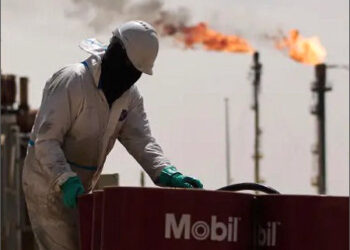


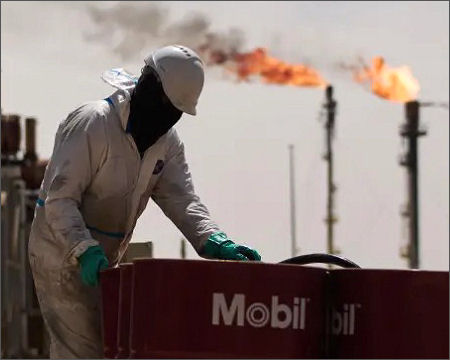
ERBIL,— A new report warns that falling oil demand could destabilize the Middle East’s most vulnerable petrostates, not because the oil runs out, but because the money does.
The Stone Age didn’t end because the world ran out of stone. The Oil Age won’t end because we run out of oil, either. It will end because demand for it shrinks.
That’s the finding of a new report from E3G, a climate think tank. “Playing the Oil Endgame,” published in September 2026, warns that declining global oil demand will hit Iraq, Algeria, Iran, and Libya harder than almost anyone is prepared for.
The problem isn’t running out of oil. It’s running out of revenue.
Iraq: The Fragility of a Single Source
Iraq offers the clearest example.
Oil accounts for roughly 90% of Iraq’s budget revenues. In the first half of 2026, Iraq recorded a budget deficit of more than $16 billion.
Of the money spent, 85% went to salaries and operational costs. Only about $1.9 billion went to investment.
Public debt now stands at about 47% of GDP, and the Prime Minister’s financial advisor has warned that “a drop in oil prices or an increase in allocated expenditures would put pressure on the general budget.”

The deeper problem is that Iraq has struggled to build anything else. Non-oil revenues reached 20% of total revenues in early 2026, an improvement, but nowhere near enough. Corruption drains what little non-oil income exists.
E3G identifies Iraq among countries where oil and gas generate 70 to 90% of government revenue, structurally vulnerable to any sustained decline in demand.
The Kurdistan Region of Iraq faces the same structural trap. Oil provides roughly 90% of the region’s budget revenues, making it just as vulnerable to declining demand as federal Iraq.
According to observers and critics, the KRG also suffers from entrenched corruption, with ruling parties accused of smuggling oil for their own benefit. The Kurdistan Region is not separate from Iraq’s oil curse. It is a second chapter of the same story.
Iran: The Chokepoint That Cuts Both Ways
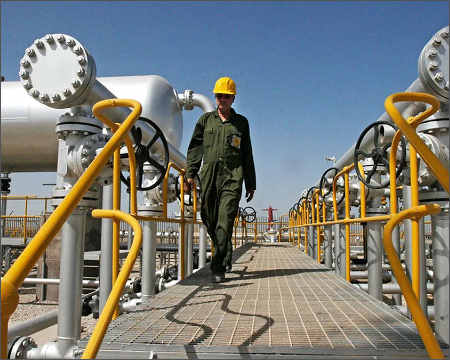
Iran’s economy has been strangled by sanctions and now by a direct US naval blockade. Iranian crude loadings fell to about 260,000 barrels per day in August 2026, down from roughly 1.7 million a year earlier.
The rial has collapsed, falling from around 1 million to the US dollar a year ago to more than 2.2 million now. Annual inflation is nearly 70%, while food inflation has reached 128%.
The IMF expects Iran’s economy to shrink by 5.4% this year, its worst performance since the 1980s.
The irony is that Iran’s weapon, its ability to threaten the Strait of Hormuz, has become a liability.
When Iran tried to disrupt the waterway, its own crude shipments fell 94%. Even its sanctions-evasion networks are becoming too expensive to maintain.
Libya: Growth on a Knife’s Edge
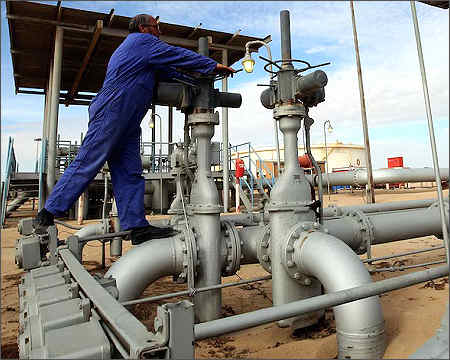
Libya’s numbers look superficially positive. The country earned $15.23 billion from oil exports in the first half of 2026, exceeding its revenue target. Production reached 1.439 million barrels per day in June, the highest since 2013.
But the foundation is fragile.
Oil accounts for 97% of exports, 90% of fiscal revenues, and 60% of economic activity.
The IMF estimated Libya’s fiscal deficit at approximately 30% of GDP in 2025, while public debt nearly doubled within two years to 146% of GDP. Government wages consume about 30% of GDP; energy subsidies account for another 20%.
The IMF has warned that spending the temporary oil windfall could worsen Libya’s vulnerabilities. But Libya lacks the institutional capacity to save.
The country has rival eastern and western authorities, and when oil revenues decline, there is no mechanism to adjust smoothly.
Algeria: The 87 Percent Question
Algeria faces perhaps the most dramatic projected losses.
According to E3G’s research, Algeria could lose as much as 87% of its oil revenue as global demand declines. The country’s hydrocarbon sector accounts for 83% of exports and 47% of budget revenues.
Unlike wealthier Gulf producers, Algeria has limited financial buffers. The state-owned energy company Sonatrach dominates the economy, and the country has continued investing in oil and gas to serve European buyers.
The strategic question is agonizing: should Algeria accelerate investment now to maximize revenue before demand weakens, or limit new investment to avoid being left with expensive, uneconomic assets?
Beth Walker, a co-author of the E3G report, highlighted Algeria as a particular concern because of its proximity to Europe. “A major loss of state revenue could create pressure on public services and increase the risk of unrest and migration,” the report warns.
The Gulf’s Advantage
Not all oil producers face the same fate.

Saudi Arabia holds an A+ credit rating. The non-oil sector now accounts for about 70% of GDP.
The UAE has gone further: non-oil activity now accounts for 79.4% of its GDP, and non-oil foreign trade reached a record 1.937 trillion dirhams in the first half of 2026.
Kuwait, Qatar, and Bahrain sit somewhere in between. Kuwait is among the countries where oil and gas generate 70 to 90% of government revenue, a level of dependence similar to Iraq and Libya.
Qatar and Bahrain have made progress on diversification, but both remain heavily reliant on hydrocarbon exports.
Gulf states collectively manage sovereign wealth funds exceeding $4.9 trillion, giving them tools that Iraq, Iran, Libya, and Algeria simply do not have.
Why This Matters Beyond the Middle East
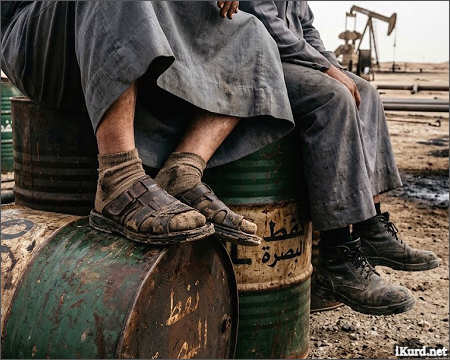
“Producer fragility is a more pressing risk than oil supply scarcity,” the report argues. When oil-dependent states face fiscal crisis, the consequences spill across borders: price shocks, migration, regional instability, and more transactional geopolitics.
Venezuela offers a precedent. After the 2014 oil price collapse, more than 7 million people fled the country.
The report calls for coordinated action: clearer demand signals from major importers, transition finance from international institutions, and diplomacy that treats transition risk as a security issue.
For Iraq, Algeria, Iran, and Libya, the question is not whether oil demand will decline. The question is whether they can build something else before the revenues run dry.
The UAE and Saudi Arabia have a head start. Kuwait, Qatar, and Bahrain are racing to keep up. The rest are running out of time.
(With files from E3G, The Third Generation Environmentalism)
Copyright © 2026 iKurd.net. All rights reserved.
Related posts:
 Iraqi Kurdistan – “Sold Out!” – Part II
 Iraq – The Cynical Swindle
 The Resurrection (Ba’ath) Party – Before the Iran-Iraq War
 Saddam Hussein’s Enemies: Paving the Road to the Invasion of Iraq
 Business with ISIS – Updated
 Iraq: Revenge and Corruption
 Saddam Hussein was a Friend to the West
 Iraqi Kurdistan – “Sold Out!” – Part III
 The Suffocation of Iraq Kurdistan
 Iraq Under The ‘Resistance’ Muqawama Militias