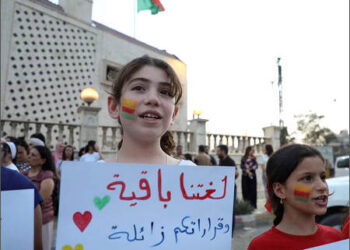


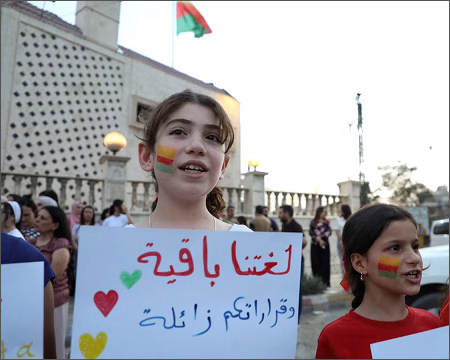
QAMISHLO,— Syrian Kurds are seeking to preserve education in their mother tongue as Damascus restores authority over Syrian Kurdistan (Rojava Kurdistan) after years in which Kurdish regions governed themselves during years of war, Reuters reported.
The issue has emerged at the beginning of the first school year since Kurdish-majority areas were reintegrated into the Syrian state under agreements between Damascus and Kurdish-led authorities.
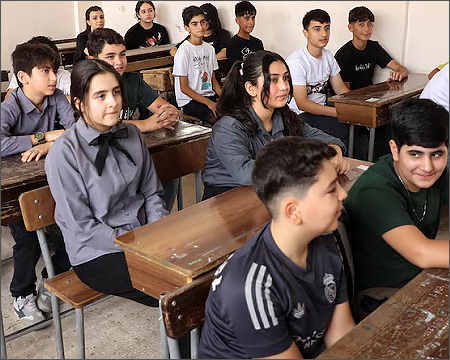
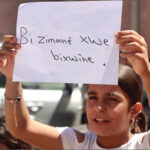
Pupils in Kurdish regions have protested against the introduction of a new Arabic-language curriculum.
The role of the Kurdish language is a sensitive matter for Kurds. It was banned in schools under the Assads, who promoted a Baathist ideology based on Arab nationalism, but the language expanded during years of Kurdish self-rule in northern Syria.
President Bashar al-Assad was ousted in 2024. Syria’s Kurds now face a changing situation after the state, under Islamist interim President Ahmed al-Sharaa, also known as Golani, took control of Kurdish-run regions in an offensive in January following the Kurds’ withdrawal.
Before Sharaa’s rise, Syrian Kurdistan was governed through a secular, decentralized system of self-administration that emphasized gender equality under the law, participatory and direct democracy, and a strong commitment to environmental sustainability.
That offensive opened the way for negotiations over merging their security and civilian institutions with the state, while Kurds sought to preserve as many of their gains as possible.
Before the school year began, the education ministry issued a decree recognizing Kurdish as a national language that could be offered in areas where Kurds make up a significant share of the population.
The measure met a longstanding Kurdish demand.
However, Kurds who have been educated largely in Kurdish since 2012 object because the decree limits Kurdish instruction to three class sessions each week.
It also allows geography, history, social studies and philosophy to be taught in Kurdish, while Kurdish officials said science and math would be taught in Arabic under the arrangements.
“I have studied Kurdish since the start of my schooling up through 11th grade, and now they are saying they will only allocate three class periods for Kurdish. This is unacceptable,” said Suzan Ali, 16.
“Half the curriculum in Kurdish and the other half in Arabic – we cannot study in Arabic.”
She said students should continue receiving their education in Kurdish because they had used the language throughout their schooling and needed to maintain that instruction through university.
Merva Amo, 18, said she had protested to demand “a return to the previous curriculum where all subjects were taught in Kurdish” and would continue demonstrating.
The education ministry did not respond to a request for comment.
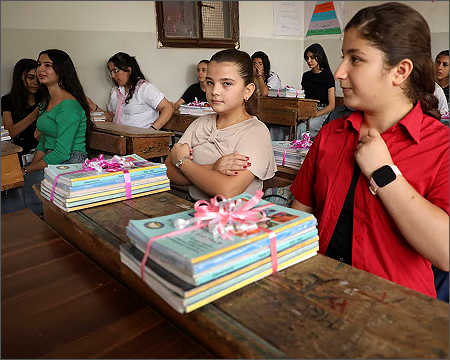
Education Minister Mohammed Abdul Rahman Turko told parliament on Monday that there had been two views: one called for Kurdish to be studied alongside other subjects, while the other sought to have the entire curriculum translated into Kurdish.
“Translating the curriculum completely into Kurdish, frankly, it’s very difficult,” Turko said in excerpts of the session posted on social media by news outlet afrin now. “First, providing teachers for all specialties, and second, how is (the student) going to continue their university studies?”
A ‘good’ step but short of Kurdish hopes
Syria’s Kurds are part of an ethnic group that became stateless when the borders of the Middle East emerged from the collapse of the Ottoman Empire.
Kurdish groups took control of parts of northern Syria after 2011. They built an armed group that fought Islamic State alongside U.S. forces and established autonomy they had hoped to preserve.
Their position was weakened by the government offensive in January and as Washington urged them to integrate with Damascus. Negotiations since then have led to the dissolution of the Kurdish-led forces and their merger into the defense ministry.
Syrian Kurdish official Ilham Ahmad called the decree “a good initial step” but said it fell short of “the demands of our community”.
“We believe that all subjects should be taught in Kurdish – alongside English, Arabic and other languages – especially in these regions. It is essential for the Kurdish people to learn in their own language, though what we see now is nonetheless a step,” she told Reuters.
Ahmad said the constitution must protect the right to teach in Kurdish.
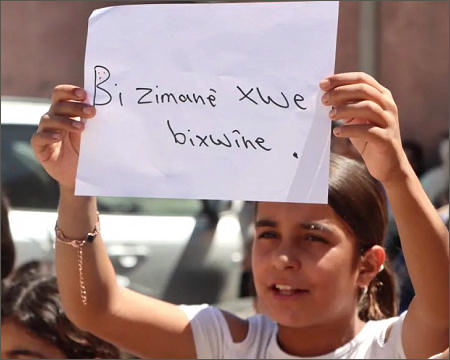
Syrian Kurds speak Kurmanji, a variety of Kurdish written in a Latin-based script. Kurdish belongs to the Indo-European language family and is distinct from Arabic.
Teacher urges transition period
Sharaa has pledged to protect minority rights and appointed General Mazloum Abdi, head of the dissolved Kurdish-led forces, as a presidential adviser.
Kurdish was taught secretly under Assad.
Teacher Mohamed Ahmed said he expected difficulties for pupils who had been taught only in Kurdish and called for “a transitional period of a year or two”.
“We hope things proceed smoothly and easily, and that the region’s situation is accepted, especially given the sensitivity surrounding these issues,” he said.
(With files from Reuters)
Copyright © 2026 iKurd.net. All rights reserved.
Related posts:
 Arabic fades in Iraqi Kurdistan as English takes over
 Voices of a Linguistic Revolution in Rojava, Northeastern Syria
 The Resurrection (Ba’ath) Party – Before the Iran-Iraq War
 Sabotaging Syria
 Business with ISIS – Updated
 The SDF–Damascus deal: A gamble over keys to Kurdish homeland
 Kurds in Syrian Kurdistan want to preserve the cultural rights
 The SDF–Syrian Regime Agreement: Context, Gains, and Ongoing Risks
 Sharaa’s forces enter Qamishlo under agreement with Syria’s Kurds
 The Mustashar and the Jash – A View from the Position of ‘Iraqi National Unity’ on the ‘Descendants of Treason’