

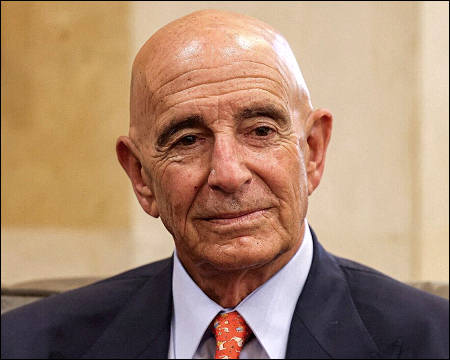
BERLIN,—The Society for Threatened Peoples (STP) in a statement on Thursday has criticized the promotion of U.S. diplomat Tom Barrack to serve as Special Envoy for Syria and Iraq under President Donald Trump, saying the move worsens conditions for minorities in Syria.
Barrack previously served as the U.S. Special Envoy for Syria and as U.S. ambassador to Turkey.
Secretary of State Marco Rubio had first announced the end of his tenure in the Syria envoy role before President Donald Trump later named him to a new position.
Dr. Kamal Sido, Middle East consultant at STP, said minority groups blame Barrack for what they describe as a severe deterioration in their situation.
He said Barrack is seen as supporting Syria’s new Islamist leadership while downplaying alleged abuses against minorities and democratic groups.
Sido also criticized Barrack’s remarks suggesting that democracy is not suitable for the region, calling them concerning and dismissive of people across the Middle East.
He said such statements reflect how Western policy treats Syria and show that democratic aspirations are not being taken seriously.
He said the situation is causing growing distrust in democracy and human rights inside Syria, while the country’s new leadership is becoming more politically accepted despite continued abuses against minorities.
In the Druze province of al-Suwaida, displaced residents remain unable to return home. During violence against the Druze community in southern Syria in July 2025, thousands of homes were burned.
The Syrian regime now reports 7,144 homes destroyed.
Many people were killed in the attacks, and Druze areas outside government control remain isolated. Attacks against Druze civilians on roads leading to Damascus also continue.
In Alawite areas along the Syrian Mediterranean coast, killings and sexual violence against civilians continue, according to the STP.
In Wadi an-Nasara in western Syria, about 150,000 mostly Christian residents are facing growing pressure. Armed Islamist groups are said to move through villages at night, spreading fear among the population.
In Syrian Kurdistan (Rojava), Kurdish and Aramaic languages are being systematically removed from public signage and government buildings, despite their official status in the autonomous region.
Many Kurds also fear that agreements with Damascus will not be upheld.
STP also said thousands of Kurds, including former female fighters with the Syrian Democratic Forces who fought the Islamic State group, remain imprisoned in Damascus.
The group urged Germany and the European Union not to step back from engagement in Syria and the Middle East, saying instability and authoritarian rule increase the risk of conflict and refugee flows toward Europe.
(With files from The Society for Threatened Peoples | gfbv.de)
Copyright © 2026 iKurd.net. All rights reserved.
Related posts:
 Betrayal by the Rogue State of America – The Bull in the China Shop
 The Resurrection (Ba’ath) Party – Before the Iran-Iraq War
 One year after Assad’s fall, genocide risk for Alawites and Druze
 Business with ISIS – Updated
 Sabotaging Syria
 Syria: Revisiting The Caesar Torture Victim Photographs
 Syria: The Hijacking of the Arab Spring: From ISIS to Hayat Tahrir al-Sham
 Syria: A ‘Caliphate’ by Any Other Name — Would Smell the Same
 Syria withdraws forces from Druze city of Sweida after Israeli strikes
 Iran theocracy’s survival may revive Shia Crescent’s Mideast power