


A Temporary Change in Our Kurdish National Identity Between Traitors of the Nation and Traitors of Belief!
Dlêr Mohammed Nuri | Exclusive to iKurd.net
Translated by iKurd.net from Kurdish Awene
No one should criticize me, because I know there is nothing in science called “national genetics.” And all those terms like “pure nation” or “racial nation” have not been scientifically proven.
However, our sense of national identity can be passed down from generation to generation, and our solidarity with people who share our language can be strengthened in the face of unwanted events.
As a Kurd, the pain of any Kurd anywhere in the world also causes me pain. This is directly connected to my relationship with being Kurdish. It is similar to the genetic material of any living being, which, in behavior, form, duties, and functions, remains connected to the group that shares the same genetic material.
But if you see a Kurd, whether from Qarakh [Qerax] or Khorasan, named Hakan or Halo, a mullah or a Salafi, a good person or not, and the suffering, disasters, and defeats of the Kurds do not move him, do not shake him, or he takes no position regarding them, then know that a major change has happened in his thinking. To the point that he becomes a friend of his enemy and an enemy of himself.
Science in general says that genetic changes in living beings do not happen easily or in a short time. For a real genetic change to occur in a living being, it takes millions of years. Even if the purpose of this article and the idea of genetic change are not logically identical, the comparison makes the point clearer.
The fact that most of us have remained Kurdish, under all these threats, occupations, hostility, killings, massacres, and oppression, if this did not cause a real change in us and we still remained Kurdish, proves how difficult it is to change our “genetics” when it comes to being Kurdish and staying Kurdish. Just as genetic change in living beings is very difficult, it would have been natural for all of us, in the embrace of Kurdistan, to remain Kurdish in spirit as beings connected to this land called Kurdistan.
Here we are talking about the ordinary Kurdish person. But even among Kurds, there are abnormal ones.
After all this suffering, persecution, and pressure, it was expected that a Kurd would remain Kurdish. Suffering should create deep regret. If the opposite happens, and we see a Kurd standing against Kurds or against himself, then this shows that a systematic change has occurred in his thoughts, ideas, and behavior.
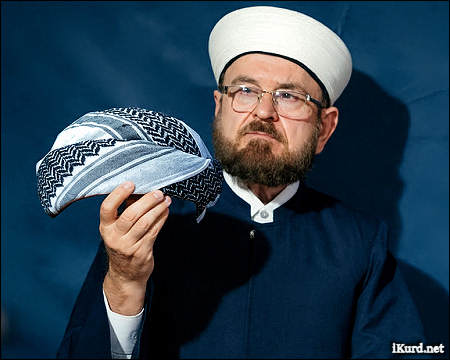
For example, the position we see today in someone like Ali Qaradaghi, or in any Kurdish mullah or activist from the Muslim Brotherhood or Islamic movements, such individuals have every right to examine themselves, their minds, their thinking, their behavior, and the filters they have passed through. Of course, they have passed through the wrong filter.
The minds and thinking of such Kurds have cut off and removed every connection to Kurdish identity. Because it is impossible for someone to cut off your brother’s head, violate your sister’s honor, cut down your trees, steal your olives, and yet you warmly shake their hands and kiss their heads. If this is not a genetic change in your thinking, then what is it?
If I want to be very considerate toward these Kurdish Brotherhood members, Islamists, and mullahs, I could easily describe their condition as Stockholm Syndrome. This psychological condition is defined as a situation in which a victim develops sympathy for his executioner, and this sympathy grows into support.
Kurdish history with Islamic and Arab invasions is full of Anfal campaigns, slaughter, enslavement, looting of wealth and property, and so on. Yet this group of Kurds still supports the same enemy whose victims were themselves, their fathers, and their grandfathers. If this is not Stockholm Syndrome, then what is it?
What remains to be said concerns the difference between two types of these “sick” individuals within Kurdish society who become enemies of their own people and their just cause. I call them traitors of the nation and traitors of belief.
A traitor of the nation is a person or a party that, for material gain, power, or self-interest, becomes a servant of its enemy. But this type of betrayal, at the level of leadership, group, or party, is usually temporary. It benefits the betrayer and harms part of his nation. It is more like tactical betrayal, even though it may cause strategic damage to the national issue.
There are many examples of party and leadership betrayal in both distant and recent history, and there is no need to mention names here. In the end, these national traitors often see and present themselves as more patriotic than you and me. They always describe their betrayal as a tactical choice or a necessity in order to protect a greater achievement.
But the bigger problem and the long-term pain is ideological betrayal, when you become a servant of the enemy because of belief. This type of betrayal means stripping yourself of all national values, emptying yourself of all national sanctities, and avoiding all shared national duties. It is a planned project designed to eliminate the future of the nation and dissolve it into a larger religious nation.
It means making your own nation’s past, culture, and history appear ugly and hateful. It means opposing all your own old and new political, intellectual, and literary symbols. Therefore, while a traitor of the nation may one day regret his actions and return to the national line, an ideological traitor has taken a path with no return. It is a path that leads to hell, both for himself and for his nation.
The recent events in Rojava have taught us a lesson, that we can all be equally Kurdish beyond all our differences. Of course, all those Islamic, mullah, and religious Kurdish patriots who have proven their national commitment deserve pride and respect. But from now on, there must be a serious and systematic examination of those ideological traitors who have turned away from the national line in such a way and who celebrate the defeat and destruction of Kurdistan.
This article was originally published in the Kurdish language in Awene Newspaper on February 15, 2026.
The opinions are those of the writer and do not necessarily represent the views of iKurd.net or its editors.
Copyright © 2026 iKurd.net. All rights reserved.
Related posts:
 The Resurrection (Ba’ath) Party – Before the Iran-Iraq War
 The Mustashar and the Jash – A View from the Position of ‘Iraqi National Unity’ on the ‘Descendants of Treason’
 Ali Qaradaghi and the Tyranny of Islam Over Human Rights
 The Truth About The Saddam Hussein Affair
 Anfal – The Black Stain on Iraqi History Spreads
 Iraqi Kurdistan – “Sold Out!” – Part II
 Kurds need leaders to serve Kurdish nationalism, not the Islamic faith
 The Suffocation of Iraq Kurdistan
 Iraq – The Cynical Swindle
 The Assassination of Abdurrahman Ghassemlou: No Friends but the Mullahs?