

CARACAS, Venezuela,— The United States carried out a surprise overnight military operation that resulted in the capture of Venezuelan President Nicolás Maduro, according to statements from U.S. officials and Venezuelan ruling party members.
Maduro was taken from his residence inside a major military compound and flown out of the country, U.S. authorities said, marking one of the most dramatic U.S. actions against a sitting foreign leader in decades.
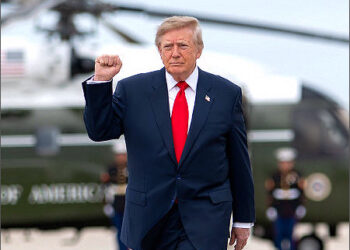
President Donald Trump confirmed the operation on Saturday during an interview with Fox News, saying the United States would remain deeply involved in determining Venezuela’s future. Trump said the operation was coordinated with U.S. law enforcement agencies and described it as successful.
The legal basis for the action was not immediately explained by U.S. officials. The operation drew comparisons from analysts and officials to the 1990 U.S. invasion of Panama, which led to the arrest of then leader Manuel Antonio Noriega.
That operation also involved U.S. troops seizing a head of state and transferring him to the United States to face criminal charges.
U.S. Attorney General Pam Bondi said Maduro and his wife, Cilia Flores, would face prosecution in the United States. In a post on social media, Bondi said the couple would be tried in American courts following indictments issued in New York.
The Justice Department released a new indictment on Saturday that expands on earlier charges connected to alleged narco terrorism activities.
According to U.S. officials, Maduro and Flores were placed aboard the U.S. Navy warship Iwo Jima and transported toward New York. Trump said the couple would be formally processed through the U.S. justice system upon arrival.
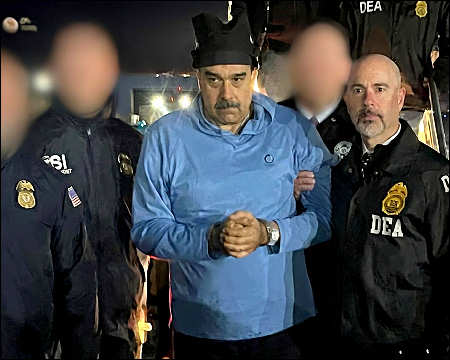
Nahum Fernández, a senior leader in Venezuela’s ruling party, told the Associated Press that Maduro and his wife were inside their home at the Ft. Tiuna military complex when the U.S. operation began. He said the area was struck during the attack and described the incident as a seizure of the president and first lady.
Early Saturday morning, residents of Caracas reported hearing explosions and seeing aircraft flying at low altitude over the city. Venezuelan authorities accused the United States of striking both civilian and military targets. The government described the action as an imperialist attack and urged supporters to take to the streets in protest.
Under Venezuelan law, Vice President Delcy Rodríguez would assume power if the president is unable to govern. While no formal announcement of a transfer of power was made, Rodríguez issued a statement demanding proof of life for Maduro and Flores and condemned the U.S. operation.
Trump later posted online that Maduro and his wife had been captured and removed from Venezuela. He said a press conference would be held later Saturday to provide further details.
According to U.S. and Venezuelan officials, the military operation lasted less than half an hour. At least seven explosions were reported across Caracas, prompting residents to leave their homes and post videos and accounts on social media.
Rodríguez said Venezuelan civilians and members of the armed forces were killed during the strikes, though she did not provide a specific number. Trump said some U.S. service members were injured but that he believed no American deaths had occurred.
It remained unclear whether additional U.S. military actions were planned. Trump said the strikes achieved their objectives.
The White House did not immediately respond to questions about the precise destination of Maduro and Flores following their departure from Venezuelan territory.
Maduro was last seen publicly on Friday during a televised meeting with a Chinese delegation in Caracas, according to state media.
The operation followed months of heightened pressure by the Trump administration. U.S. military forces had increased their presence near South America, and U.S. authorities carried out multiple strikes on vessels accused of drug trafficking in the Caribbean and eastern Pacific.
According to the Trump administration, at least 35 vessels have been targeted since September, with at least 115 people reported killed. U.S. officials said the actions were part of what Trump has described as an armed conflict with drug cartels.
Last week, U.S. intelligence agencies were involved in a drone strike at a docking facility believed to be used by drug trafficking groups. Officials said it was the first known direct U.S. strike on Venezuelan territory during the current campaign.
Maduro had repeatedly accused Washington of using drug enforcement as a justification to remove him from office.
In Caracas, some neighborhoods saw an increase in armed civilians and members of pro government militias following the attack. In a traditionally pro government area, armed groups were seen patrolling streets.
At a rally in the capital, Mayor Carmen Meléndez joined supporters calling for Maduro’s return. Protesters gathered in central Caracas and chanted slogans in support of the president.
In other parts of the city, streets remained largely empty hours after the explosions. Some neighborhoods experienced power outages, though traffic continued in several areas.
Residents described fear and confusion. Noris Prada, a Caracas resident, said many families were unable to sleep and remained uncertain about what would happen next.
Verified video footage obtained by the Associated Press showed flashes of light, smoke, and tracer fire in Caracas and an unidentified coastal city. Other videos showed vehicles driving along highways as explosions lit up nearby hills.
Smoke was visible rising from a military hangar in Caracas, and another military installation lost electricity, according to officials.
The Venezuelan government said Maduro had ordered national defense plans to be activated and declared a state of emergency. The measure allows authorities to suspend certain civil rights and expand the role of the armed forces.
The U.S. Embassy website for Venezuela, which has remained closed since 2019, issued an advisory urging American citizens in the country to remain indoors.
International and political reactions began to emerge. The Federal Aviation Administration warned U.S. pilots to avoid airspace over Venezuela and Curacao due to ongoing military activity.
Members of Congress said they had not been formally notified of the operation. Lawmakers from both parties have previously questioned the legality of U.S. strikes in the region.
Representative Jim Himes of Connecticut said there was no public evidence justifying military action without congressional approval and called for an immediate briefing.
Deputy Secretary of State Christopher Landau said the capture of Maduro marked a turning point for Venezuela. Senator Marco Rubio reposted earlier statements questioning Maduro’s legitimacy.
Cuba condemned the operation, calling for an international response. Iran’s foreign ministry also issued a statement criticizing the strikes.
Argentine President Javier Milei praised Trump’s announcement, using a slogan associated with his political movement.
(With files from AP)
Copyright © 2026 iKurd.net. All rights reserved.
Related posts:
 Protests erupt in Venezuela over alleged Maduro election fraud
 Venezuela’s Maduro sworn in as US raises bounty to $25 million
 Delcy Rodriguez named interim president by Venezuela Supreme Court
 The Resurrection (Ba’ath) Party – Before the Iran-Iraq War
 Venezuela’s María Corina Machado wins 2025 Nobel Peace Prize
 Business with ISIS – Updated
 Saddam Hussein was a Friend to the West
 Sabotaging Syria
 Iraqi Kurdistan – “Sold Out!” – Part II
 What makes a good NATO ally? The Case of Turkey