
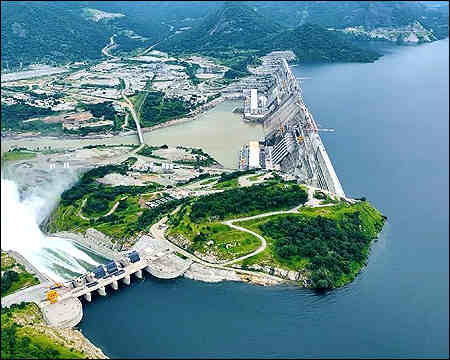
GUBA, Ethiopia,— Ethiopia formally opened Africa’s biggest hydroelectric project on Tuesday, declaring the Grand Ethiopian Renaissance Dam fully operational in a move that Addis Ababa says will bring electricity to millions but which continues to stir tensions with downstream Egypt.
The $5 billion project on the Blue Nile has long been a centerpiece of Ethiopia’s growth strategy. With more than 120 million people, the nation is Africa’s second most populous, and leaders in Addis Ababa see the dam as crucial for industrialization, regional exports and broader development.
Officials said the dam has now reached its maximum generating capacity of 5,150 megawatts after the final turbines came online.
That makes it one of the 20 largest hydroelectric plants worldwide. By comparison, it produces about one-quarter of the output of China’s massive Three Gorges Dam.
At an inauguration ceremony in Guba, a military jet flew overhead as water surged down the 170-meter (558-foot) structure.
Prime Minister Abiy Ahmed delivered remarks beneath a large national flag, addressing dignitaries that included the presidents of Kenya, Djibouti and Somalia.
“To our brothers in Sudan and Egypt, Ethiopia built this dam to bring prosperity, electrify our region and mark a new history for our continent,” Abiy said. “This project is not meant to cause harm.”
Ethiopia argues the facility will provide reliable power for its citizens, increase exports to neighboring countries and help regulate flooding.
Authorities say the massive reservoir, which covers an area larger than London, will improve irrigation and reduce the risks of drought downstream.
Construction began in 2011 and has been met with strong resistance from Egypt, which relies on the Nile for about 90 percent of its fresh water.
With a population of around 108 million, Cairo says the project could cut vital supplies during dry years. Officials also fear it could encourage additional upstream projects.
Egypt has cited colonial-era water agreements to challenge the dam, calling it a threat to national survival.
“Egypt will continue to monitor developments on the Blue Nile closely and reserves the right to take appropriate measures to protect the interests of the Egyptian people,” Foreign Ministry spokesman Tamim Khallaf told Reuters.
Sudan has echoed Egypt’s demand for a legally binding deal on how the dam is filled and operated. At the same time, Khartoum stands to gain cheaper electricity and improved flood control if operations are coordinated.
Ethiopia began filling the reservoir in stages in 2020, insisting the process would not significantly harm downstream nations. Studies by independent researchers show no major drop in Nile flows so far, with ample rainfall and gradual filling easing concerns.
For Ethiopians, the GERD has become a unifying symbol. “It has been a banner for the country during difficult times and shows what can be achieved through unity,” said Mekdelawit Messay, a water policy expert at Florida International University.
Funding for the dam came almost entirely from inside Ethiopia. The central bank provided 91 percent, while citizens contributed the remainder through bond purchases and donations. Officials have repeatedly noted that no foreign government or lender financed the project.
Some Ethiopians living near the site say they are already experiencing change. Sultan Abdulahi Hassan, a farmer in the area, told Reuters that electricity has reached his village.
“We now have refrigerators, we can drink cold water and use power for daily life,” he said.
Still, challenges remain. Despite the new supply, transmission lines are limited outside cities. According to the World Bank, 94 percent of urban households had electricity in 2022, but only 55 percent of the overall population was connected.
Experts also say the extra capacity may benefit energy-intensive industries, including bitcoin mining, before reaching many rural communities.
(With files from Reuters)
Copyright © 2025 iKurd.net. All rights reserved
Related posts:
 The Resurrection (Ba’ath) Party – Before the Iran-Iraq War
 The February 6 Earthquake: The Ataturk Dam’s effect and the ethnic conflict in Turkey
 Iraqi Kurdistan’s Qaladiza town battles water shortages, navigates regional water diplomacy
 Sabotaging Syria
 Iraqi Kurdistan’s Dukan Lake drops to 24% capacity amid poor rainfall
 Syrian Kurds reach deal with Damascus over strategic Tishrin dam
 Jina Renaissance in 1001 words
 Full-day electricity reaches 30% of Iraqi Kurdistan, officials say
 Iraq’s wheat self-sufficiency dream fades amid water crisis
 Erbil faces water shortages in Iraqi Kurdistan’s summer heat