

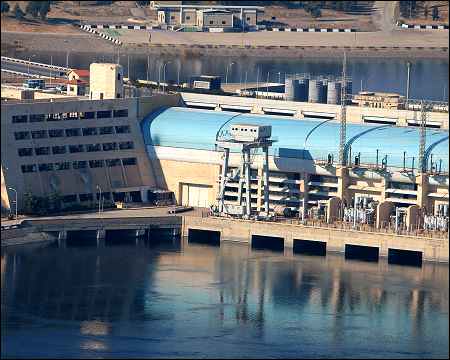
HASAKA,— Kurdish officials in Syrian Kurdistan have reached an agreement with the Syrian transitional government to jointly manage the Tishrin Dam, according to a Kurdish official who spoke to AFP on Thursday.
The dam, which lies along the Euphrates River, was previously under the control of the Kurdish-led Syrian Democratic Forces (SDF), the de facto army of the autonomous Kurdish administration in Syrian Kurdistan, following its capture from the Islamic State group in 2015 with support from U.S. forces.
As part of the agreement, SDF units are set to withdraw from the dam, making way for security forces aligned with Syria’s post-Assad government to assume control. A joint administrative body will oversee the facility, the source said.
Located in a region critical for water resources and electricity, the Tishrin Dam is one of several hydropower facilities that contribute to Syria’s infrastructure and agriculture.
The dam changed hands multiple times during the country’s prolonged civil conflict, which began in 2011.
The new arrangement follows a broader March deal between the Kurdish-led autonomous administration and Damascus, aimed at integrating Kurdish-run institutions into Syria’s state framework.
The agreement has already resulted in the Kurdish armed forces’ withdrawal from Kurdish neighborhoods in Aleppo, and a decreased presence of Turkish-backed Syrian Islamist mercenary fighters in Afrin, a historically Kurdish area in the northwest.
The Syrian Observatory for Human Rights, based in the United Kingdom, reported that Kurdish and Syrian security agents will jointly oversee protection of the dam. The same monitoring group noted that the new committee will also supervise necessary repairs to the site.

Following the fall of Bashar al-Assad’s government in December 2024, the dam came under Turkish drone attacks, killing dozens of Kurdish civilians, according to Kurdish authorities and the Observatory.
The Syrian government has not yet publicly commented on the dam agreement.
The Kurdish-led Autonomous Administration in Syrian Kurdistan, widely recognized for its grassroots approach to governance, operates under a decentralized system that promotes gender equality, democracy, and environmental care.
Established officially in 2018 the Democratic Autonomous Administration of North and East Syria has been overseeing the region with a focus on secular rule and local decision-making.
Under this model, known as democratic confederalism, power is shared among local councils and communities. The system encourages equal participation of women in all levels of leadership and highlights the importance of protecting the environment.
Since its formation, the administration has introduced this approach across towns and regions throughout northeast Syria, aiming to build a more inclusive and community-based political structure.
(With files from AFP | Agencies)
Copyright © 2025 iKurd.net. All rights reserved
Related posts:
 Business with ISIS – Updated
 Turkey: Nato’s Islamic State Member
 The Resurrection (Ba’ath) Party – Before the Iran-Iraq War
 Syria: A ‘Caliphate’ by Any Other Name — Would Smell the Same
 What makes a good NATO ally? The Case of Turkey
 Iraqi Kurdistan – “Sold Out!” – Part II
 Damascus Should Realise That Only Way Forward is Through Talks
 Syrian Islamist government forces deploy at key Tishrin dam under deal with Kurds
 Martyrs for Millionaires: The Black-Market Politics behind the Theft of Syria’s Oil
 Turkey: The Psychological War Against the Kurds Through the PKK – Part I