

Iraq Announces Seat Allocations for Newly Elected Parliament
BAGHDAD,— Iraq’s electoral commission released the official seat allocation on Monday following the November 11 parliamentary election, confirming a chamber in which multiple factions will be required to negotiate in order to shape the next government.
Although the results did not grant any single list a majority of the 329 seats, the coalition of the pro-Iran Shiite parties known as the Coordination Framework stated it has brought its affiliated groups together to form what it says is the largest bloc.
Several parties in this alliance maintain varied political links to Iran, a factor that has influenced Iraqi coalition politics for years.
According to the figures issued by the commission, Prime Minister Mohammed Shia al Sudani’s Reconstruction and Development Coalition emerged as one of the biggest winners with 46 seats.
The total represents a notable expansion of his representation compared with the previous parliament. Sudani, who seeks a second term, has not publicly confirmed whether he plans to fold his coalition into the Coordination Framework.
During the last cycle, this alliance of Shiite factions united to play a decisive role in selecting him as premier.
The breakdown shows other Framework affiliated groups also recorded strong or improved performances.
The State of Law Coalition led by former prime minister Nuri al Maliki captured 29 seats, down from 37 in 2021 yet still maintaining a prominent spot within Shiite politics.
The National State Forces Alliance, headed by influential cleric and politician Ammar al Hakim, increased its presence to 18 seats after holding only four in the last parliament.
Another key player, the Al Sadiqun list linked to Qais al Khazali, won 27 seats. Khazali has been designated a terrorist by the United States, but his organization has grown into a significant political force.
The Badr organization under Hadi al Ameri secured 21 seats. Badr is known as one of the largest groups within the pro-Iran sphere in Iraq and has maintained longstanding ties to Iranian institutions.
Huquq, which is close to Kataeb Hezbollah, gained six seats, one more than before. Kataeb Hezbollah is an armed faction with close Iranian connections and is designated a terrorist group by Washington.
Sunni representation in the new parliament will again feature the Taqaddum movement led by Mohammed al Halbussi.
Taqaddum obtained 27 seats, becoming the largest Sunni bloc and ensuring its role in the coalition discussions that follow.
In the Kurdistan Region, the political landscape remained shaped by the established competition between the Kurdistan Democratic Party KDP and the Patriotic Union of Kurdistan PUK.
The KDP earned 26 seats, compared with 31 seats in 2021. The PUK secured 15 seats, slightly lower than its previous share.
The New Generation movement (Cûłanewey Newey Nwê), a Kurdish opposition party, won three seats after holding nine during the last cycle.
Shortly after the commission confirmed the results, the pro-Iran Coordination Framework issued a statement saying its members had signed a unified document to officially present themselves as the largest bloc in parliament.
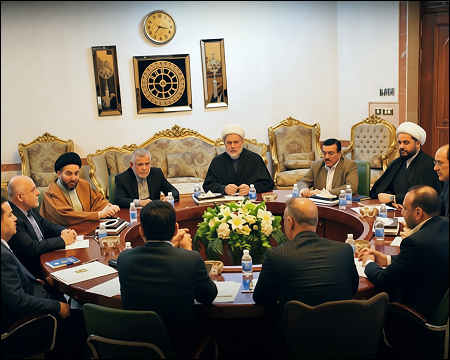
Based on this declaration, the alliance stated that it intends to nominate the next prime minister. Senior figures from the coalition held their first meeting following the election on Monday, reviewing plans and discussing how to organize negotiations with other groups.
Sources within Shiite parties noted that Framework leaders are aiming for a comprehensive political arrangement before the new parliament convenes in January.
This arrangement would address the top three state positions: the prime minister, the speaker of parliament and the president.
According to Iraq’s customary power sharing formula adopted after 2003, the premiership is held by a Shiite Muslim, the speakership goes to a Sunni Arab and the presidency is assigned to a Kurd.
Negotiators from the Framework are expected to press for agreements that include cabinet ministries and senior administrative roles in addition to the three key posts.
Iraq’s post election politics typically involve extended discussions between Shiite, Sunni and Kurdish blocs.
Leaders frequently seek to secure influence through ministries and other government positions. Officials from several parties have indicated that additional meetings will be held in the coming period to begin mapping how alliances might be structured.
The newly announced results confirm that Iraq’s political field remains fractured across multiple groups, none of which can govern alone.
The gains made by parties connected to the pro-Iran Coordination Framework are likely to shape negotiations, as these factions attempt to assemble enough combined strength to direct the formation of the next government.
Political groups across the country acknowledged that the coming weeks will involve extensive bargaining over policy direction, cabinet formation and parliamentary leadership.
Iraq’s Prime Minister Joins Majority Parliament Bloc

Iraq’s current Prime Minister, Mohammed Shia al-Sudani, has joined the country’s most powerful political alliance.
The Coordination Framework, holds the most seats in parliament. This majority position gives it the right to choose the country’s next prime minister.
Sudani announced in Duhok, that his own political group, the Reconstruction and Development coalition, is now a part of this larger alliance. He stated that their goal is to unite as the “largest bloc” in parliament.
The Prime Minister also addressed his desire to serve a second term. He said his goal is not for personal gain, but to finish the work he started. During his first term, he focused on rebuilding the country and ensuring its stability.
With this new alliance formed, discussions will now begin among the main political parties to officially select Iraq’s next prime minister, as well as a new parliament speaker and president.
(With files from AFP)
Copyright © 2025 iKurd.net. All rights reserved.
Related posts:
 The Resurrection (Ba’ath) Party – Before the Iran-Iraq War
 Iraq in the Shadow of Khomeinism – Part III: Iraq is NOT Iran!
 LOSING IRAQ — to Iran
 What makes a good NATO ally? The Case of Turkey
 Iraq: Revenge and Corruption
 Saddam Hussein was a Friend to the West
 Saddam Hussein’s Enemies: Paving the Road to the Invasion of Iraq
 The Suffocation of Iraq Kurdistan
 Iraq in the Shadow of Khomeinism – Part I: Baghdad And Erbil Under Threat
 Iraq – The Cynical Swindle