


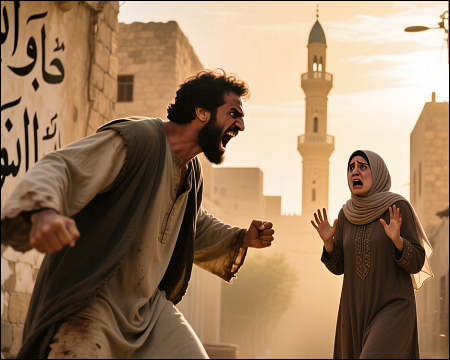
With Greetings, Respect, and Hope For a Better Life
Ali Ashouri | Exclusive to iKurd.net
On the occasion of the International Day for the Elimination of Violence against Women, we are reminded that violence against women is not only a series of isolated acts but a persistent structure embedded in language, law, memory, and everyday practices of seeing and hearing.
From subtle, normalized forms of discrimination to the most extreme manifestation—femicide—these acts reveal the fragile boundaries between what is sayable and what is erased, between visibility and systematic invisibility. To confront this violence requires more than condemnation; it demands a critical re-reading of the structures that render women’s bodies and voices controllable, silenced, and predefined, and a reclaiming of spaces for shared mourning, expression, and meaning.
The violence that continues to target women today—from everyday normalized discrimination to femicide in its most exposed and brutal form—never appears as isolated incidents. It emerges within an order that has sedimented itself in language, law, memory, and habitual ways of seeing and hearing.
When we speak of femicide, we are not describing an exception but a moment in which this order loses the cover of its invisibility and briefly reveals itself. Femicide is less an aberration than a reflection of the very rule: a rule that positions the woman’s body as something to be controlled, silenced, or disciplined.
In this sense, violence is not merely a physical act; it is a linguistic operation that precedes any act of harm. It begins in a vocabulary that names the woman not as a subject of meaning but as an object of possession, a site of threat, or a body to be regulated.
What is erased is not only physical life but the possibility of speech—the capacity of a woman to appear as a speaker and articulate her own meaning beyond the frames assigned to her. This erasure operates through naming: through words that seem neutral but quietly reproduce the structures of a male-dominated order. Violence, before it becomes injury, is already a sentence—one that positions the woman in a subordinate place long before any act is carried out.
Looking deeper, the persistence of violence against women unfolds in the gap between what is “sayable” and what must be made to disappear. In that gap, meaning slips: what is erased often returns, reshaped, displaced, haunting the very structures that sought to silence it. Femicide, from this perspective, is not an endpoint but a trace—an overcompressed meaning that bursts outward because the surrounding structures can no longer contain the contradictions they themselves have produced.
Confronting such violence demands more than condemning singular acts. Condemnation alone remains trapped within the same logic that enables the violence in the first place. Real resistance begins when the structures governing naming, seeing, and hearing are disrupted.

Re-reading is required: re-reading law, collective memory, and traditions that have naturalized women’s vulnerability and normalized the erasure of their voices. Such re-reading seeks to pull meaning out of the monopoly of dominant narratives and to recognize alternative possibilities—possibilities that may be fragile and unstable but capable of breaking the chain that binds violence to its linguistic roots.
This disruption does not happen all at once. It begins with small fissures: challenging certain names, refusing vocabularies that fix women’s bodies into predetermined roles, reclaiming denied language. Each time a woman rewrites the meaning of her own presence, the order that has long attempted to define her is unsettled. This rewriting may not be loud; it may even seem imperceptible. Yet it is within these quiet gestures that the space of rupture opens.
Ultimately, the notion of a “life in shared mourning” must be rethought. A society that treats a woman’s death as private, exceptional, or merely a domestic matter is, in fact, depriving her of shared mourning; and the withholding of mourning is itself a form of erasure. Rethinking violence against women means rethinking who is worthy of shared mourning, who is permitted to have a voice, and which lives are admitted into collective memory.
When violence is embedded in language, it can only be confronted through language—through writing, rewriting, and opening fractures in meaning. Perhaps these fractures, fragile as they may be, are the only spaces where resistance can breathe: spaces where the cyclical return of violence may be interrupted, and where life—uncertain, unstable, yet insistently present—can return to the scene.
Ali Ashouri, a contributing writer for iKurd.net based in San Diego, California, U.S.
The views expressed are solely those of the author and do not necessarily reflect the opinions of iKurd.net or its editorial team.
Copyright © 2025 iKurd.net. All rights reserved.
Hêmin Mukriyanî: Language, Memory, and the Incompleteness of Modernity in Kurdish Poetry
Related posts:
 The Resurrection (Ba’ath) Party – Before the Iran-Iraq War
 Angels of Sinjar: Body, Memory, and the Afterlife of Genocide in Cinema
 Powerful, yet are they Useless?
 Business with ISIS – Updated
 Ocalan’s Secular Lens on a “Democratic Islam”
 Anfal – The Black Stain on Iraqi History Spreads
 The Truth About The Saddam Hussein Affair
 Who Are the Persians, Part V
 What makes a good NATO ally? The Case of Turkey
 Mother Tongue in the Age of Modernity, Power, and Digital World