

Ali Ashouri | Exclusive to iKurd.net
Hêmin Mukriyanî occupies a liminal position in the history of modern Kurdish literature — not merely as a poet, but as a mediator between the oral tradition and the emerging modern written form.
He wrote at a time when Kurdish poetry still hovered between collective memory and individual expression; a time when language was crossing from orality to writing, and the poet stood precariously in-between.
It is precisely this in-betweenness that renders his poetry a threshold text — neither wholly traditional nor entirely modern, but a restless search for a language capable of expressing memory without being confined by it.
Linguistically, Hemin sought to liberate Sorani Kurdish from the rigidity of classical prosody and syntax, bringing it closer to the living rhythm of speech. Yet this liberation was never complete. The resonance of classical diction and metrical cadence remains present in his lines — a voice that desires to move beyond the past while still drawing nourishment from it.
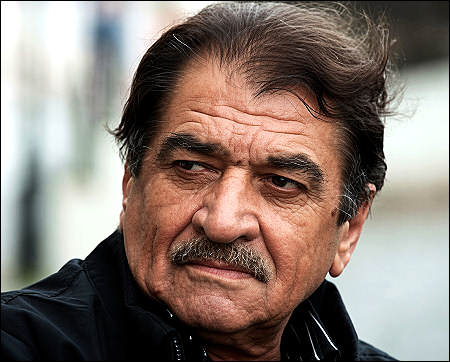
This tension between fidelity and freedom constitutes the core of his aesthetic. Compared with his contemporaries such as Abdullah Goran or Sherko Bekas, Hemin was less preoccupied with political rupture or revolutionary diction and more with rescuing the beauty and integrity of the Kurdish language itself. Instead of deconstructing the historical order of poetry, he sought to heal it from within — transforming the poem into a vessel of cultural memory rather than a field of ideological revolt.
In matters of rhythm and sound, Hemin found a subtle balance between classical meter and spoken cadence. Though he never fully abandoned the traditional structure, his flexible use of rhythm softened its rigidity, creating a more intimate and collective tone.
The music of his poetry is not grand or heroic but human and communal — a sound that belongs to the ear of the people rather than to the palace of tradition. His poems are “audible” in the truest sense: not because of their outer melody, but because they echo the deep, historical listening of a language long denied its voice.
Visually and imagistically, Hemin was among the first Kurdish poets to elevate the image from mere ornament to meaning. Nature in his poetry is not a decorative backdrop but a living text — a symbolic landscape where mountains, rivers, and horses embody a collective existence on the edge of erasure.
Yet his imagery does not reach abstraction or philosophical reflection; it remains sensory rather than conceptual. In this sense, Hemin’s work drifts away from modernism and toward a kind of national romanticism — a poetics of mourning that seeks to preserve rather than reinvent the past. His verse oscillates between remembrance and renewal, awakening and dream.
Historically, however, Hemin’s role in the institutionalization of the Sorani dialect cannot be overstated. As a teacher and scholar at a time when Kurdish lacked formal educational support, he worked tirelessly to make it a language of learning, writing, and thought.
Through editing texts, collecting folklore, and developing linguistic materials, he built a bridge between speech and writing — between the living voice of the people and the emerging discipline of literacy. His cultural project was thus profoundly political: an act of resistance against oblivion.
Yet within this cultural labor lies an inner contradiction. As an educator, Hemin sought standardization; as a poet, he longed for freedom. He stood between grammar and song, between the law of language and the dream of its dissolution. This paradox is the source of his enduring vitality: in his work, language itself becomes a site of struggle — between history and the present, between discipline and imagination.
Hemin Mukriyanî, then, is the poet of continuity amid rupture. He does not break tradition but transforms it from within, keeping alive the voices, idioms, and affections of a people on the verge of silence. His innovation lies precisely in his restraint, in his refusal to forget. He may not have reached the full horizon of Kurdish poetic modernism, yet he illuminated its path — as one lights a lamp without seeing the end of the road.
The true significance of Hemin Mukriyanî lies not in the overthrow of tradition but in making tradition self-aware. He taught the Kurdish language to listen to itself, and in that act of listening, thinking began. He stands, therefore, as a poet between history and dream — one who transformed the incompleteness of Kurdish modernity into a language of persistence and reflection.
1. Hassanpour, Amir. Nationalism and Language in Kurdistan, 1918–1985. Mellen Press, 1992.
2. Blau, Joyce. Manuel de kurde (dialecte Sorani). L’Institut Kurde de Paris, 1999.
3. Omarkhali, Khanna. The Yezidi Religious Textual Tradition: From Oral to Written. Harrassowitz Verlag, 2017.
4. Ali, Haidar. “From Orality to Modernity: The Reconfiguration of Kurdish Literary Identity.” Journal of Kurdish Studies, vol. 8, no. 2, 2021, pp. 45–
Ali Ashouri, a contributing writer for iKurd.net based in San Diego, California, U.S.
The views expressed are solely those of the author and do not necessarily reflect the opinions of iKurd.net or its editorial team.
Copyright © 2025 iKurd.net. All rights reserved.
Related posts:
 Sherko Bekas: Poetry as a Testimony to Freedom, Nature, and Memory
 The Resurrection (Ba’ath) Party – Before the Iran-Iraq War
 Iraq: Revenge and Corruption
 Ali al-Zaidi from Da’wa to peak of Iraq’s rentier system
 Anfal – The Black Stain on Iraqi History Spreads
 Business with ISIS – Updated
 The Mustashar and the Jash – A View from the Position of ‘Iraqi National Unity’ on the ‘Descendants of Treason’
 Angels of Sinjar: Body, Memory, and the Afterlife of Genocide in Cinema
 The Terror Instructor – Nouri al-Maliki
 The Suffocation of Iraq Kurdistan