

Serwan Zangana | Exclusive to iKurd.net
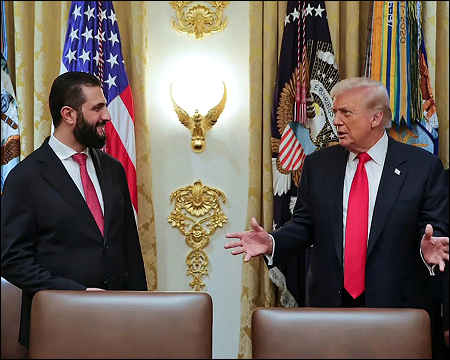
The U.S. President Donald Trump’s meeting with the new President of Syria, once he was a leader of the Al Qaeda organization, Ahmad al-Sharaa, at the White House, and overall, the new U.S.-Syrian relationship is a turning point for the Syrian regime.
Obviously, the volatility in the U.S. foreign policy has caused disasters and devastations in the Middle East while benefiting major U.S. interests. However, Trump and Al-Sharaa, who were the U.S.’s enemy yesterday and became today’s friends, have celebrated in the White House.
Lifting the restrictions on Syria and providing support to Al-Sharaa will strengthen the Syrian regime and boost its power in the country, and indeed, narrow the path for Kurds to obtain autonomy in the northeast of the country. President Trump’s business mentality is circling in the Middle East with a vision of long-term benefit even after his presidency.
The U.S.’s double-standard policy regarding the Kurds’ case is eroding the trust in Americans in the region. The Trump administration is invigorating Al-Sharaa’s regime, which also reflects positively on Turkey’s presence in Syria.
Regardless of vocal condemnation, the U.S. has not been taking a firm and serious position to stop Turkey’s attacks on the Kurdish civilians in the past.
The Kurds in northeastern Syria are in a predicament dealing with the same chauvinistic mentality of the Arab regime but in a different form now. The correlation between former President Bashar al-Assad and current President Ahmad Al-Sharaa is their opposing of Kurdish autonomy and rejecting the political identity of Kurds. The matter of a decentralized system in Syria, which is demanded by Kurds, has been a major concern for both the Syrian and the Turkish regimes.
In fact, Turkey is standing on a solid podium in a strong position after the official disarmament of the Kurdistan Workers’ Party (PKK). By ending the PKK and removing the actual threat of its armed guerrillas, the Turkish President, Recep Tayyip Erdogan, has added more iron to his hammer on Rojava.
The Foreign Minister of Turkey, Hakan Fidan, at a press conference in Syria, has already called the Syrian Democratic Forces (SDF) to abandon its “separatist agenda.” Foreign Minister Fidan said, “the Syrian government has the will to conduct simultaneous operations against Daesh, and we must all support Syria in supporting this will with the necessary capabilities and capacity… at this point, the SDF, which is pursuing a separatist agenda under the guise of combating Daesh, must abandon this equation.”
However, the March 10 agreement between SDF commander Mazloum Abdi and Syrian President Ahmad al-Sharaa, as Abdi said in an interview with Ronahi TV, that they agreed on “how the SDF integrates into the Syrian army,” can obviously reveal that the SDF is not seeking separation from Syria.
Evidently, Turkey’s main goal is to disband the SDF and shift the U.S. agenda from supporting Kurds in Syria. Yet, Turkey has not recognized the Kurdish political identity despite the PKK’s disarmament and Kurds’ willingness to engage in the democratic political process in Turkey. Unfortunately, such a willingness is fading into a dream for Kurds.
Obviously, Al-Sharaa has been opposing decentralization in the Syrian government, but it is important to realize that the SDF’s integration into the Syrian army will not succeed without decentralization. However, Trump’s agenda in the Middle East has opened a different gate for the nations’ region to connect with the U.S. and establish peace, which reflects on many aspects, and indeed, his own interests and business. Evidently, Trump became agitated when the reporter from ABC News asked him during the meeting with Crown Prince Mohammed bin Salman about his family business in Saudi Arabia as a conflict of interest.
Also, it is important to realize that the agreement between Al-Sharaa and Abdi to integrate the SDF with the Syrian army is not as simple to implement. However, Al-Sharaa’s power is now generated by major countries, such as the U.S. and Turkey, as the latter has vowed to support Al-Sharaa through a defense agreement to provide weapons to the Syrian regime.
Furthermore, as Israel is an inseparable component of the U.S. foreign policy and Trump’s agenda in the Middle East, by establishing a relationship with Syria, embracing Al-Sharaa and becoming the U.S. ally, Trump is hoping to end the threat from the new Syrian regime to Israel.
But the impediment to peace is the rigid mindset of the leaders and politicians in the region. Trump will not be able to create a safe haven for all in the Middle East while some of the governments are not willing to recognize the ethnic and religious diversity in the region.
Now, as Syria has joined the U.S.-led global coalition to combat ISIS, the concern about the U.S. commitment to the Kurds in northeastern Syria will arise and prompt questions if Trump is planning to replace the SDF with Al-Sharaa’s regime.
Believably, behind the cordial meeting between Trump and Al-Sharaa in the White House, there were many agreements. The questions are whether Washington will continue support to its most loyal allies, the SDF, or gradually abandon such forces.
The stability and peace in Syria have no chance without a decentralized government. The sectarian clashes can clearly show the failure of the new Syrian government in recognizing the diversity and seeing the fact that each sect and ethnicity must live under its own umbrella. Demanding decentralization in Syria is not limited to the Kurds, as indeed, other minority groups and ethnicities, including Alawites and Druze, have called for decentralization as well.
Serwan Zangana, a contributing writer for iKurd.net, lives in Virginia, U.S. He serves as a correction officer.
The views expressed are solely those of the author and do not necessarily reflect the opinions of iKurd.net or its editorial team.
Copyright © 2025 iKurd.net. All rights reserved
Related posts:
 Business with ISIS – Updated
 What makes a good NATO ally? The Case of Turkey
 The Resurrection (Ba’ath) Party – Before the Iran-Iraq War
 Syria: A ‘Caliphate’ by Any Other Name — Would Smell the Same
 Stealing Syria
 Turkey: The Psychological War Against the Kurds Through the PKK – Part I
 Turkey: Nato’s Islamic State Member
 Martyrs for Millionaires: The Black-Market Politics behind the Theft of Syria’s Oil
 Syria’s Kurds Should Seek a More Trusted Ally Than Trump’s U.S.
 Syria: Revisiting The Caesar Torture Victim Photographs