

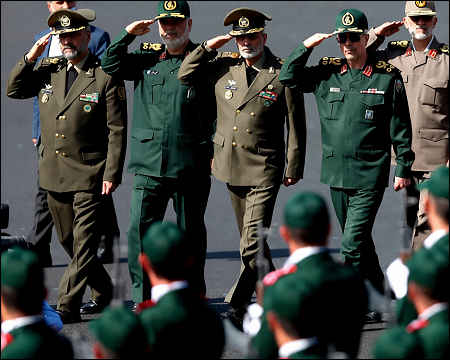
BRUSSELS,— The European Union has formally added Iran’s Islamic Revolutionary Guard Corps to its list of terrorist organizations, a move that sharply escalates pressure on Tehran following a violent crackdown on protests across the country.
The decision was reached unanimously by foreign ministers from the 27-member bloc during a meeting in Brussels on Thursday, the EU’s top foreign policy official said in a public statement.
The designation places the Guard alongside groups such as al-Qaida, Hamas and Daesh on the EU’s terrorism list.
The move follows months of debate inside the bloc over how to respond to unrest in Iran, where activists and human rights organizations say thousands of people have been killed during demonstrations that spread nationwide.
The protests initially erupted over economic hardship and later expanded into broader opposition to Iran’s ruling system.
In addition to the terrorist designation, the EU announced a new round of sanctions targeting 15 Iranian officials. Those listed include senior commanders of the Revolutionary Guard who European officials say played key roles in directing or overseeing the response to the protests.
Six Iranian organizations were also sanctioned, including bodies linked to monitoring online activity. Iran has faced an internet blackout lasting several weeks, which authorities have described as a security measure. The sanctions include asset freezes and travel bans within the European Union.
European officials described the measures as part of a broader strategy aimed at increasing diplomatic and economic pressure on Tehran.
While the sanctions are not expected to cause immediate structural changes, analysts say they signal a hardening of the EU’s position after years of attempting dialogue.
Iran has not issued an official response to the designation. However, Tehran has criticized European governments in recent days as discussions were underway.
Iran has previously rejected accusations of widespread abuses and has characterized protest-related violence as the work of hostile groups.
The Revolutionary Guard, established after Iran’s 1979 Islamic Revolution, operates alongside the country’s regular armed forces and answers directly to the supreme leader.

Over the decades, it has expanded its influence beyond military affairs into construction, energy, banking and telecommunications, making it a central economic and political force.
International concern has also grown amid rising tensions between Iran and the United States. U.S. President Donald Trump has warned of possible military action in response to what Washington describes as the killing of peaceful demonstrators and the threat of mass executions.
The U.S. military has deployed the aircraft carrier USS Abraham Lincoln and several guided-missile destroyers to the Middle East. U.S. officials have not confirmed whether the deployments are preparatory or defensive. It remains unclear if Washington intends to use force.
Iran has issued counterwarnings, stating it could carry out pre-emptive military strikes or expand attacks across the region. Iranian officials have said potential targets could include U.S. military bases and Israel.
On Thursday, Iran issued a maritime warning indicating it would conduct military drills next week in the Strait of Hormuz. The exercise is expected to involve live-fire activity.
The strait is one of the world’s most critical shipping lanes, carrying roughly 20 percent of global oil supplies. Any disruption could affect energy markets and regional security.
Some European governments had initially expressed reservations about the terrorist designation. France, in particular, had raised concerns that the move could endanger European citizens detained in Iran or complicate diplomatic operations. French officials later signaled their support.
France’s foreign minister said before the EU meeting that additional sanctions were necessary and that crimes committed during the repression could not go unanswered. He said diplomatic caution could not justify inaction.
Policy experts say the designation is largely symbolic but politically significant. Kristina Kausch of the German Marshall Fund described the decision as a clear signal that engagement had failed.
She said labeling a formal arm of the Iranian state as a terrorist organization stops short of severing diplomatic relations but leaves little room for further dialogue.
The sanctions mean that any assets linked to the Revolutionary Guard within EU jurisdictions can be seized. Members of the organization are barred from traveling to EU countries.
Iran’s economy has already been weakened by multiple layers of international sanctions imposed by the United States, Britain and others. On Thursday, Iran’s currency fell to a new low, trading at about 1.6 million rials to the dollar, a development economists say reflects deepening financial instability.
The U.S.-based Human Rights Activists News Agency reported that at least 6,373 people have been killed in the recent unrest. Its figures include protesters, children, government-affiliated forces and civilians not involved in demonstrations. The group also reported more than 42,000 arrests.
(With files from AP)
Copyright © 2026 iKurd.net. All rights reserved.
Related posts:
 The Assassination of Abdurrahman Ghassemlou: No Friends but the Mullahs?
 The Resurrection (Ba’ath) Party – Before the Iran-Iraq War
 The Sun Also Rises in Western Iran
 The Suffocation of Iraq Kurdistan
 Iran, a Failed Country by Enemies Within
 Iran – Toxic Theocracy – Part I
 Sabotaging Syria
 Business with ISIS – Updated
 Iraq in the Shadow of Khomeinism – Part I: Baghdad And Erbil Under Threat
 Iran is Not Syria