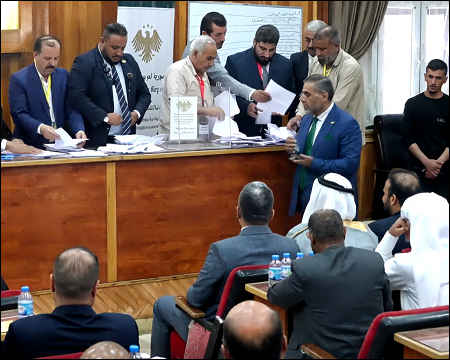
HASAKA,— Voting took place Sunday in Syrian Kurdistan (Rojava), the predominantly Kurdish regions of northeastern Syria, to select representatives for the country’s transitional parliament after an agreement earlier this year to integrate the areas into the central government.
The ballot was part of a process launched last year that has faced criticism from opponents who describe it as undemocratic.
Members of local committees throughout Syria have been voting to choose lawmakers for the assembly, which will serve a renewable mandate of 30 months.
Interim President Ahmed al-Sharaa is expected to appoint 70 members to the 210-seat parliament.
The remaining representatives are being selected by local committees that were appointed by the electoral commission. The commission itself was appointed by Sharaa.
State news agency SANA reported that Sunday’s vote involved seven representatives for sections of Hasakeh province.
Two additional seats in the area were filled without a vote because only two candidates sought the positions.
Voting was also underway for two parliamentary seats in the Kurdish-majority city of Kobane, also called Ain al-Arab, in Aleppo province.
In January, authorities in Damascus and Kurdish groups agreed to integrate Kurdish civilian and military institutions into the Syrian state.
During the civil war, the Kurds established a semi-autonomous administration across large areas of northeastern Syria.
The model emphasizes direct democracy, gender equality, secularism, and environmental sustainability. It has been widely recognized for advancing women’s participation in politics and local decision-making.
Several Kurdish parties criticized Sunday’s vote in a statement, saying the system used to form the legislature amounted to “nothing but an appointment process” and did not represent the “free Kurdish will.”
The parties also objected to the allocation of only four seats in the 210-member assembly to Kurds. They called for a larger number of seats to better represent Syria’s Kurdish population.
About two million Kurds live in Syria, most of them in the northeast.
In October 2025, Syria’s electoral commission announced the names of 119 assembly members out of the 140 positions to be filled through the voting process. Damascus has exclude the Kurds.
At that time, seats remained unfilled in Kurdish-held parts of Raqa and Hasaka provinces and in the Druze-majority province of Sweida because of what officials described as security reasons.
After Sunday’s vote, only Sweida, which is allocated three seats, will remain outside the process.
The situation follows sectarian violence in Sweida in July last year and tensions between Damascus and Druze leaders, including Hikmat al-Hijri, regarded as the Druze figure opposed to Damascus.
Last week, Hijri called for autonomous administration in Sweida and for the “right to self-determination.”
(With files from AFP)
Copyright © 2026 iKurd.net. All rights reserved.
Related posts:
 The Resurrection (Ba’ath) Party – Before the Iran-Iraq War
 Business with ISIS – Updated
 The SDF–Damascus deal: A gamble over keys to Kurdish homeland
 Syria withdraws forces from Druze city of Sweida after Israeli strikes
 Turkey: Nato’s Islamic State Member
 Kurdistan Parliament: Empty Seats, Stolen Salaries
 Syria: The Truth Lies Buried beneath an Edifice of Lies
 Syria picks parliament, excludes Kurds and Druze
 Syrian Kurds reject parliament appointments
 Syria: The Hijacking of the Arab Spring: From ISIS to Hayat Tahrir al-Sham