

Saudi Arabia-Pakistan-Turkey defense pact equals NATO Article 5, Fidan says
MECCA, Saudi Arabia,— Saudi Arabia, Pakistan and Turkey signed a joint defense pact on Friday, drawing together three major Sunni Muslim nations at a time when Iranian missile strikes have rattled Gulf oil producers.
Since February 28, 2026, when the United States and Israel launched a major strike on Iran, Tehran and its allies have fired on Saudi Arabia and other Gulf states and blocked energy shipments from the region.
Called the Mecca Joint Defense Agreement, the deal aims to build up collective deterrence against outside aggression.
It states that an armed attack on any one of the three countries will be treated as an attack on all of them, the nations said in a joint statement.
The statement did not spell out exactly what each country had agreed to do, leaving unclear how far the pact would push any of them toward military action on behalf of the others.
Turkish Vice President Cevdet Yilmaz said the deal was not directed at any single country.
A Turkish official said the pact was strictly defensive and would not cancel out any agreements the three nations already have with other states.
Saudi Arabia, Pakistan and Turkey all share worries about growing military assertiveness from both Israel and Iran, as the United States, their longtime partner, struggles to manage unrest that has helped push up energy prices worldwide.
Abdulaziz Sager, who chairs the Gulf Research Center, a think tank based in Saudi Arabia, called the signing a moment of strong political symbolism.
He said three of the most influential states in the Muslim world are meeting at a time of deep uncertainty, showing that regional and middle powers are more willing to work together on security.
He added that the three-way framework could raise the diplomatic and defense standing of all three countries and help build a security system led more by the region itself.
Turkey fields NATO’s second-largest military force. Saudi Arabia holds Islam’s two holiest sites and ranks among the world’s leading oil exporters. Pakistan is the only Muslim-majority country with nuclear weapons.
Rayed Krimly, Saudi deputy minister for public diplomacy, wrote on social media that the agreement does not amount to a military alliance or a sectarian grouping, and said it has no link to nuclear ambitions or an arms race.
Pakistan signed a separate mutual defense pact with Saudi Arabia last year but has not taken military action against Iran despite Tehran’s strikes on the kingdom.
Pakistani officials have also downplayed talk that its nuclear arsenal could be extended to allies, saying last year that nuclear weapons were not part of the Saudi arrangement.
Both Pakistan and Turkey have backed a Saudi-led plan for a maritime coalition to guard regional shipping lanes and energy routes.
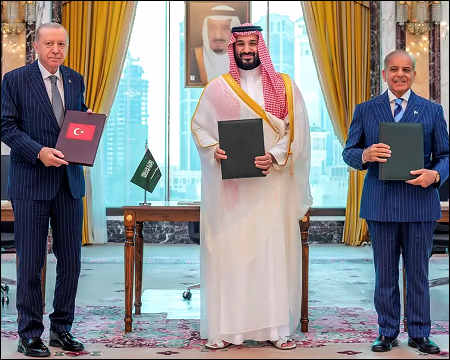
Saudi Crown Prince Mohammed bin Salman, Turkish President Tayyip Erdogan and Pakistani Prime Minister Shehbaz Sharif signed the pact Friday in Mecca, capping nearly a year of talks first reported by Reuters in January.
The region has been unsettled since Islamist extremist group Hamas attacked Israel on October 7, 2023.
Israel has fought a war in Gaza, sent troops into southern Lebanon, taken territory in Syria and carried out two rounds of airstrikes on Iran.
Iran, in turn, has struck Saudi Arabia, Kuwait, Bahrain, Qatar, the United Arab Emirates, Oman, Jordan and Israel.
Turkey and Pakistan have largely avoided direct attacks but want to see the fighting cool down for the sake of their own security and economies.
Burcu Ozcelik, a senior research fellow on Middle East security at the RUSI think tank, said the pact is meant to offset Iranian influence and strengthen deterrence against Israel, not to set up a clash with Tehran.
She said the goal runs in the opposite direction.
Pakistan has trained Saudi forces for decades, and Turkey and Pakistan have swapped warships and training planes. Saudi Arabia buys many of its drones from Turkey.
Pakistan has sent roughly 8,000 troops, along with jets, drones and an air-defense system, to the kingdom, and has opened talks with Kuwait on security help in return for energy cooperation.
Israeli Prime Minister Benjamin Netanyahu’s office had no comment. India’s foreign ministry said it was tracking the pact closely. Iran gave no immediate response.
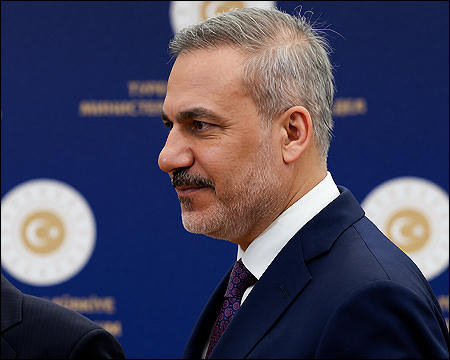
Mecca defense pact equals NATO Article 5, Fidan says
Turkey’s foreign minister said Saturday that a new defense agreement works just like NATO’s Article 5, where members promise to defend each other if one is attacked.
Hakan Fidan stressed that the pact is not aimed at Iran or any other country.
Fidan told Turkey’s official Anadolu news agency that the alliance is simply a commitment to help protect its three member nations.
He also said Turkish President Recep Tayyip Erdogan wants to expand the group, with Egypt mentioned as a possible new member.
When a member faces attack, the allies will discuss how much help to provide and in what form, Fidan explained. The agreement doesn’t target any nation as long as no member nation comes under attack, he added.
The article was update on August 8, 2026.
(With files from Reuters)
Copyright © 2026 iKurd.net. All rights reserved.
Related posts:
 Business with ISIS – Updated
 What makes a good NATO ally? The Case of Turkey
 The Resurrection (Ba’ath) Party – Before the Iran-Iraq War
 Turkey: The Psychological War Against the Kurds Through the PKK – Part I
 Turkey: Nato’s Islamic State Member
 Behind the Veil of Turkey’s ‘Zero Problem’ Policy – A Kurdish Perspective
 “ISLAMBUL”
 Saudi Arabia, Pakistan sign defense pact after Israel strikes Qatar
 Syria: A ‘Caliphate’ by Any Other Name — Would Smell the Same
 Pakistan’s Policy blunders have turned the Taliban into an adversary