

RIYADH,— Saudi Arabia and Pakistan signed a new defense pact late Wednesday, marking a significant expansion of a long-standing military partnership at a time of shifting security dynamics in the Middle East. The deal comes just a week after Israeli airstrikes in Qatar unsettled regional alliances.
According to officials, the agreement formalizes years of discussions between Riyadh and Islamabad and builds on decades of cooperation. Both sides emphasized that the pact was not directed against any single nation.
“This is a comprehensive defensive agreement that encompasses all military means,” a senior Saudi official told Reuters. He added that the arrangement was meant to institutionalize deep-rooted ties rather than respond to any specific event.
Pakistan, the only Muslim-majority country with nuclear weapons and home to the Islamic world’s largest standing army, has repeatedly stressed that its arsenal is intended solely as a deterrent against India.
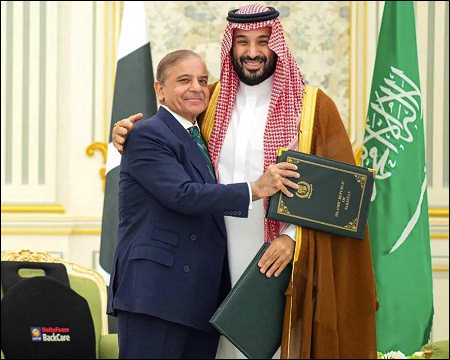
The agreement was signed in Riyadh by Pakistani Prime Minister Shehbaz Sharif and Saudi Crown Prince Mohammed bin Salman, the kingdom’s de facto ruler. Pakistan’s army chief, Field Marshal Asim Munir, also attended the ceremony.
In a statement, Sharif’s office said the pact commits both countries to treat any attack on one as an attack on both. Pakistani state television broadcast images of Sharif and Mohammed bin Salman embracing after the signing.
The deal strengthens a partnership anchored in religion, strategy and economics. Saudi Arabia, home to Islam’s holiest sites, has long hosted Pakistani troops.
Currently, between 1,500 and 2,000 Pakistani soldiers are stationed in the kingdom, offering training and operational support to Saudi land and air forces.
Riyadh also provides vital financial assistance to Pakistan. In December, Saudi Arabia extended a $3 billion loan aimed at stabilizing Islamabad’s foreign exchange reserves.
The new agreement comes after Pakistan fought a short border conflict with India in May. India, also a nuclear power, has been monitoring the deal.
On Thursday, Indian foreign ministry spokesperson Randhir Jaiswal posted on X that New Delhi is aware of the pact and will review its implications for regional security.
Saudi officials stressed that the kingdom intends to maintain strong relations with India despite the new pact. “Our relationship with India is more robust than it has ever been,” the senior Saudi official said. “We will continue to grow this relationship and seek to contribute to regional peace.”
The timing of the agreement coincides with heightened tensions following Israel’s airstrikes in Doha on September 9.
The strikes targeted Hamas leaders during talks on a possible Gaza ceasefire mediated by Qatar. The move angered many Arab governments.
Qatar has faced multiple attacks in the past year, including strikes by both Israel and Iran. The violence has prompted Gulf states to reassess their security arrangements amid concerns about the reliability of the United States as a long-term guarantor.
Israel is widely believed to maintain a nuclear arsenal but follows a policy of ambiguity, neither confirming nor denying its weapons program. Pakistan, by contrast, has openly declared its nuclear capabilities, though it maintains they are intended only as a deterrent.
(With files from Reuters)
Copyright © 2025 iKurd.net. All rights reserved
Related posts:
 This is how the Saudis deal with bullies
 Pakistan Army: An Expert in Deception
 Pakistan’s Policy blunders have turned the Taliban into an adversary
 Why Israel’s attack on Hamas in Doha outraged Qatar?
 Pakistan Has Lost Control in Balochistan
 Saudi Arabia to host 2034 FIFA World Cup
 Trump meets Sharra, vows to lift sanctions on Syria
 Trump hosts Saudi crown prince Mohammed bin Salman at the White House
 Pakistan Should Realise That Taliban is Out of its Orbit
 The New Great Game: An Impending Danger with Serious Global Implications