

Dr. Amir Sharifi | Exclusive to iKurd.net
A political revolution is occurring in Rojava in northeastern Syria after the integration and dissolution of the Syrian Democratic Forces (SDF). A new generation of youth who have studied Kurdish for 12 years now face an official decree from the transitional Syrian government that Kurdish can only be taught for three hours.
The language practices have changed both aesthetically and ethically as waves of thousands of demonstrators at the beginning of the new academic year refuse to attend Arabic classes; the students sing the Kurdish national song “Oh, Enemy,” speaking of resilience, persistence, and resistance. They sing a familiar national song, composed by Younis Rauf in prison in 1938.
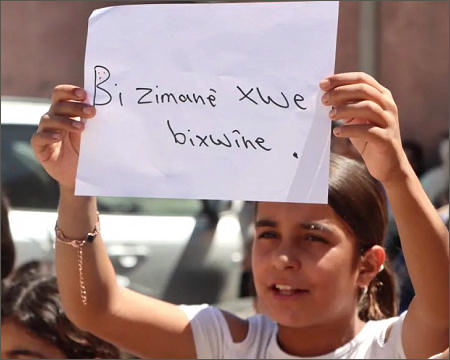
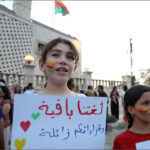
Social media images permeate as students, teachers, and parents congregate in front of schools, and thousands of demonstrators of various age groups in Qamishlo, Kobani, and Hasaka participate in rallies and refuse to attend classes. Kurdish was once banned, and speakers of the language would be imprisoned for using the language in Syria.
Now, more than 400,000 students who have learned Kurdish express new ways of being in the world. They share freely their ideas and dreams—a world that must reckon with the force of linguistic freedom. They want a radical change in their history to heritage and heritage to identity in Rojava (northeastern Syria).
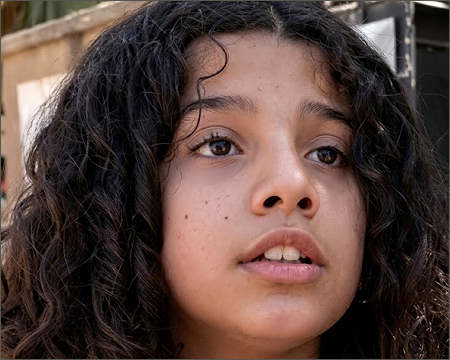
A 10-year-old child, Noor Gohar from Qamishlo in Rojava, or Northeastern Kurdistan in Syria, captures the imagination of all in a Rudaw interview as she addresses a linguistic fact eloquently: “As a child, I reject the proposal; as Kurds, we come into this world, it is our right to learn, to use our own language, not only [for] special topics but all, not only one year but up to the university,”
“We have the right to study Kurdish. I hope that we learn in Kurdish and that Kurdish becomes an official language both in elementary [school] but in the whole Syria…. I love Kurdish as my family fostered in me the love of Kurdish. It is the language of my ancestors: Faqi Tayran’s and Mullah Jaziri’s poetry and mysticism, Mastura Ardalan’s poetry and history, Maryam Khan, the vocalist, Muhammad Arif, Jagar Khwin and Abdulla Pashew, poetry, and Jaladat Badr Khan, the linguist and creator of the modern Kurdish Latin alphabet.”
The revolution in Rojava is uplifting linguistically as a great many pupils and students in various cities, in opposition to the new decree of the Ministry of Education, refuse to attend the new academic year. They want Kurdish to be recognized constitutionally; they have indeed learned a new way of learning about their identity. They rise above linguistic abstractions and do things with their mother tongue; this is the first time that so many youths appreciate the beauty of their language in social actions.
Rosev, about 11 years old, a resident of Amudia near Qamishlo, sobs as she wipes her tears, reflecting on the implications of this decision: “If I had to go back and start learning Arabic from scratch, it would be incredibly hard—and I am not alone.
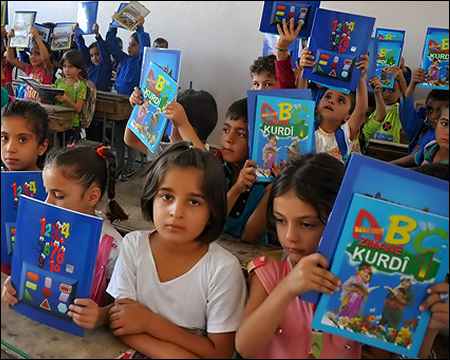
All my friends are going through the same thing; we have studied in Kurdish in Northern Syria (Rojava). I have a message for Kurdish officials in Rojava: we know these are difficult times, and we know sacrifices must be made—but we ask only one thing: do not let the Kurdish language be one of them….” An old man, Arshak Baram, argues this is the beginning of integration or forced assimilation.
A sign of linguistic revolution is also found among the youth in collaboration with their teachers in Zirkan, Hasaka, Kobani, and elsewhere. They want official recognition of Kurdish after rejecting the decision of the Ministry of Education.
In Hasaka, teachers held a sociocultural event where signs such as “Kurdish is our identity,” “Kurdish is our history,” “Language is our culture,” and “There is no life without language” were displayed and uttered.
The same process occurred in the city of Zirakan. Women’s Bakery was where the protests began, where participants held slogans such as “I want nothing but the Kurdish language” and “Education in your mother tongue is a legitimate right.” This event was reiterated by paying tribute to martyrs who gave their lives for the language and human rights of others.
According to Channel 8, which captures a vibrant rally and interviews with some of the demonstrators: “We want our school; we want our own teachers. I have studied Kurdish for 11 years. I have no objection to Arabic and English as foreign languages.” Another student stated: “We go out every day and are not leaving the streets. We demonstrate every day until we achieve the right to use our own language, until we get our rights as human beings.”
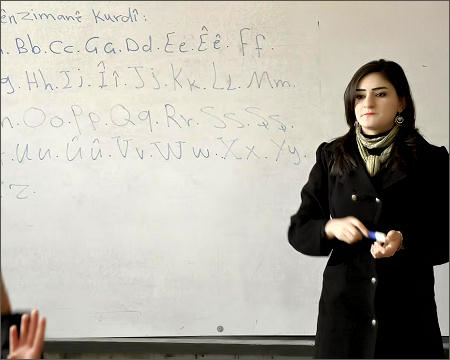
“We want to study our own language in an equal state. I am a Kurd and I cannot study Arabic. I do not understand Arabic. I do not. If an Arab were to study in Kurdish, would they do it? They could not.” Hamida Mohammed observed through Rudaw: “We laughed, played, and cried and joined school using our mother tongue; how did they change it to a foreign language overnight? The decision will never be implemented as we will not accept it.”
The Kurdish language rights revolution began a long time before UNESCO declared Cultural Diversity Day on February 21, 2001. Kurdish is spoken by 15% to 20% of the population in various areas in Rojava in Syria; it deserves to be enshrined in the constitution of the new Syria. The Kurdish youth, in their revolution, have discursively brought heritage to personal and communal levels; our world needs more equitable dynamics of both past and present, the present speaking of the past.
Our world needs linguistic equity, diversity, and equality as upheld in the UN. Mother-tongue education ensures this equity and inclusive development and empowers cultural and cognitive development. This is where a new vision is born, where the linguistic hegemony of dominant languages is seriously challenged by the speakers of those languages as well.
Demonstrators stress not only that Kurdish is a tool of communication and a foundational source of knowledge but also a component of historical identity, deep-seated in the cradle of civilization, where Jaladat Badirkhan used Latin characters to write Kurmanji in 1932. This is where history echoes an ancient memory and re-echoes the current revolution.
Dr Amir Sharifi, a lecturer at California State University, Department of Linguistics, Long Beach, and Co-Director of the Kurdish Human Rights Advocacy Group ( KHRAG), Los Angeles.
The opinions are those of the writer and do not necessarily represent the views of iKurd.net or its editors.
Copyright © 2026 iKurd.net. All rights reserved
Related posts:
 The Resurrection (Ba’ath) Party – Before the Iran-Iraq War
 Arabic fades in Iraqi Kurdistan as English takes over
 Syrian Kurds fight to keep their schools amid Damascus power push
 Business with ISIS – Updated
 The Rojava Revolution Has Lessons for Western Feminism
 Syria: Revisiting The Caesar Torture Victim Photographs
 Syria: The Hijacking of the Arab Spring: From ISIS to Hayat Tahrir al-Sham
 Turkey: Nato’s Islamic State Member
 Martyrs for Millionaires: The Black-Market Politics behind the Theft of Syria’s Oil
 Syria: The Truth Lies Buried beneath an Edifice of Lies