

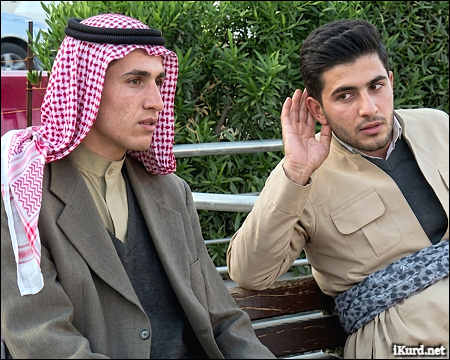
Kurdish youth have built a life with zero Arabic, no Arabic songs, no Arabic dramas or movies, no Arabic news, no interaction with Arab tourists
SULAIMANI,— Although Arabic is the official language of Iraq, and Kurdish students study it from the primary level in schools across the Kurdistan Region, most still do not learn it even after completing university.
A university professor says, “Learning English has taken the place of Arabic in the Kurdistan Region.”
Rêkar Mariwan, 24, who graduated last year from the College of Administration at the University of Sulaimani, says that he studied Arabic for more than 12 years, yet even now he does not understand it or speak it.
He said, “Even now, I still don’t understand Arabic grammar. I can’t tell the difference between verb forms, particles, vowels, or the hamza. When I speak, I mix up feminine, masculine, and dual forms. Honestly, it’s a difficult and unpleasant language. Kurdish and Arabic are very different and far from each other, and even many of their letters are not similar. No matter how much I tried, I couldn’t learn it.”
He added, “Maybe the problem is that my friends and I don’t have any exposure to Arabic in our daily lives. We don’t listen to Arabic songs, we don’t watch Arabic dramas or movies, our news sources are not in Arabic, and we don’t interact much with Arabs. That’s why it’s hard to learn Arabic through a study program when we only try to pass exams.”
Rêkar is just one example of thousands of Kurdish students and young people in Kurdistan who, despite studying Arabic, do not really know the language, unlike their parents and grandparents, who grew up under Ba’ath rule and learned Arabic for various reasons.

Hassan Al-Dulaimi, a 40-year-old Arab man from Anbar who has lived in Sulaimani city for several years, learned Kurdish out of necessity for work. Not only does he understand Kurdish, but he also speaks it.
“He said, “From what I have noticed, many Kurds over the age of fifty know Arabic, because most of them either served in the military or studied in institutes and universities in Baghdad, Mustansiriya, or Mosul, and they had daily contact with Arabs.”
“Most of them also listened to famous Arab artists like Umm Kulthum, Mayada Al-Hanawi, and Kadim Al-Sahir.”
“Unlike young people today, who did not serve in the military and did not need to go to Baghdad or Mosul for university, only those who need it for work, such as doctors, traders, or shopkeepers, learn Arabic.”
He added, “In my opinion, the most important factor that makes people learn Arabic is work necessity.”
“For example, I learned Kurdish because most of my work is with Kurds, and I had no choice but to learn it, as I deal with buying and selling daily.”
“Otherwise, there are people who came with me to Sulaimani and still live here but have not learned Kurdish.”
“Often, when buying or making transactions, they ask someone who knows Arabic to translate for them.”
This comes at a time when learning English, due to its widespread use today, has become a basic necessity, especially for Kurdish students and youth to connect with the world. This has also reduced the importance given to Arabic.
Tavge Omar, an Arabic teacher who has been teaching at the high school level for 25 years, points out that all signs indicate a decline in interest in Arabic.
He said, “Young people in Kurdistan today listen to Kurdish singers much more than Arab artists. They no longer listen to Persian or Turkish artists as they used to.”
“They do not watch Arabic dramas, and their interaction with Arabs is very limited. Even though many Arabs have come to cities in Kurdistan, social interaction is still limited, and this has not led to young people learning Arabic.”

He added, “From what I have observed, Arabic is one of the subjects that Kurdish students struggle with in both basic and high school levels, and they do not get high grades in it. This generation is more focused on learning English than Arabic.”
Experts in the field of the Arabic language, in addition to these factors, also point to several other reasons for the weakness in learning Arabic in the education system of the Kurdistan Region.
Ata Abdulqadir, an Arabic language expert and university professor, points out that one sign of the lack of interest in Arabic among Kurdish youth is that in recent years, the number of Kurdish students willing to study Arabic at university has dropped to nearly zero.
This is because learning this language is not a necessity in today’s job market, and there are no longer enough job opportunities, such as becoming an Arabic teacher in the Ministry of Education.
He said, “In contrast, in recent years, dozens and even hundreds of kindergartens, schools, institutes, and private universities have opened in the Kurdistan Region where the main language of instruction is English, not Kurdish or Arabic.”
“This is because English today is a global language, and most science, technology, and the internet are in English. It is also the most important tool for communication with the outside world.”
“This is now the case in the education systems of most countries, even if English is not their official language. This has led to English replacing Arabic in the Kurdistan Region.”
This Arabic language expert, regarding why Kurdish students do not learn Arabic, points out that there are many reasons, from the curriculum and teaching methods to the school environment, class time, and students’ motivation to learn.
He said, “Research results show that, unfortunately, although high school graduates spend eight years studying this language, and then most of them study Arabic for four more years at university, they still cannot speak it.”
“Clearly, presenting grammar and language rules in a purely theoretical way is not only ineffective, but it also makes students tired and causes them to lose the desire to learn the language. They begin to see it as difficult.”
He added, “Solving the problem of learning Arabic is not only the responsibility of the Ministry of Education. Media channels can also play an effective role in this area, which has not been noticeable in Kurdistan in recent years.”
“One of the biggest weaknesses in both teaching and learning is poor communication, meaning speaking and listening, which leads to not learning grammar, phonetics, and proper sentence formation.” he concluded.
This report, by Mohammed Hawzhin, was translated from Awene newspaper from Kurdish language.
Copyright © 2026 iKurd.net. All rights reserved.
- Arabs, foreigners can own property in Sulaimani, court says - October 23, 2026
- Who’s Really Arabizing Kurdistan? It’s Not Baghdad – Part V - August 10, 2026
- Arabic ads in Iraqi Kurdistan are killing the region’s identity - August 4, 2026
- Who’s Really Arabizing Kurdistan? It’s Not Baghdad – Part IV - August 1, 2026
- Who’s Really Arabizing Kurdistan? It’s Not Baghdad – Part III - July 28, 2026
- Massoud Barzani, Stop Selling Kurdistan to Arabs - July 26, 2026
- Who’s Really Arabizing Kurdistan? It’s Not Baghdad – Part II - July 23, 2026
- Who’s Really Arabizing Kurdistan? It’s Not Baghdad – Part I - July 22, 2026
- Arabic fades in Iraqi Kurdistan as English takes over - May 1, 2026
- Liberation begins when we stop singing their songs, write our own - April 24, 2026
- Hewlêr: Erbil is becoming Al-Arbil and Silêmanî Al-Sulaymaniyeh - April 20, 2026
- One Million Arabs Inside Iraqi Kurdistan, A Strategic Gamble With National Consequences - February 24, 2026
Related posts:
 The Resurrection (Ba’ath) Party – Before the Iran-Iraq War
 Who’s Really Arabizing Kurdistan? It’s Not Baghdad – Part III
 Iraq: Revenge and Corruption
 Who’s Really Arabizing Kurdistan? It’s Not Baghdad – Part V
 Who’s Really Arabizing Kurdistan? It’s Not Baghdad – Part I
 The Suffocation of Iraq Kurdistan
 Voices of a Linguistic Revolution in Rojava, Northeastern Syria
 Why “Arab” should be removed from Middle Eastern state names
 Saddam Hussein was a Friend to the West
 Who’s Really Arabizing Kurdistan? It’s Not Baghdad – Part II