

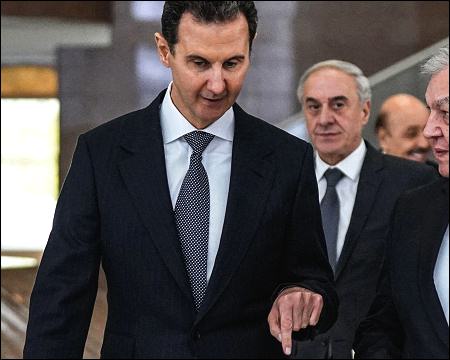
DAMSCUS,— Syrian President Bashar al-Assad stated on Monday that he would consider meeting with Turkish President Tayyip Erdogan under specific conditions focusing on key issues.
In a video released by the presidency in Damascus, Assad emphasized that the crucial aspect is not the meeting itself but its substance.
Relations between Turkey and Syria deteriorated in 2011 following the onset of the Syrian civil war, during which Turkey backed rebel groups seeking to overthrow Assad, whom the Syrian leader regards as terrorists.
Turkey established a “safe zone” in northern Syria, deploying troops there and conducting military operations across the border to counter threats to its national security.
Erdogan recently expressed willingness to invite Assad for talks to mend relations. However, Assad stressed that any potential meeting must address fundamental concerns, particularly Ankara’s alleged support for terrorism and the withdrawal of Turkish forces from Syrian territory.
“The basis for the meeting must be addressing the root causes of the issue: ending support for terrorism and vacating Syrian lands,” Assad asserted, underscoring these as pivotal to resolving their differences.
Assad indicated openness to constructive initiatives aimed at enhancing bilateral ties but insisted on clarity regarding the meeting’s agenda beforehand. He highlighted that a meeting without addressing core issues would hold little significance.
The remarks from Assad come amid tentative diplomatic gestures between the two countries, pointing to a potential shift in their long-standing adversarial relationship.
This isn’t the first time where Assad has rejected talks with Erdogan. In March 2023, Assad stated that he would only consider meeting Erdogan once Turkey had completely withdrawn its military from northern Syria and returned the region to its pre-war condition.
Ankara has launched multiple military operations into northern Syria since 2016, taking control of significant Kurdish territory and penetrating up to 30 kilometers into Syrian territory. These actions primarily targeted the Syrian Kurdish YPG militia, which is supported by the United States.
The first Turkish military intervention occurred in 2016, east of Afrin, to prevent the YPG from expanding its influence and linking Kobani and Hasaka in eastern Syrian Kurdistan with Afrin in the west.
In January 2018, Turkish armed forces, alongside Syrian mercenary fighters, conducted a military campaign to expel the YPG from Afrin, culminating in March 2018 with the capture of the Kurdish city. This operation saw Turkish and Syrian rebel flags raised in Afrin, while a statue of the Kurdish hero Kawa, revered as a symbol of resistance among Kurds, was removed.
An additional Turkish incursion in 2019 targeted the YPG in Syrian Kurdistan, sparking international condemnation and leading several countries, including Finland and Sweden, to impose restrictions on arms sales to Turkey.
Human rights organizations and displaced Kurdish families have accused Ankara-backed Syrian Islamic mercenary fighters of severe abuses, including executions, property seizures, and looting along the border.
The Autonomous Administration in Syrian Kurdistan, led by the PYD and widely respected globally, operates under a secular, decentralized self-rule system. This administration emphasizes principles such as gender equality, direct democracy, and environmental stewardship.
Since its establishment in 2013, the PYD, the political arm of the YPG, has formed three autonomous cantons—Jazeera, Kobani, and Afrin—in Syrian Kurdistan. In 2016, these semi-autonomous regions were united into a federal region. Turkey’s military actions in January 2018 targeted Afrin, resulting in the expulsion of the YPG by March 18 with support from Syrian Islamic fighters.
On September 6, 2018, the Democratic Autonomous Administration of North and East Syria was declared in Ain Issa. This administration has since been tasked with implementing democratic confederalism across municipalities and regions in North-East Syria.
The PYD, supported by its military wing YPG/YPJ, is renowned for its effectiveness in combatting the Islamic State (IS) in Syria. The United States has provided arms to the YPG, which forms the core of the Syrian Democratic Forces (SDF), the de facto military of the autonomous Kurdish administration in Rojava. These forces have successfully liberated large areas of Syria from IS, including their final stronghold in Baghouz in March 2019.
Despite these victories, Kurdish forces continue to detain approximately 12,000 suspected IS members in Kurdish prisons since 2019. The conflict against IS has been costly for the Kurds, with over 11,000 male and female fighters killed in the five-year campaign to eliminate the IS “caliphate” that once spanned Syria and Iraq, an area comparable to the size of Great Britain.
(With files from Reuters and AFP)
Copyright © 2024 iKurd.net. All rights reserved
Related posts:
 Business with ISIS – Updated
 The fate of the Christian community in Afrin, Syrian Kurdistan
 Turkey: Nato’s Islamic State Member
 What makes a good NATO ally? The Case of Turkey
 The Resurrection (Ba’ath) Party – Before the Iran-Iraq War
 Interview with Kurdish hostage, Huseyin Baybasin
 The Syrian Problem is Turkey – Part I
 Turkey: The Psychological War Against the Kurds Through the PKK – Part I
 The Syrian Problem is Turkey – Part II
 “ISLAMBUL”