

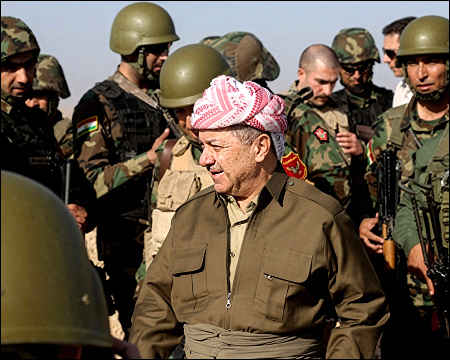
ERBIL, Iraqi Kurdistan region,—Tribal leader and the head of Kurdistan Democratic Party, Massoud Barzani, indirectly rejected reports suggesting potential restrictions on his Kurdish paramilitary Peshmerga forces’ weapons under Iraqi state authority, as Baghdad pushes to bring armed factions under central government control.
“For some time now, due to the particular political situation that has emerged, some parties have been speaking about the Peshmerga’s arms and presenting incorrect interpretations and false opinions on the matter,” Barzani said in a late Wednesday statement posted on X.
Barzani said it is “necessary for everyone to remember that the Peshmerga was born from the blood, suffering, and tears of the people of Kurdistan.”
He added that the Peshmerga’s “weapons are not merely pieces of iron, ammunition, or tools of war,” describing them instead as symbols of “history, sacrifice, dignity, and belief.”
Earlier Wednesday, Iraqi Prime Minister Ali al-Zaidi ordered the formation of a committee to oversee measures aimed at separating political parties and armed factions from the Shitte Popular Mobilization Forces, or PMF, and bringing weapons under state control.
A statement from Zaidi’s office said the move is in line with the Iraqi constitution and existing laws, aimed at strengthening state authority and reinforcing security and stability.
Bakhtiyar Mohammed, secretary-general of the Peshmerga “ministry”, told reporters that if such a proposal is formally raised, “the parliament and the government must first be informed so that legal reviews can be conducted and legal experts consulted.” He said the issue should be addressed through law, not through discussions and meetings.
The Peshmerga forces in Iraqi Kurdistan are not unified. They are considered paramilitary forces taking orders directly from the ruling parties, the KDP, led by Massoud Barzani, and the Patriotic Union of Kurdistan, or PUK, led by the Talabani family.
The two major Kurdish political parties each maintain independent security structures. Under the federal constitution, the Kurdistan Regional Government holds the right to maintain internal security forces.
However, the KDP and PUK separately control additional Peshmerga militia units, separate police forces under nominal Kurdish Interior Ministry oversight, and each operates its own Asayish internal security service and independent intelligence agencies.
The PMF was established in 2014 following the rapid advance of the Islamic State group, known as ISIS, which seized large portions of northern and western Iraq.
It was created in response to a religious decree, known as a fatwa, issued by Iraq’s most senior Shiite religious authority, Grand Ayatollah Ali al-Sistani.
At its founding, the PMF served as an umbrella organization covering roughly 70 predominantly Shiite armed groups, with approximately 250,000 members.
Although the PMF is a state-funded institution, it notably includes factions widely believed to be linked to the Iran-led Axis of Resistance.
Since what sources described as the outbreak of the Iran war in late February, those factions have carried out attacks against alleged U.S. targets in the region in support of Tehran, frequently operating through shadow groups under the banner of the Islamic Resistance in Iraq, or IRI.
Baghdad’s latest effort reflects ongoing tensions over armed group governance across Iraq, where state authority over armed factions, including Kurdish forces, remains a deeply contested political issue.
(With files from Rudaw)
Copyright © 2026 iKurd.net. All rights reserved.
Related posts:
 The Mustashar and the Jash – A View from the Position of ‘Iraqi National Unity’ on the ‘Descendants of Treason’
 Iraqi Kurdistan: The Emperors’ New Clothes
 Business with ISIS – Updated
 The Suffocation of Iraq Kurdistan
 Iraq Under The ‘Resistance’ Muqawama Militias
 Iraqi Kurdistan – “Sold Out!” – Part II
 Iraq: A State of Surveillance – Databases, Tracking And Corruption
 For Sale: Iraqi Kurdistan, a Nation and Its Values
 Iraqi Kurdistan has better individuals than Massoud Barzani to lead
 Kirkuk – Wars of Deception And Elections