


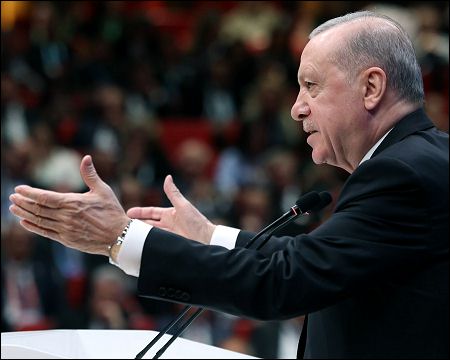
ANKARA,— Turkish President Recep Tayyip Erdogan disclosed on Tuesday that he has established a panel of legal experts to begin work on drafting a new Turkish constitution, a development that has raised alarms among critics who suggest it could enable him to stay in power beyond his term’s scheduled end in 2028.
Erdogan, who has controlled Turkish politics for more than twenty years as both prime minister and president, maintains that constitutional reform is necessary because the current document was written following a 1980 military intervention and still carries traces of military oversight, despite numerous amendments.
Speaking to regional party administrators, Erdogan said, “As of yesterday, I have designated 10 legal experts to commence their duties, and through this undertaking, we will advance with groundwork for the new constitution. For 23 years, we have continually proven our honest desire to complete our democracy with a new civilian and liberty-oriented constitution.”
The existing constitutional framework bars Erdogan from running for re-election unless early voting occurs or legal modifications are implemented. Critics interpret the constitutional drive as Erdogan’s method to sidestep term limitations and maintain his hold on power.
Erdogan, whose administrative approach has grown more authoritarian through the years, has dismissed suggestions that the new constitution serves his personal political interests.
According to his comments from the previous week, “we desire the new constitution not for ourselves, but for our country.”
The ruling party and its nationalist partners currently lack the parliamentary majority required to enact constitutional reform.
Some political analysts believe the government’s recent initiatives to resolve the decades-old conflict with the Kurdistan Workers’ Party (PKK) group represent part of a broader strategy to secure support from pro-Kurdish parliamentary members for the constitutional overhaul.
The Kurdistan Workers’ Party began its armed campaign in 1984 against Turkish government forces, seeking increased self-rule for Kurdish communities in Turkish Kurdistan (Bakur).
Turkey’s constitution does not formally recognize Kurds as a distinct group, despite Kurds representing approximately 30 percent of Turkey’s 85 million citizens.
The long-running battle between Turkish military forces and Kurdish fighters has resulted in more than 40,000 deaths on both sides over the past four decades.
Legal restrictions also target the Kurdish language itself. Turkish courts have prosecuted people for using three Kurdish letters – X, W, and Q – which do not appear in Turkey’s official alphabet.
This constitutional push emerges several months after authorities arrested Ekrem Imamoglu, Istanbul’s popular mayor and significant Erdogan challenger, on corruption-related charges.
While officials maintain Turkey’s courts operate independently without political interference, many observers consider his detention politically motivated.
The arrest has sparked widespread public demonstrations calling for his release and protesting what opponents describe as Turkey’s retreat from democratic governance during Erdogan’s tenure.
(With files from AP)
Copyright © 2025 iKurd.net. All rights reserved
Related posts:
 Business with ISIS – Updated
 The Resurrection (Ba’ath) Party – Before the Iran-Iraq War
 Turkey: The Psychological War Against the Kurds Through the PKK – Part I
 Turkey: Nato’s Islamic State Member
 “ISLAMBUL”
 Interview with Kurdish hostage, Huseyin Baybasin
 Welcome To The ‘Islamic Republic Of Turkey’
 What makes a good NATO ally? The Case of Turkey
 Iraqi Kurdistan – “Sold Out!” – Part II
 No democracy in Turkey – ‘insulting Kurdishness’: Interview with Sheri Laizer