


A Warning Regarding Sulaimani
Sirwan Gharib | Exclusive to iKurd.net
Translated by iKurd.net from Kurdish Awene Newspaper
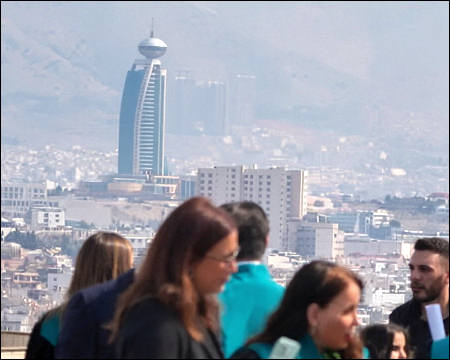
At a time when the Kurdistan Regional Government needs to form a government that prioritizes peace, reconciliation, and social progress, the (Kurdistan Democratic affiliated) media and social media platforms are instead being used for a psychological war against the people of the city of Sulaimani.
Linking the violations committed by a faction within the Patriotic Union of Kurdistan to the city of Sulaimani, attacking the city from every direction, and accusing intellectuals and writers of being “without principles” has become part of the ruling party’s media narrative.
This strategy is carried out through thousands of paid pages funded by public money and resources, with the main goal of changing the image and identity of Sulaimani from a vibrant city with principles, intellectuals, brave writers, and honest journalists into a city that supposedly has no principles, where “the intellectuals, journalists, and writers have been bought, and the people have lost hope.”
They present the situation in our country as if these violations are something unfamiliar, as if such torture has never existed in the Kurdistan Region or Iraq, and as if these disgusting acts have never been discussed before.
This media narrative of the ruling party seeks to influence Kurdish public psychology by portraying Sulaimani, known as a city of culture, art, and strong Kurdish identity, as if it has lost its role and has now become a city “without principles” and “a field of fear.”
Creating networks of attacks and defamation within the ruling party’s narrative is fully active, and we are not far from the truth if we say that during the civil war, the same methods of smearing and discrediting political opponents were used. Instead of separating the people from the Patriotic Union of Kurdistan, this narrative constantly works to present them as one inseparable unit, as if they share the same thinking and goals.
A large portion of the people of Sulaimani have, for many years and election after election, punished the PUK as the main authority in the area and criticized it. Many have withdrawn their genuine support from it. This happened at a time when their alternatives were the Gorran Movement and New Generation, not the Kurdistan Democratic Party, whose political history goes back 80 years.
This narrative from the ruling party not only fails to separate the people of Sulaimani from the PUK, but also connects the mentality of a torturer to the psychology of the people of Sulaimani. Their major media outlets and affiliated pages continue spreading this anti-Sulaimani rhetoric in their own style and language.
Alongside this narrative, some writers, without realizing it, become carriers of this party rhetoric directed against Sulaimani. Through self-glorification and the use of angry and offensive language that does not align with the ethics of writing and intellectualism, they attack the people of Sulaimani and describe the city as “cowardly,” “dishonorable,” and “without principles.”
This narrative relies on a massive media machine, and some writers unintentionally become the voice of that machine, using phrases such as “Sulaimani is cowardly, dishonorable, without principles, and lacking courage.” Such writers are driven by a kind of intellectual narcissism whose main goal is to become national heroes while acting as sellers of insults, without caring which party narrative or regional hatred they have fallen into.
The violation is clear and obvious. We all demand accountability and punishment for those who committed illegal and inhumane acts, and we stand against the ugly treatment inflicted upon Hama Rash and any other human being whose dignity and humanity were violated. Despite the confusion surrounding the case, even if someone had been killed during the conflict, there are laws and punishments for that. Yes, together we must all oppose such treatment, period. Not through insults and humiliation, but through criticism, even if that criticism is harsh.
The role of writers and writing should serve the public interest, not personal self-glorification. Writing should be based on criticism, not insults and humiliation. Writing should become a force for reforming a system that, from Zakho to Basra, remains vulnerable to abuse, where the personal mood of the torturer or the motivation of personal hatred and party resentment controls actions.
It is unfortunate that some writers claim neutrality, yet when evaluating crimes they do not act according to the principle of truth. Instead, they publish according to personal closeness and political alignment, saying things such as, “with respect to some respected patriotic writers.” This changes the writer’s essential role from protecting public awareness to serving party ideology.
When a writer remains silent before one authority and only raises their voice against another side, this means that, at the intellectual and moral level, they have sacrificed truth and reality for personal interests. One of the harmful roles of such writers is portraying one region entirely as hell and another as paradise. This false evaluation neither reveals the reality of society nor contributes to reform.
Writing based on hostility toward a city is often not in the service of awareness or knowledge, but in the service of creating a fabricated image. Many times, under the name of criticism, some writers wound an entire city without realizing they are participating in the process of oppression and collective punishment against it, because their position is not based on principles, but on the desire to appear heroic at the expense of breaking the dignity and honor of others.
Alongside this intellectual hypocrisy, there is also a planned attack against independent intellectuals aimed at damaging their role and position and weakening their social and political influence. In my opinion, the blind generalizations against intellectuals as social and intellectual actors in these articles directly contribute to this systematic assault that has poisoned and degraded the intellectual atmosphere of our society.
This article was originally published in the Kurdish language in Awene Newspaper on May 18, 2026.
The opinions are those of the writer and do not necessarily represent the views of iKurd.net or its editors.
Copyright © 2026 iKurd.net. All rights reserved.
Related posts:
 The Resurrection (Ba’ath) Party – Before the Iran-Iraq War
 The Kurdish Diplomacy: Historical, Political, and Legal Explanation – Book Review
 The Kurdish Mind – Critique of Practical Reason – Book review
 Business with ISIS – Updated
 Turkey: The Psychological War Against the Kurds Through the PKK – Part I
 The Mustashar and the Jash – A View from the Position of ‘Iraqi National Unity’ on the ‘Descendants of Treason’
 Iraq – The Cynical Swindle
 Ethics Hammer and the Fall of Sacred Illusions
 Anfal – The Black Stain on Iraqi History Spreads
 Iraq: Revenge and Corruption