


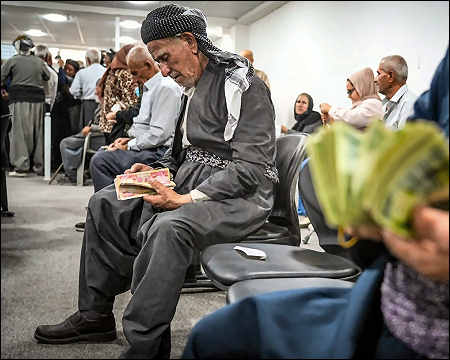
The Kurdish economy in the intensive care unit amid salary delays, Economist says
ERBIL,—The Kurdistan Region’s economy is experiencing a severe economic slowdown as a dispute over public-sector wages between Baghdad and Erbil continues, leaving salaries delayed for months and markets stalled.
Economists and local analysts warn that the crisis has cut across nearly every sector, drying up liquidity and weakening household spending power.
Experts say that while resuming payments is critical, it will take more than wage transfers to restore confidence and revive the local economy.
Salaries at the Center of the Standoff
Public-sector salaries, which support a large share of households in the Kurdistan Region, have become the focus of disagreement between the federal government and the regional administration. The delays have not only left employees struggling with debts and reduced income but have also disrupted the financial circulation that sustains trade.
Economic expert Othman Karim told Baghdad Today that the Kurdistan region’s markets are “clinically dead.” He said they will need at least six months of consistent salary disbursements to regain activity across all sectors.
Multiple Sectors Affected
According to Karim, entire areas of the economy have been frozen, including real estate, gold trading, cars, electronics, livestock, and luxury goods. These markets depend directly on household incomes, and without steady wages they cannot function.
“Once employees begin receiving salaries again, most will first repay debts, then focus on necessities,” he said. “Only later will they return to purchasing non-essential or high-value goods.”
This step-by-step pattern, analysts note, shows how the crisis has forced families to reorganize spending priorities, which has both economic and social consequences.
Liquidity Shortage
The lack of salaries has led to a sharp liquidity shortage. Businesses in retail and services have reported steep declines, landlords are facing falling demand, and luxury items have seen sales collapse. Complaints about overdue bank loans and personal debts are spreading, especially among middle-income households.
Independent estimates suggest the Kurdistan Region is losing between one and two percent of its monthly gross domestic product as a result of frozen wages. Small and medium-sized businesses have responded by reducing staff, adding to underemployment and increasing reliance on public support systems.
Path to Recovery
Karim argued that sustained salary payments are essential to recovery, but not enough on their own. He called for a broader plan that includes financial incentives such as easy-access loans and measures to strengthen private-sector activity. Such steps could create jobs and help restart commercial flows.
“The government and parliament must prioritize salary funding and establish mechanisms for handling non-oil revenues to avoid similar crises,” he said. Disputes over oil and budget transfers between Baghdad and Erbil have often disrupted wage disbursements in the past, especially during periods of political or financial strain.
Beyond an Administrative Step
Analysts underline that restoring salaries is not just an administrative act of transferring money. It represents a restart of the wider economic cycle that sustains businesses, households, and government revenues.
Sectors dependent on regular liquidity, such as property, vehicles, and gold, are expected to take months to recover even after payments resume. Observers say that maintaining trust is just as important as resuming salaries, since confidence drives both spending and saving behavior.
“The Kurdistan economy will not recover overnight,” Karim noted. “What is required is a steady commitment to disbursements, alongside policies that give the private sector space to grow and citizens the ability to plan their finances.”
Without such measures, experts warn, the region risks recurring cycles of stagnation that could undermine both economic performance and public trust.
Corruption
The Kurdistan Region of Iraq is described by watchdogs and critics as one of the most corrupt parts of the country, with billions of dollars in oil revenues reported missing.
According to Kurdish lawmakers, oversight groups, and leaked documents, large sums of money from the region’s oil sales cannot be traced. Critics also say millions of barrels of crude have been smuggled by authorities in Kurdistan.
The ruling Barzani family, which dominates political life in the region, has long faced accusations of nepotism. Observers and opponents allege that the family has amassed vast personal wealth from the oil trade instead of directing revenues toward public services and citizens’ needs.
(With files from Baghdad Today News | Agencies)
Copyright © 2025 iKurd.net. All rights reserved
Related posts:
 Iraqi Kurdistan – “Sold Out!” – Part II
 Iraq – The Cynical Swindle
 Business with ISIS – Updated
 Saddam Hussein’s Enemies: Paving the Road to the Invasion of Iraq
 The Resurrection (Ba’ath) Party – Before the Iran-Iraq War
 Iraq comes full circle: The rehabilitation of Abd al-Karim Qasim
 The Misleaders: Corrupt, Filthy Rich, and Proud of it
 The Suffocation of Iraq Kurdistan
 The Mustashar and the Jash – A View from the Position of ‘Iraqi National Unity’ on the ‘Descendants of Treason’
 Iraqi Kurdistan – “Sold Out!” – Part III