


ANKARA,— Shaswar Abdulwahid, leader of the New Generation Movement (NGM, Newey Nwê) of Iraqi Kurdistan, visited Turkey on Tuesday and held discussions with Turkish Deputy Foreign Minister Nuh Yilmaz, according to a statement from Turkey’s Ministry of Foreign Affairs.
Abdulwahid’s trip comes at a pivotal time for the Iraqi Kurdistan region, as political factions continue to negotiate the formation of a new regional government. Sources suggest that Abdulwahid’s visit was primarily focused on garnering support from Turkey for the NGM as political parties in Iraqi Kurdistan work to finalize a new government.
Observers believe that the meeting also touched on wider regional concerns, particularly the political implications of the ongoing conflict in Syria. Turkey’s military actions against Kurdish forces in Syrian Kurdistan (Rojava) have drawn significant criticism, and the issue was reportedly part of the conversation between Abdulwahid and Turkish officials.
Critics have raised concerns about Abdulwahid’s silence regarding Turkey’s military operations against the Kurds in northern Syria, as well as in the Kurdistan region of Iraq. This silence has sparked frustration, especially considering the heavy toll Turkey’s military actions are taking on Kurdish civilians.
Sources familiar with the visit indicated that Abdulwahid discussed the political landscape in Iraqi Kurdistan and the need for cooperation between Turkey and the NGM, especially in the context of security concerns along the Sulaimani border region. The discussions reportedly aimed to align the party’s objectives with Turkey’s strategic interests in the region.
Erdogan meets Masrour Barzani, says no room for ‘terrorist’ groups in Syrian Kurdistan
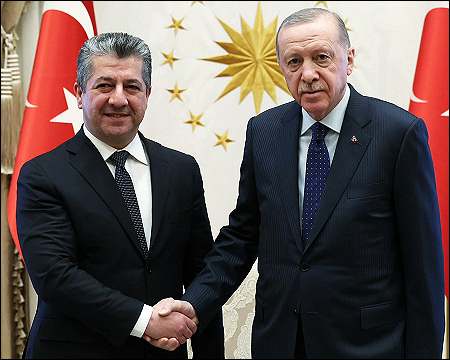
Meanwhile, Masrour Barzani, the deputy leader of the Kurdistan Democratic Party (KDP) and the Prime Minister of the Kurdistan Regional Government (KRG), which has strong ties with the Turkish government, arrived in Turkey on Tuesday for separate high-level talks. Barzani met with Turkish President Recep Tayyip Erdogan, Foreign Minister Hakan Fidan, and other high-ranking officials.
Erdogan warns against the presence of Kurdish forces in northern Syria, stating there is no room for “terrorist organizations” in the country under its new Islamist leadership.
Erdogan made the remarks during talks in Ankara with Masrour Barzani, according to a statement from the Turkish presidency.
The Turkish leader emphasized that Turkey is committed to preventing further instability in the region as Syria transitions under its current government.
“There is no place for terrorist organizations or their affiliates in the future of a new Syria,” Erdogan said, signaling Turkey’s ongoing concerns about Syrian Kurdish groups near its border.
According to the KRG, the meetings will focus on strengthening bilateral relations and discussing the latest regional developments, including the situation in Syria.
The developments come amid ongoing tensions in Syria, where Turkey and its Syrian Islamist mercenary fighters have intensified their military operations in the Kurdish-majority northern regions following shifts in the Syrian conflict.
In December 2024, Salahaddin Bahadin, the Secretary-General of the Kurdistan Islamic Union (KIU), also visited Turkey to meet with Turkish Deputy Foreign Minister Nuh Yilmaz and Ambassador Ali Reza Gunay.
Kurdish media has criticized Abdulwahid and the New Generation Movement for not publicly addressing Turkey’s actions in Kurdish regions.

In December 2024, and in contrast to many political factions in Iraqi Kurdistan, Bafel Jalal Talabani, President of the Patriotic Union of Kurdistan (PUK), voiced full support for Kurdish forces in Syrian Kurdistan.
Talabani emphasized the need for solidarity, stating, ‘We stand with our brothers and sisters in Rojava at this critical moment.’ He also noted that lasting peace in the Middle East depends on respecting Kurdish rights and finding a fair resolution to the Kurdish issue.
Turkey extended its flight ban on Monday on Sulaimani International Airport in Iraqi Kurdistan. The Turkish government said the move was in response to growing activities by the Kurdistan Workers’ Party (PKK) in the Sulaimani governorate, which is controlled by the PUK.
As Turkish military operations continue to affect Kurdish communities in both Iraq and Syria, there is increasing pressure on Kurdish political leaders to take a stronger stance on the issue.
Copyright © 2025 iKurd.net. All rights reserved
Related posts:
 Business with ISIS – Updated
 What makes a good NATO ally? The Case of Turkey
 Turkey: Nato’s Islamic State Member
 The Resurrection (Ba’ath) Party – Before the Iran-Iraq War
 Iraqi Kurdistan – “Sold Out!” – Part II
 “ISLAMBUL”
 Turkey: The Psychological War Against the Kurds Through the PKK – Part I
 Interview with Kurdish hostage, Huseyin Baybasin
 Syria: A ‘Caliphate’ by Any Other Name — Would Smell the Same
 Martyrs for Millionaires: The Black-Market Politics behind the Theft of Syria’s Oil