

The Rape Of Raqqa: How The City Became The Capital Of ISIS In Al Sham (The Levant).
Sheri Laizer | Exclusive to iKurd.net
One would do well to ask what the fight against ISIS was ultimately for and how much it cost in blood as well as economically – for it to be surrendered to Ahmed al-Sharaa’s Salafists anew.
Sheri Laizer, September 28, 2026
Introduction
This analysis is not intended to be exhaustive but to provide an overall digest focused on Raqqa’s suffering since the Arab Spring began to ignite in Syria on March 15, 2011.
With the passing of time, it is too easy to overlook and/or forget key developments from the period in question and view them instead through the distorted lens of hindsight. By the time the ‘Arab Spring’ touched Syria, it had gathered enormous popular momentum as a springboard for the overthrow of potentates too long in power that had failed to deliver on promises of change.
Demands of demonstrators focused on decentralisation, revenue sharing, democratic openings, human rights and societal benefits beyond the privileges enjoyed by the ruling establishment and the structures of governance largely dependent on patronage, and nepotism.
At the outset of the Arab Spring in Syria, the demands were much the same, but the movement was swiftly infiltrated and then overtaken by Islamic extremists. Their goal was the establishment of an Islamic state and the imposition of Sharia law, not a civil state. The call to jihad was not a beckoning to help create any kind or liberal democracy or achieve social equalities. It aimed at the overthrow of the secular order.
Syria had been secular throughout the Assad dynasty. Even the fierce crushing of the 1980s rebellions in Homs and Hama had been about ensuring the Muslim Brotherhood did not gain traction as it was doing in Egypt – its erstwhile partner in the short-lived United Arab Republic (UAR – February 22, 1958- September 28, 1961). Egypt had been sliding into Islamic terrorism under the Muslim Brotherhood in the early 1980s threatening its tourism-based economy. The revolt in Hama of February 2, 1983, was launched by the Muslim Brotherhood in the Sunni majority city.
Brotherhood commandos attacked Ba’ath government institutions, party offices and military personnel. The army fought the Brothers for almost three weeks leaving much of the town destroyed and between 10,000 – 40,000 people killed and disappeared. The rebellion was put down with extreme force and the secular government then carried on as before.
Although now, the Assad dynast is too often referred to as ‘Alawite’, religion and sect were not prevailing influences. Bashar al-Assad was highly educated, Westernised, and married to Asma Fawaz al-Assad, of Sunni origin but born to professional Syrians, her father a diplomat and her mother a cardiologist, living in London. Their children’s upbringing was secular and academic.
Bashar had come to power unwillingly in the year 2000. His late brother, Basel, had been groomed for the role but had been killed when his fast car wrapped itself around a tree in January 1994. Political billboards before his death had shown Hafez al-Assad flanked by his two eldest sons.
At the time of Basel’s demise, Bashar was training as an ophthalmologist in London whereas his brother was part of the security apparatus running the country. When Bashar was named successor, he brought optimism over technological reform and a short-lived Damascus Spring ensued, long forgotten ever since as the promises withered like blossom in the heat of the sun.
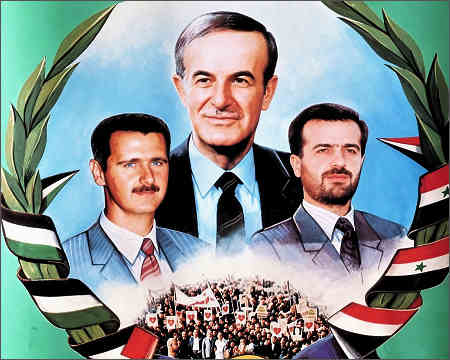
Basel would most likely have maintained military power. So too, their youngest brother, Maher, already part of the military. The least politically involved brother, Majd, was never part of state or military affairs, and their sister, Bushra, a trained pharmacist was married off to the former Chief of Staff in the consolidation of family power. That said, no member of the ruling elite exhibited any religious sympathies in public. Religion and state were kept separate, and faith remained a private matter.
Typical art of its era celebrating President Hafez al-Assad and his two eldest sons and heirs
The Arab Spring was swiftly hijacked by religious extremists taking advantage of the popular momentum for democratic change. Democratic values are being trampled underfoot by the ‘new’ regime.
Raqqa
Syria’s 6th largest city, Raqqa, was a bustling place that sits astride the Euphrates River, some 80 km south of the Turkish border. Turkish acquiescence in the filtration of would-be jihadists throughout the conflict played a highly significant role in the territorial gains ISIS (and other jihadist groups) enjoyed at the time.
In November 2011, eight months into the wider revolt, Bashar al-Assad had paid a comfortable visit to Raqqa and received the support of the sheikhs from the 14 major clans who were paid handsomely. However, that support eroded soon after the militias moved into the city who also paid the Sheikhs for support. An article written retrospectively recalled the previous warnings:
Assad led the Eid prayer, then listened to a sermon by Sheikh Abdul Azim Shekho at Raqqa’s Rehab al-Nour mosque. Shekho delivered a political sermon exhorting Assad and the people of Syria to resist the same international intervention that had “destroyed” Iraq, “burned” Libya, and split Sudan into two states. He then turned to Assad: “The secret is to go forward with all the people behind you,” he urged. “God will guide your footsteps.”10 Shekho, a Sufi, would be murdered by ISIS in Raqqa two and a half years after those remarks…1
Raqqa city lies on both banks of the river. It had been a Hellenistic, Roman, then Byzantian city before becoming the capital of the Abbasid Caliphate under Harun al-Rashid between 796 and 809 CE after he moved the capital from Baghdad in 796. It developed from a twin city, Rafiqa.
Their strength largely arose through Raqqa’s proximity to the Byzantine frontier. He cultivated strong relations with the rulers of the Byzantine Empire and Charlemagne’s Frankish empire yet still undertook military campaigns against Byzantium to secure the borders of the Caliphate and exert dominion across the region.2
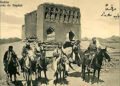
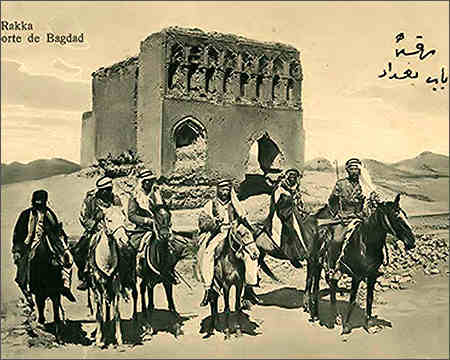
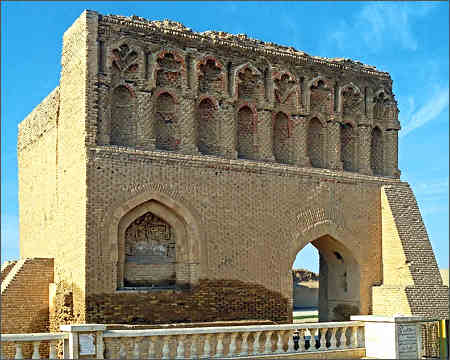
The ancient walls of the Abbasid stronghold remained largely intact like surviving structures of the same period in Iraq. One of the Raqqa gates is named the Baghdad Gate – Bab al-Baghdad. The distance to Baghdad, the city of Harun al-Rashid is 858 km.
Raqqa had a population of over 220,000 people at the beginning of the new millennium according to the 2004 census. Although the majority belonged to Arab tribes from within a Sunni historical tradition, Turkmen, Kurds, Circassians and Christian Armenians also lived there as in other large cities in the Levant and Middle East. Numerous Armenians were descendants of the families that had fled Turkish genocide in 1915. The Arab Ujayli tribe exhibited great tolerance, and compassion towards them and supported their need for asylum.
The Assyrian Christians were also part of the diversity – a pluralism swiftly extinguished by the extremist ideology of the Islamist militias that rapidly imposed all manner of restraints and demanded taxes (jisya) from them. Their churches were vandalised or taken over to function as ISIS headquarters and prisons.
Western journalists were also kidnapped, ransomed, or tortured and several killed by the FSA, ISIS, Ahrar al-Sham and al-Nusra. In previous articles I have cited the testimony of Theo Padnos, an Arabic speaking American writer and reporter held and tortured by Al Sharaa and his men for almost two years, including a very harsh stint in the group’s Raqqa torture chambers. Unlike other Western prisoners and hostages whose paths he crossed inside Syria, a ransom (for an undivulged figure) eventually secured his liberty from al-Nusra. Others were not so lucky.
Kayla Mueller
American aid worker, Kayla Mueller, became the toy of al-Baghdadi as attested by her fellow hostages and even al-Baghdadi’s first wife, Umm Sayyaf, who claimed the rapes were love. In fact, Mueller had become just another sex slave. Al Bagdhadi’s widow was charged in Iraqi custody for her part in the crimes the group committed. Mueller had been kidnapped from Aleppo in August 2013 and was killed in captivity during airstrikes on Raqqa in February 2015.3 ISIS attributed the strike to Jordan, which naturally it rebutted.
ISIS claimed Mueller was held in this house outside Raqqa when it was struck during an aerial bombardment by Jordan.4
The fall of Raqqa to jihadist groups
The city itself had first fallen on March 4, 2013, to armed anti-government forces that were increasingly being taken over by jihadist groups. Most of the Islamist fighters came from outside the area and originated from Hama and Idlib and were concentrated in the ranks of Ahrar al-Sham.5
The Turkish-backed misnomer Free Syrian Arm (FSA) and Jabhat al-Nusra under Abu Mohamed al-Jolani’s command also surged into the area, sometimes co-operating with each other, at other times seeking ultimate dominion. The democratic opposition was swiftly taken over by the jihadists.
Al Nusra set up a Sharia court in the sports centre, flying its black banners.6 Al Nusra fighters clad in black patrolled the streets, smashed alcohol in two Christian owned shops and consigned the former governor to prison taking over the Governor’s Palace, and the city’s institutions.7
The radical Egyptian cleric, originally of Turkmen origin, Sheikh al-Dhahabi, (Hani Dahab) once an ISIS mufti, who now promotes Niqab for female students and employees, was brought in to preside over the court and lead Friday prayers under al-Nusra after defecting from ISIS. 8
A Telegraph report from May 12, 2013, once opined of al-Nusra:
Their new-found power is such that it is changing international calculations over the conflict. After first being discouraged from action by their presence in rebel ranks, Britain now has a revised diplomatic strategy.
David Cameron put it to Russia’s president Vladimir Putin on Friday and will discuss it this week with a nervous President Obama in Washington.
Mr Cameron’s officials now feel Jabhat al-Nusra has to be defeated by actively supporting the less militant rebels, including with arms. Many of Jabhat’s rival militias are being marginalised in cities like Raqqa across the north. On Tuesday, Britain will seek to have Jabhat al-Nusra added to an official list of sanctions at the United Nations.
In taking Raqqa two months ago al-Qaeda achieved its greatest coup in the war to date: it was the first provincial capital to fall outright to the rebels, and allowed Jabhat to assume a leadership role over a large swathe of north-eastern Syria, to the Iraqi border…
Part of it is money. Jabhat al-Nusra has always been well-funded compared to other militias – most people assume due to wealthy backers in the Gulf, though few have been able to track down the lines of the money supply…9
This is the man that was welcomed to the UK to address the government’s Chatham House think tank last year.
Radicalised rulership
After al-Nusra and Ahrar al-Sham formed a pragmatic alliance having gained military control of the city early in 2013, their fighters increasingly used the city’s resources for themselves paying local tribes for support just as the Assad dynasty had done. Some of the tribes had supported the government all through the opening of the civil war but the extremists imposed Sharia law by force and through fear but did little to help or protect the local people whose numbers swelled with incoming IDPs to as many as 800,000 people.10
They seized control of the adjoining oilfields in Deir Ez Zour selling enough for cash.11 They smuggled the town’s goods across to Turkey for profit, stripping the factories, recalled a witness to the Telegraph’s reporter, David Rose.12 Members of the Farouq Brigade (Liwa al-Farouq) from Homs were present along with the Lions of the Caliphate Battalion and Ahfad al-Rasoul, all in pursuit of an Islamic state. The Farouq Brigade ran the border crossing gates with Turkey including at Tal Abyad.
More than 70 groups operated across the country, several composed almost entirely of foreign fighters including Saudis, Chechens, Uzbeks, diverse north Africans and mixed brigades.13 On the government side, Hezbollah and the Iraqi Shi’a Resistance (Hashd and independent militia) groups were equally committed to victory within a Shi’a crescent alliance.
The jihadists had operated an aid and supplies corridor through the border crossing with Turkey at Tal Abyad. Turkey closed the border gate in 2014 from the Turkish side at Akçakale. The Turks had partially opened the border crossing at Tal Abyad in 2019 for access by government and military officials during military operations against both ISIS and the Kurdish fighters of the SDF/YPG as well as allowing some trade and goods across and access for funerals.14
ISIS seized Raqqa from Al-Sharaa’a Nusra Front before going on to take Mosul in Iraq. The government’s Al Tabqa military airbase lay just outside Raqqa.15 ISIS overran the base taking soldiers hostage, torturing and executing them despite their begging the government to negotiate their release.16

Abu Bakr al-Baghdadi reclaims the caliphate of Harun al-Rashid
A tweet in circulation from when al-Baghdadi was reported injured in early November 2014. It was untrue..17
In November 2014, Jabhat al-Nusra’s base and prisons were finally taken over by rival extremists loyal to ISIS and al-Nusra and the smaller groups driven out. The earlier alliance entirely fragmented.18
After sweeping across the border into Iraq from Syria and taking control of Mosul in June 2014 Abu Bakr al-Baghdadi (19originally named Ibrahim Awad al-Badri from Samarra in Iraq) proclaimed the Caliphate of the Islamic State there but Raqqa was to become its new capital. Raqqa was strategically and ideologically important to him. He saw himself as bringing about the renewal of the Caliphate recalling the Caliphate of Harun al-Rashid. He stayed there with his first wife, Umm Hudaifa in the summer of 2014. She later gave an account of the period when held prisoner in Iraq.20
Munitions and equipment seized in Mosul as the Iraqi Army fled without putting up a fight was then transported back into Raqqa and elsewhere across Syria. As early as July 2014 conditions had become extremely unstable with the violence exploited in the streets by militia commanders unchecked. By the end of the year Raqqa had become one of the most dangerous parts of Syria to live in.21
US-led strikes on ISIS positions included Raqqa, peaking at the end of 2014 into early 2015. Living conditions rapidly deteriorated. Bread shortages soon began and overall power supply was inadequate. Raqqa was one of the main bread baskets of Syria, but ISIS lacked specialist managers and engineers able to run the city effectively. The group held on there until October 2017 but by that stage, the extremists had lost the support of the local population.
Overall, ISIS was perceived to have become detrimental to the revolution and did not represent local people. Crime rates and kidnapping had risen to new heights even when under the control of al-Nusra.
By 2017 many residential neighbourhoods of Raqqa had been destroyed in fighting. ISIS lost its seat in the autumn. The US-backed SDF then gained control after heavy fighting. It was reported that by then 80% of the city had been reduced to rubble.
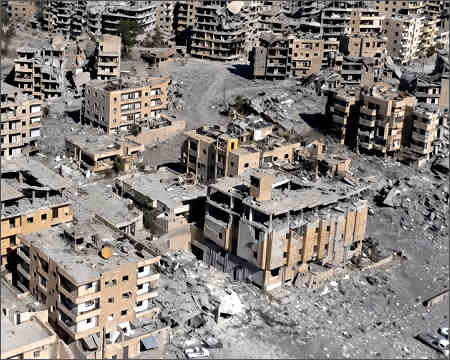
The SDF declared complete liberation from ISIS which had held the city for the past three years. Mines and explosive devices had to be removed before locals could begin to return and assess the destruction to their homes and livelihoods. They had fled even as ISIS fighters surrendered to the YPG Kurdish forces. ISIS had run the stadium as a prison, the last bastion to be abandoned. See the ABC video of the destruction soon after liberation from ISIS:
While some Arab tribes and locals first supported ISIS in Raqqa, disenchantment swiftly set in over the militias’ excesses.
“We didn’t fight and protest Assad to then have these fanatics,” explained a secular activist, already aware of religious hardline militias. He continued, “one thing that keeps us activists hopeful is our society. Although Raqqa is a tribal area, people are open and tolerant. Even those who are a bit conservative, are very open-minded compared to Jabhat al-Nusrah or ISIS. So, our society will resist [their] imposed regime.”2322
The border crossing gate at Tal Abyad into Turkey wasn’t re-opened until 12 years later in May 2026 after the SDF had been obliged to surrender control to Al Sharaa’a forces.
Al Hol Internment Camp in al-Hasakeh Province
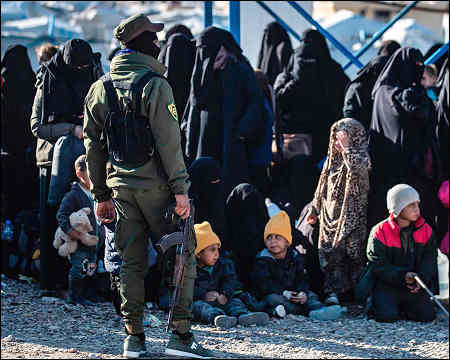
Al Hol lies about 170 km west of Raqqa as the crow flies but just 13 km from the Iraqi border and entry to the Yazidi area of Sinjar via the flashpoint town of Rabia. It was first established as a refugee camp for Iraqi refugees fleeing the turmoil of the 1990 Gulf War.
It re-opened at the time of the US invasion of Iraq for the same purpose. Between 2016-2017 it received a new wave of Iraqi’s fleeing from ISIS and Shi’a militia revenge attacks in Nineveh governorate. 23
In 2019 the camp was transformed into a holding tank for ISIS-allied families after the fall of Baghouz in SE Syria on March 23 of that year, at one point holding as many as 73,000 people. It was closed down in February 2026 after the Kurdish SDF forces were pressurised into giving up control of the camp along with the rest of Raqqa, Der ez-Zor and much of al-Hasakeh.
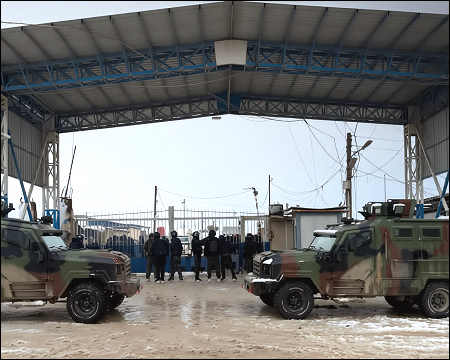
ISIS loyalists outside the camp engaged in battle leading to the escape of detainees when the site as left without guards in the change-over of responsibility. The New Arab cited official data from the camp that thousands of detainees escaped due to the sudden lack of surveillance.
The camp’s population had been 23,407 people the day before the government takeover, including 6,280 foreigners from more than 40 nationalities. The SDF said its forces had been “compelled” to withdraw from the camp. As they had already lost the support of many of their Arab fighters during the HTS take-over of the country, they were left without backing.24
The second Trump administration had already abandoned them as during his first term in office, instead welcoming Ahmed al-Sharaa to the diplomatic fold as a ‘great new leader.’ The smaller Roj camp was located near Derik. It contained suspects accused of links to jihadist groups, many of whom were foreign nationals.
Derik provides access to the Semalka crossing leading across the river to Faysh Khabur in Iraqi Kurdistan. The river represents the border. It has long been the artery feeding arms, oil and US personnel back and forth between the two Kurdish-controlled regions.25
A report published by the Emerald Expert Briefings of October 16, 2017, observed of Raqqa that:
“Some 80% of the city, which was the de facto capital of Islamic State (IS) until its capture by the US-backed Syrian Democratic Forces (SDF), was ruined in fighting and reconstruction efforts have been limited. With 90% of the governorate’s population of tribal origin, the Kurdish-dominated SDF relies on clientelist networks with tribal leaders, all Sunni Arab, to maintain order and garner support.”26
The organisation also made predictions that largely held true until after regime change on December 7, 2024, as below:
Impacts
Local and regional actors will compete for tribal leaders’ loyalty, creating divisions within tribes and clans.
The SDF will retain the support of Raqqa-based tribal leaders.
Tribal leaders who have fled elsewhere will promote dissent in SDF areas of control.
Some youths who sympathise with IS’s cause will cause instability in Raqqa.27
When Islamist militiamen who had gathered under the banner of Hay’at Tahrir al-Sham descended on Hama from their stronghold northwest in Idlib in December 2024, locals old enough to remember the earlier slaughter feared a replay. Hama was Syria’s 4th largest city. It fell swiftly in the end, but 13 long years into the internal conflict that had ravaged the entire country.
Rival Arab tribes and the creation of the Office of Tribes and Clans
The tribes – and there are many – remain very powerful locally. The truce agreement reached on January 18, 2026, under considerable duress between Al Sharaa’s regime and the SDF following violent clashes between their respective forces led to the withdrawal of the SDF from Raqqa and Deir ez-Zour provinces as well as their removal from control over Al Hol camp in al-Hasakeh, as detailed above.
Less publicised has been that this situation ostensibly arose because the Arab fighters in their brigades had largely defected to al-Sharaa. The Arab Center DC usefully analysed it thus:
Importantly, the region changed hands not because Syria’s newly established national army proved more capable, but because Arab tribes switched sides, defecting from SDF military structures and handing the region to the Damascus government on a golden platter. Yet control has not delivered inclusion. Arab tribes that helped the central authority regain control are now largely ruled by outsiders, and many feel that the capital benefits from the region’s natural resources without giving local people their fair share. In consequence, the same grievances about regional inequality that existed under Bashar al-Assad—and that contributed to Syria’s 2011 uprising—are now building up against the new government…
The relationship between this peripheral part of Syria and the capital has rarely been stable. Protesters in the region joined the 2011 uprising against the Assad regime; in 2014, when the Sheitat clan rose up against IS’s attempts to control the al-Omar oilfield, fighting killed as many as 1,000 people. In 2023-24, Ibrahim al-Hefl, one of the sheikhs of the Uqaydat tribe, led an insurgency against the SDF on the grounds that it was seizing the region’s oil while neglecting its people…
Damascus has seized the east, but so far has made no real effort to include it in governance. It rules the three eastern governorates through outsiders, draws on the region’s natural resources, and responds to protests with concessions rather than with inclusion. This relationship risks reproducing the same dynamic that existed between the center and the periphery under the Assad regime. Unless Damascus offers the east a real share of power and revenue, it will recreate the same grievances that led to earlier revolts in this region… 28
In September 2025, Ahmed Al Sharaa established an “Office of Tribes and Clans” in September. Administration was put into the hands of his old combatant, Jihad Issa al-Sheikh, (Abu Ahmed Zakour) with three branches in Aleppo, Hama and Idlib.
France 24 noted: “Strategically placed alongside Aleppo’s Bureau of political affairs, the local branch of the Office of Tribes and Clans has moved into the former premises of the …Its task is to maintain the non-aggression pact between Syria’s former rebels and the Sunni militias that had previously backed the Assad regime, before switching sides during the lightening offensive… in November 2024. It was their change of allegiance that led to the fall of Aleppo, Syria’s economic capital, in just three days, hastening the end of Assad rule…”29
The eastern provinces’ descent into Salafism anew
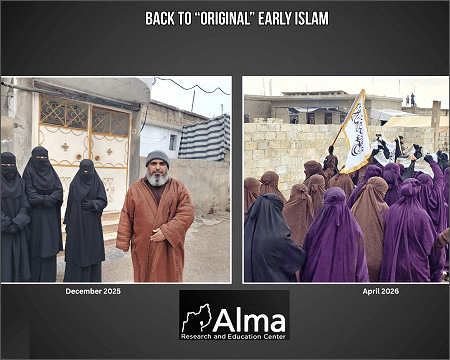
Sheikh al-Dhahabi proselytises extremist Islamic views anew, back where his voice once echoed in the name of ISIS.
Al-Sharaa’s former allies have been rewarded with positions and power. According to the Asma Center’s research, immediately after Kurdish forces withdrew from northeastern Syria and al-Sharaa’s forces deployed in their place, numerous documents emerged showing (Egyptian cleric, Sheikh) al-Dhahabi’s preachers arriving in Raqqa and al-Hasakah alongside al-Sharaa’s soldiers, distributing Qur’an and hadith books, Islamic kits, and bags containing niqabs for local women.30 See, Niqab makes a comeback to Syria’s Universities.
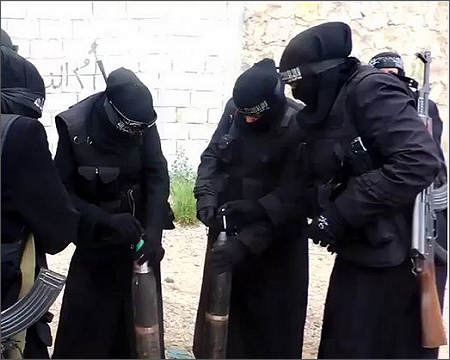
A female ISIS member brigade, the Khansa Battalion, led by Saudi militant, Nada al-Qahtani, once paraded in Raqqa’s streets, all concealed in niqab and brandishing rifles.31
One would do well to ask what the fight against ISIS was ultimately for and how much it cost in blood as well as economically? Equally, what has the Syrian uprising achieved and what has it lost? And, ultimately, are we seeing a Taliban-style clampdown on all manner of freedoms that Syrians had once taken for granted?
A recent poster edict hung in the streets of Damascus equates long hems on men’s trousers that fall below the ankle bone providing a ticket to hell.
The poster reads:
قال رسول الله ﷺ ما أسْفَلَ مِنَ الكَعْبَيْنِ
مِنَ الإِزَارِ فَفِي النَّارِ
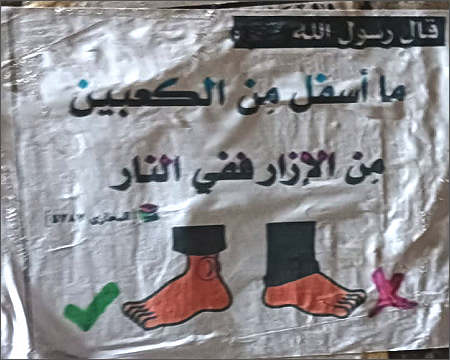
“The Messenger of Allah ﷺ said: ‘Whatever of the lower garment (Izār) is below the ankles is in the Fire.'”
The Hadith “Whatever of the lower garment is below the ankles is in the Fire” is an authentic (sahih) Hadith narrated by Imam al-Bukhari in Sahih al-Bukhari on the authority of Abu Hurairah (may Allah be pleased with him).
Brief Meaning of the Hadith
The lower garment (Izār): Refers to what is worn on the lower half of the body; trousers, robes, and pants are measured by the same rule.
The two ankles (Al-Ka’bayn): The two prominent bones at the joint connecting the lower leg and the foot.
Below the ankles: Whatever part of the clothing extends beyond the ankles and drags towards the ground.
Is in the Fire: A severe warning indicating the prohibition of Isbal (lengthening clothing below the ankles), signifying that the portion of the garment extending beyond the prescribed limit exposes the wearer to punishment in the Fire.
Backwards in time
Clearly such medieval religious pronouncements that the ‘new’ regime neither rejects nor prevents from being made public do not bode well for Syria’s present or future wellbeing. Raqqa was largely rebuilt when under SDF control through the AANES funding sources. Now, it is back in the hands of the duplicitous sheikhs and, increasingly, it seems, the fundamentalists.
1 Asharq al-Awsat, January 6, 2014, Militant Groups Surveil Syrian Sufis
2 https://worldhistoryedu.com/abbasid-caliph-harun-al-rashid-life-reign-accomplishments/
3
4 “There was no word from the Jordanian government on whether its planes had struck Raqqa on Friday. But activists who monitor the Syrian conflict from inside the country said US-led coalition planes hit several targets on the edges and outskirts of Raqqa, in quick succession on Friday.” See more at https://www.ynetnews.com/articles/0,7340,L-4623818,00.html
5 https://www.newamerica.org/insights/how-raqqa-became-capital-isis/revolutionary-rule-in-raqqa-march-2013-november-2013/
6 https://www.telegraph.co.uk/news/worldnews/middleeast/syria/10051207/Under-the-black-flag-of-al-Qaeda-the-Syrian-city-ruled-by-gangs-of-extremists.html
7 Ibid.
8 https://israel-alma.org/is-syria-returning-to-salafi-islam-the-sharia-campaign-of-the-isis-mufti/
9 www.telegraph.co.uk/news/worldnews/middleeast/syria/10051207/Under-the-black-flag-of-al-Qaeda-the-Syrian-city-ruled-by-gangs-of-extremists.html
10 http://www.aljazeera.com/news/middleeast/2013/03/201334151942410812.html
11 Op. Cit. https://www.telegraph.co.uk/news/worldnews/middleeast/syria/10051207/Under-the-black-flag-of-al-Qaeda-the-Syrian-city-ruled-by-gangs-of-extremists.html
12 Ibid.
13 https://www.bbc.com/news/world-middle-east-25460397
14 https://www.institutkurde.org/en/info/latest/turkey-syria-border-gate-to-reopen-after-12-year-closure-15141/
15 https://www.pbs.org/wgbh/frontline/documentary/the-jihadist/
16 https://creativememory.org/chronology/al-tabqa-airbase-massacre/
17 https://www.courrierinternational.com/article/2014/11/10/le-tweet-qui-montre-que-le-calife-de-l-etat-islamique-est-blesse
18 https://www.eip.org/report-on-the-legacy-of-isis-rule-in-northeast-syria/raqqa/
19 https://jamestown.org/new-details-on-the-life-of-iraqs-abu-bakr-al-baghdadi/
20 https://www.bbc.com/afrique/articles/c255ge7j7n1o
21 https://www.newamerica.org/insights/how-raqqa-became-capital-isis/raqqa-isis-capital/
22 Ibid.
23 https://reliefweb.int/report/syrian-arab-republic/camp-profile-al-hol-al-hasakeh-governorate-syria-april-2017
24 https://thearabweekly.com/eu-alarmed-mass-escape-relatives-isis-members-syrian-camp
25 https://dearborn.org/preview/sudden-closure-of-the-faysh-khabour-semalka-crossing-between-the-regions-of-iraqi-kurdistan-and-the-sdf-29575
26 https://www.emerald.com/expert-briefings/article-abstract/doi/10.1108/OXAN-DB239205/471083/Rivals-will-use-tribes-to-destabilise-Syria-s?redirectedFrom=fulltext
27 Ibid.
28 https://arabcenterdc.org/resource/control-without-inclusion-eastern-syria-under-damascus/
29 https://www.france24.com/en/middle-east/20260115-syria-sunni-clans-hold-key-to-stability-ending-sectarian-strife-sharaa
30 https://israel-alma.org/is-syria-returning-to-salafi-islam-the-sharia-campaign-of-the-isis-mufti/#_ftn9
31 https://english.alarabiya.net/News/middle-east/2016/02/28/Baghdadi-appoints-ISIS-female-fighter-to-Syria-battalion
Sheri Laizer, a Middle East and North African expert specialist and well known commentator on the Kurdish issue. She is a senior contributing writer for iKurd.net. More about Sheri Laizer see below.
The opinions are those of the writer and do not necessarily represent the views of iKurd.net or its editors.
Copyright © 2026 Sheri Laizer, iKurd.net. All rights reserved.
Related posts:
 Business with ISIS – Updated
 The Resurrection (Ba’ath) Party – Before the Iran-Iraq War
 Sabotaging Syria
 Hostages to Jihad – Austin Tice, The Long Missing American in Syria – Part One
 Stealing Syria
 Syria: A ‘Caliphate’ by Any Other Name — Would Smell the Same
 Syria: The Hijacking of the Arab Spring: From ISIS to Hayat Tahrir al-Sham
 Turkey: Nato’s Islamic State Member
 Hiding in Plain Sight: Turkey’s ISIS Links, Al-Baghdadi’s Last Refuge and the Jihadist-Controlled “Safe” Zone
 Martyrs for Millionaires: The Black-Market Politics behind the Theft of Syria’s Oil