

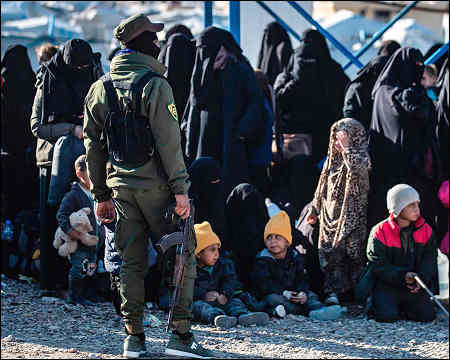
QAMISHLO, Syrian Kurdistan,— The Kurdish-led Syrian Democratic Forces said on Tuesday that they were forced to pull back from Al-Hol camp in northeast Syria, a large detention site holding thousands of relatives of Islamic State fighters, after the Syrian army accused them of leaving the area without protection.
Al-Hol camp is located in Hasaka province and is the largest of several camps and prisons run by Kurdish authorities in northeast Syria.
These facilities hold tens of thousands of people suspected of links to Islamic State. Nearly seven years after the jihadi militant group lost its territorial control, more than 24,000 people are still being held at Al-Hol.
In a statement, the Syrian Democratic Forces said their units had been redeployed to areas near cities in Syrian Kurdistan that face what they described as growing risks and threats.
The group said it had no choice but to shift its forces away from the camp due to security pressures elsewhere in the region.
The SDF also criticized the international community, accusing it of failing to take responsibility for the issue of Islamic State detainees.
The statement said global actors had shown indifference toward a problem that continues to pose security challenges in Syria and beyond.
The withdrawal came as Syrian army Islamist units moved additional forces toward Hasaka province. State media reported that the army had already taken control of neighboring Raqa and Deir Ezzor provinces and was reinforcing its presence in areas long held by Kurdish forces.
Earlier, Syrian state media quoted the army as saying that the SDF had abandoned its duty to guard Al-Hol camp. The military said it would work with internal security forces to enter the area and secure the site.
The defense ministry said it was prepared to assume responsibility for Al-Hol camp and all Islamic State prisoners following the SDF pullout.
The interior ministry said it was taking all necessary steps, in coordination with the international coalition, to preserve security and stability after the change in control.
Jihan Hanan, the director of Al-Hol camp, told AFP in December that the camp housed more than 24,000 people. These included about 15,000 Syrians, around 3,500 Iraqis, and roughly 6,200 foreign nationals from other countries.
An analysis cited by regional observers told iKurd.net that if Syrian government Islamist militias were to gain full control over the camps and prisons, many Islamic State detainees could be released.
The assessment said that government-linked former Islamic State militants could end up overseeing facilities holding members of the same group.
Al-Hol also contains a high-security section for women and children who are neither Syrian nor Iraqi. This section has been a long-standing concern for Kurdish authorities and international partners.
Syrian Kurdish official Elham Ahmad said during an online event that repeated appeals to the US-led international coalition had not received a response.
Her remarks, delivered in Kurdish and translated into English, said calls for intervention remained unanswered.
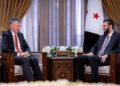
On Sunday, Syrian interim President Ahmed al-Sharaa, former ISIS and al-Qaeda leader, and SDF commander General Mazloum Abdi signed an agreement that includes a ceasefire and plans to integrate the Kurdish administration in north and northeast Syria into the state.
The deal states that responsibility for Islamic State prisoners, camps, and the forces guarding them will be transferred to the Syrian government, which will assume full legal and security control.
Kurdish officials have long urged foreign governments to take back their citizens from the camps. Most countries have repatriated only small numbers, citing security concerns and political pressure at home. Iraq, however, has increased the pace of returns in recent months.
(With files from AFP | Agencies)
Copyright © 2026 iKurd.net. All rights reserved.
Related posts:
 Business with ISIS – Updated
 Syria’s Massacres of Christians, Alawites, Druze, and Shi’as…
 The Resurrection (Ba’ath) Party – Before the Iran-Iraq War
 Syria: A ‘Caliphate’ by Any Other Name — Would Smell the Same
 Sabotaging Syria
 Syrian government starts emptying Islamic State-linked al-Hol camp
 After Kurdish pullout, volatile security blocks UN at Syria IS camp
 Most foreign IS families depart Syria’s Al-Hol camp: Humanitarian sources
 Turkey: Nato’s Islamic State Member
 Syrian gov’t visits camp housing ISIS families after Kurdish deal