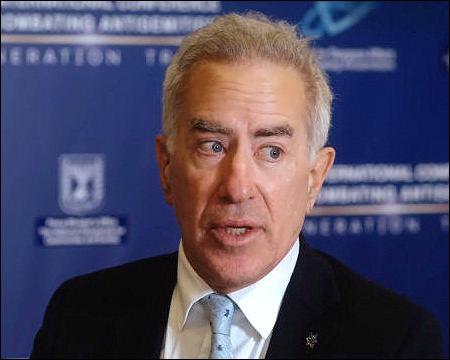
NEW YORK,— A Canadian-Israeli billionaire businessman and president of the World Jewish Congress said in an interview that a global propaganda campaign against Israel has been developing over the past two decades, alleging it is led primarily by Qatar with additional involvement from Iran and China.
Sylvan Adams, speaking in an interview with media founder Stefan Thompson, he described what he called a coordinated international effort aimed at shaping public opinion and influencing institutions across Western countries.
Adams described what he called a coordinated campaign rooted in the ideology of the Muslim Brotherhood and supported by significant financial investment.
According to Adams, the initiative began about 25 years ago and included the establishment of media platforms such as Al Jazeera.
He said the campaign has focused on shaping narratives and building influence within academic, political, and social institutions in the West.
Adams pointed to the rapid emergence of protests following the October 7, 2023 attacks by Hamas in Israel as evidence of coordination.
He said demonstrations appeared in multiple global cities on October 8, including London, Berlin, Sydney, Montreal, and New York.
“These were not spontaneous events,” Adams said, arguing that the protests were organized in advance.
He claimed that participants expressed support for Hamas despite the absence of Israeli military operations at that time.
He said the speed and scale of the protests suggested the presence of established networks capable of mobilizing quickly. Adams described these networks as funded and directed by external actors.
In his remarks, Adams identified Qatar as a central figure in the campaign, citing its financial capacity and international outreach.
He also named Iran and China as additional contributors, though he noted that China’s involvement is driven by broader geopolitical objectives rather than direct hostility toward Israel.
Adams said these actors share a common interest in weakening Western influence. He described their cooperation as strategic, with overlapping goals despite ideological differences.
He contrasted Qatar’s position with that of other Middle Eastern countries that have normalized relations with Israel, including the United Arab Emirates, Bahrain, and Morocco.
Adams said those nations have rejected the ideology of the Muslim Brotherhood, which he described as a form of political Islam.
According to Adams, political Islam promotes a vision that challenges Western governance and social systems. He said the issue should not be viewed solely as a regional conflict but as part of a wider ideological struggle.
He also addressed the role of funding in Western institutions. Adams claimed that Qatar is among the largest foreign donors to U.S. universities and suggested that these contributions are intended to influence academic discourse.
He said similar efforts are targeting younger audiences through education systems and social media platforms.
Adams identified TikTok as one example, arguing that digital platforms are being used to shape perceptions among younger generations.
Adams further described cooperation between activist groups on the political left and Islamist organizations. He referred to this as a “red-green alliance” and said it has expanded in recent years to include a broader range of participants.
He argued that countering such influence is challenging because it operates within legal frameworks, including donations and investments.
Adams called for legal and regulatory responses to address what he described as interference in democratic processes.
On Israel’s response, Adams said the country has been effective in military operations but less successful in communication strategies. He cited actions against Iran and its regional allies as examples of military capability.
However, he acknowledged that Israel and its supporters underestimated the scale of the information campaign. Adams said this has led to difficulties in presenting Israel’s position internationally.
“We did not recognize the extent of this effort,” he said.
Adams also commented on global attention to conflicts, noting that violence in other regions receives less coverage than the Israeli-Palestinian situation. He listed countries including Sudan, Nigeria, Syria, and the Democratic Republic of Congo as examples.
He suggested that the level of focus on Israel reflects bias in international discourse.
At the same time, Adams dismissed claims that Israel controls global systems. He said such assertions are contradicted by the country’s diplomatic and public relations challenges.
“If those claims were accurate, the situation would look very different,” he said.
Adams concluded by urging Western countries to examine what he described as long-term influence operations. He said recognizing these efforts is essential for developing effective responses.
The interview focused on the intersection of geopolitics, media, and public opinion, with Adams emphasizing the role of information in modern conflicts.
Copyright © 2026 iKurd.net. All rights reserved.
Related posts:
 Why Israel’s attack on Hamas in Doha outraged Qatar?
 The 12-Day War: A Tactical Failure, Yet a Strategic Win for Israel
 The Resurrection (Ba’ath) Party – Before the Iran-Iraq War
 Business with ISIS – Updated
 The New Great Game: An Impending Danger with Serious Global Implications
 Iran, a Failed Country by Enemies Within
 Internal Revolt Against Hamas in Gaza Was Already Underway
 Qatar’s 2036 Olympic bid sparks alarms over Islamist agenda
 All prepare for the mini state of Kurdistan!
 Qatar Misused FIFA For Pushing its Extremist Agenda