


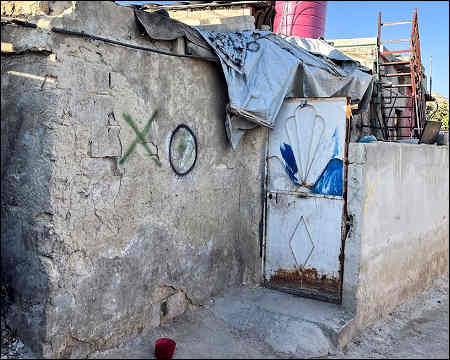
AL-SOMARIA, Syria,— Syrian security forces swept through the Damascus suburb of al-Somaria in late August, leaving behind spray-painted symbols and eviction orders that signaled which families could remain in their homes and which had to leave, residents and local leaders told Reuters.
Armed with rifles, swords and official papers, dozens of officers moved block by block between August 27 and 29. They ordered people to prove legal ownership of their properties, saying the land had been illegally seized by the Assad family decades earlier.
Those who could not provide immediate documentation found large black “O”s painted on their walls along with printed eviction notices. Houses marked with an “X” were deemed safe, though some of those also carried orders to vacate.
Residents said the operation was directed by a senior Interior Ministry commander known as Abu Hudhayfah.
Families described how officers interrogated men about past military service in the Assad army. Several men were detained in a residential building turned into a police post, where witnesses said they were beaten.

Ali Barakat, a lawyer and member of al-Somaria’s neighborhood committee, said he was struck during questioning. “I have lived here for 40 years. My father bought this house to secure a future for us. I will not surrender it,” he said.
It could not be independently confirmed whether the evictions were carried out by force. But residents said panic spread quickly through the community, and most families fled within days, fearing violence similar to what occurred in March 2025 in coastal regions where armed factions killed Alawite civilians.
Al-Somaria, now largely deserted, was once home to about 22,000 people, nearly half of them families of former soldiers, according to the local committee. By early September, only about 3,000 remained.
A reporter visiting on September 3 and again on September 11 described empty homes, unlit streets and few people outside.
The neighborhood’s history reflects the long shadow of the Assad dynasty. In the 1970s, Rifaat al-Assad, brother of then-president Hafez al-Assad, seized the area, previously called al-Balan, and renamed it after his son, Somar.
Many of the houses were distributed to Alawite military families as part of a belt of loyalist neighborhoods built to secure Damascus.
During the August raids, some families presented title deeds, but residents said Abu Hudhayfah dismissed documents dating from the Assad period as invalid. Their homes were still marked for seizure.
Damascus Governor Maher Marwan addressed the incident in a statement on September 3, saying problems in al-Somaria stemmed from “decades of unjust expropriation and corruption under the previous regime.”
He pledged that the current administration would resolve the matter transparently and fairly, without resorting to forced evictions, through legal committees to review land ownership.
Neither the Information Ministry nor the Interior Ministry responded to questions about the raids. The authenticity of the “Public Housing Committee” cited in the eviction orders could not be independently verified.
Abu Hudhayfah, contacted by phone on August 29, declined to comment. A text message on September 2 confirmed he was no longer in al-Somaria, but he gave no further details.
Miloon Kothari, a former United Nations Special Rapporteur on housing, described the events as a “succession of violations.” He told Reuters that forced displacement violates international law. “If the authorities intend to respect global human rights standards, they must address this directly,” he said.
Bashar al-Assad’s overthrow nine months ago created a fragile new government dominated by former members of Hayat Tahrir al-Sham, a Sunni Islamist rebel faction.
The group has incorporated other militias and foreign fighters into its ranks, but violence between sectarian groups continues, leaving Alawite and Druze civilians vulnerable.
Property disputes are now a major test for the new authorities. Over decades, the Assad regime redistributed land to Alawite allies, fueling resentment among displaced Sunni communities. Other districts such as Mazzeh 86 and al-Wuroud were similarly allocated to regime loyalists.
Analysts say that settling these ownership conflicts is critical as the government moves forward with major infrastructure plans. In August, state media announced a $2 billion metro project around Damascus. The design includes a transfer hub and large parking facility in al-Somaria, making control of the neighborhood strategically important.
Moatasem al-Sioufi, executive director of the Syrian group The Day After, said national planning reforms are urgently needed. “Any solution must address informal housing, but not in a way that forces people out overnight,” he said.
The exodus from al-Somaria left the area nearly empty by early September. Security checkpoints were set up at the main entrance, controlling access and keeping outsiders away.
For some in nearby towns, the developments have revived old claims. Residents of Moadhamiyet al-Sham, a Sunni-majority suburb, said their families once farmed parts of al-Somaria before losing the land to Rifaat al-Assad’s forces.
“We abandoned hope of ever reclaiming it,” said Mohammed al-Wawi, who runs a cleaning supply shop in Moadhamiyet al-Sham. “Who imagined the regime would collapse like this?”
(With files from Reuters)
Copyright © 2025 iKurd.net. All rights reserved
Related posts:
 The Resurrection (Ba’ath) Party – Before the Iran-Iraq War
 Syria: Revisiting The Caesar Torture Victim Photographs
 Sabotaging Syria
 Syria: The Hijacking of the Arab Spring: From ISIS to Hayat Tahrir al-Sham
 Stealing Syria
 Business with ISIS – Updated
 Syria: The Truth Lies Buried beneath an Edifice of Lies
 Hostages to Jihad – Austin Tice, The Long Missing American in Syria – Part One
 Syria: A ‘Caliphate’ by Any Other Name — Would Smell the Same
 Syria’s Sharaa forces kill hundreds of Alawite civilians, monitor reports