


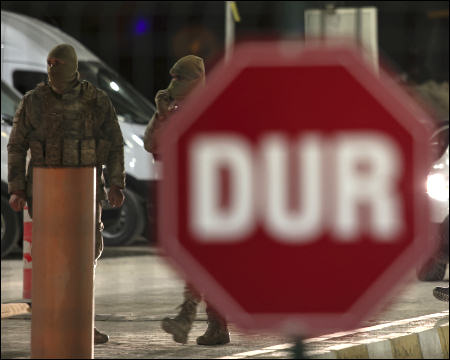
AMED,— Turkish authorities prevented a convoy of aid trucks from reaching the Kurdish city of Kobane in Syrian Kurdistan on Saturday, nonprofit organizations and a Kurdish party lawmaker said, even as a new political agreement had just been announced between Damascus and Kurdish administration in Rojava.
The Diyarbakir Solidarity and Protection Platform said 25 trucks loaded with drinking water, milk, baby formula, and blankets were stopped before they could reach the Turkey-Syria border.
The supplies had been collected in Amed (Diyarbakir), the Kurdish main city in Turkish Kurdistan (Bakur), the Kurdish region in southeastern Turkey.
The platform said it organized the campaign to send basic necessities to civilians in Kobane, which lies inside Syrian Kurdistan along the Turkish frontier.
In a statement, the group said blocking humanitarian assistance was unacceptable under international humanitarian law and raised questions of moral responsibility. The platform includes several local and national nongovernmental organizations working on relief efforts in the region.
Earlier in the week, residents of Kobane told AFP that they were running out of food, water, and electricity because large numbers of people had fled into the city as the Syrian army advanced nearby.
Syrian government forces have fully surrounded the town of Kobane, leaving residents with limited access to basic services, including water, food, and electricity. The border city is besieged from three sides by Syrian troops, while Turkey controls the northern boundary along the frontier.
Adalet Kaya, a member of Turkey’s pro-Kurdish DEM Party who accompanied the convoy from Diyarbakir, told AFP that the trucks were still parked in a depot along a highway on Saturday.
“The trucks are still waiting,” Kaya said. “We will continue negotiations today. We are hoping the trucks will be permitted to pass through the Mursitpinar border crossing.”
Mursitpinar sits on the Turkish side of the border directly across from Kobane. Turkish authorities have kept the crossing closed since 2016, though they have occasionally opened it for short periods to allow humanitarian shipments to pass.
This week, both the DEM Party and Turkey’s main opposition Republican People’s Party, known as CHP, publicly called for Mursitpinar to be opened to prevent what they described as a possible humanitarian tragedy.
Turkish officials said that any aid convoy should instead use the Oncupinar border crossing, which is about 180 kilometers, or roughly 110 miles, away from Kobane.
Kaya rejected that suggestion, saying the issue was not only the distance. He told AFP that organizers wanted assurances that the aid would actually reach Kobane and would not be redirected elsewhere by Damascus, which Kurdish officials say has encircled the city.
On Friday, after months of political stalemate and intermittent fighting, representatives of the Syrian Islamist government and Kurdish leaders in Syrian Kurdistan announced an agreement that would gradually integrate Kurdish military forces and civilian institutions into the central Syrian state.
The deal covered both security structures and local administration in areas Syria’s Kurdish region. However, the agreement had not yet changed conditions on the ground around Kobane by Saturday.
Kobane, which is historically located in Syrian Kurdistan, is located about 200 kilometers from the main Kurdish region of Syria’s northeast, making access complicated during periods of conflict.
The city holds symbolic importance for Kurds in Syrian Kurdistan, Iraqi Kurdistan, and across Bakur Kurdistan in Turkey.
In 2015, Kurdish forces drove out the Islamic State group after a prolonged siege, marking their first major victory against the jihadist organization.
Kobane remains bordered by Turkey to the north and surrounded on all other sides by Syrian government forces, pending the implementation of Friday’s agreement.
For now, humanitarian access remains blocked, and the 25 trucks continue to wait on the Turkish side of the border.
(With files from AFP)
Copyright © 2026 iKurd.net. All rights reserved.
Related posts:
 Business with ISIS – Updated
 What makes a good NATO ally? The Case of Turkey
 Turkey: Nato’s Islamic State Member
 Turkey again prevents aid convoy from reaching Syrian Kurds in Kobane: NGO
 The Resurrection (Ba’ath) Party – Before the Iran-Iraq War
 Sabotaging Syria
 “ISLAMBUL”
 Hiding in Plain Sight: Turkey’s ISIS Links, Al-Baghdadi’s Last Refuge and the Jihadist-Controlled “Safe” Zone
 UN humanitarian convoy reaches Syria’s besieged Kurdish town of Kobane
 Turkey: The Psychological War Against the Kurds Through the PKK – Part I