

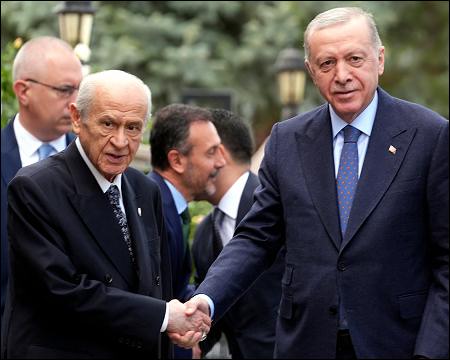
ANKARA,— Turkish President Recep Tayyip Erdogan has voiced support for an unexpected overture by nationalist ally Devlet Bahceli toward Turkey’s Kurdish population, calling it a “historic window of opportunity.”
Bahceli, head of the Nationalist Movement Party (MHP), recently extended an olive branch to Abdullah Ocalan, the imprisoned Kurdish leader and the founder of the Kurdistan Workers’ Party (PKK). The unprecedented suggestion proposed inviting Ocalan to parliament to formally end the PKK’s armed struggle.
Turkey has long conducted military operations against Kurdish targets in Iraqi Kurdistan (Bashur) and Syrian Kurdistan (Rojava).
Bahceli’s proposal, however, goes beyond typical nationalist rhetoric, implying that Ocalan, held in solitary confinement since his 1999 capture, deserves a “right to hope.” This comment has been widely interpreted as hinting at the possibility of improving Ocalan’s prison conditions or even an early release.
The move comes amidst ongoing tensions, especially following a recent attack on a defense facility near Ankara, which killed five and injured 22.
The PKK claimed responsibility, complicating the environment for Bahceli’s unprecedented call for Kurdish-Turkish “brotherhood.” Despite this, Bahceli emphasized the need for unity, suggesting that “Turks and Kurds must love each other” as both a “religious and political obligation.”
Addressing lawmakers from his Justice and Development Party (AKP), Erdogan expressed his backing for Bahceli’s approach, urging Turkey’s Kurdish population to consider the call for peace as genuine.
“My dear Kurdish brothers,” Erdogan remarked, “we expect you to firmly grasp (Bahceli’s) sincerely outstretched hand,” adding that resolving the Kurdish conflict would represent the “crowning achievement” of his political career.
Erdogan, however, clarified that the appeal was directed toward Kurdish citizens rather than “terror leaders” in Iraq and Syria, reinforcing Ankara’s military stance with recent airstrikes on PKK bases.
Nonetheless, the presence of over 22.5 million Kurds in Turkey, primarily in the southeastern region known as Turkish Kurdistan (Bakur), highlights the weight of this potential shift.
The PKK’s four-decade-long fight for Kurdish rights has been aimed at securing cultural and political rights for this substantial Kurdish population, which makes up more than a quarter of Turkey’s 84 million citizens.
In a gesture seen as a sign of possible leniency, Ocalan was recently allowed his first family visit since 2020. This followed an announcement from the pro-Kurdish People’s Democratic Party (HDP) that it had engaged in talks with the Turkish justice ministry to discuss easing Ocalan’s isolation.
HDP co-chair Tuncer Bakirhan commented on the meeting, asserting, “Lifting the isolation would benefit us all, as Ocalan’s ideas contribute to peace and democratic reforms.”
Despite being labeled a “terrorist” group by Turkey, the PKK has strictly avoided targeting civilians, focusing instead on military and government facilities.
Since launching its armed struggle in 1984, the PKK has sought autonomy and civil rights for Turkey’s Kurdish minority. However, with over 40,000 lives lost in the ongoing conflict, the call for unity and brotherhood could mark a turning point—though achieving lasting peace will remain a complex challenge.
(with files from AFP | Agencies)
Copyright © 2024 iKurd.net. All rights reserved
Related posts:
 Business with ISIS – Updated
 Turkey: The Psychological War Against the Kurds Through the PKK – Part I
 What makes a good NATO ally? The Case of Turkey
 The PKK’s Personality Cult: Changing Influences – Part II
 Can Abdullah Ocalan be a better leader than Mustafa Barzani?
 The Resurrection (Ba’ath) Party – Before the Iran-Iraq War
 Turkey: Nato’s Islamic State Member
 Debunked PKK Leader Ocalan Will Never Be Set Free
 There is no hope in Ocalan’s unilateral peace initiative
 Turkey’s Parliamentary Approval to Dissolve the PKK