

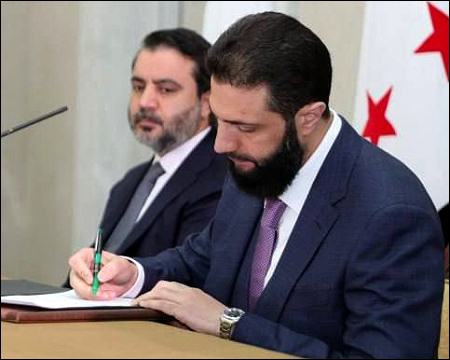
DAMASCUS/QAMISHLO,— Syria’s interim leader Ahmed al-Sharaa signed a constitutional declaration on Thursday, formally launching a five-year transitional period aimed at restructuring the country’s governance and guaranteeing new rights for citizens.
The declaration follows the fall of Bashar al-Assad’s government three months ago after Islamist opposition forces seized control. The collapse of Assad’s rule has fueled calls for a more inclusive political system that respects civil rights and freedoms.
The announcement also comes amid a surge in violence, particularly along Syria’s Mediterranean coast, where rights groups say security forces killed nearly 1,500 civilians last week. Most of those killed were from the Alawite sect, a minority group that had been closely aligned with Assad’s government.
Al-Sharaa, who now serves as Syria’s interim president, has a controversial background, including previous affiliations with extremist groups such as al-Qaeda and ISIS. He later founded al-Nusra Front, which eventually rebranded as Hayat Tahrir al-Sham (HTS).
Speaking at the presidential palace in Damascus, al-Sharaa described the declaration as the start of “a new history for Syria, one where oppression is replaced with justice and suffering with mercy.”
The new declaration replaces the Assad-era constitution and dissolves the former parliament. It establishes a transitional justice commission, which will investigate human rights violations under the previous government and work to provide accountability.
According to a copy of the document released by the presidency, the declaration prohibits “glorifying the former Assad regime and its symbols” and criminalizes any effort to justify or minimize its actions.
Abdul Hamid al-Awak, a member of the committee that drafted the declaration, said it guarantees women’s rights in education, employment, and politics, ensuring their participation in the country’s future.
Islamic jurisprudence remains the primary source of legislation, and the document maintains a requirement that the president must be a Muslim. The declaration grants the president a sole exceptional authority: the power to declare a state of emergency.
It also establishes a legislative body in which one-third of the members will be appointed by the president. This body will have the authority to draft laws but does not have the power to remove the president from office.
Kurdish Opposition
The Kurdish-led administration in the semi-autonomous Syrian Kurdistan sharply criticized the declaration, saying it fails to reflect the country’s ethnic and religious diversity.
“The declaration contradicts the reality of Syria and its diverse communities,” the administration said in a statement, pointing out that it excludes groups such as Kurds, Arabs, Syriacs, and Assyrians.
Earlier this week, the Syrian Democratic Forces (SDF), the de facto army of the Syrian Kurdistan, signed an agreement with Damascus to integrate into state institutions. However, Kurdish leaders expressed disappointment with the new constitutional framework, arguing that it undermines democratic efforts.
The declaration criminalizes calls for separatism or foreign intervention, though it also states that the government will work with international partners on reconstruction efforts.
The United Nations responded cautiously to the new constitutional declaration. UN Special Envoy for Syria Geir Pedersen said the success of the framework would depend on its implementation.
“A legal framework is an important first step, but what matters is how it is applied in practice,” Pedersen said in a statement.
The declaration was signed just days after a wave of deadly violence along Syria’s coast, which has been described as the biggest threat to stability since Assad’s removal. The Syrian Observatory for Human Rights reported that at least 1,476 civilians—mostly Alawites—were killed by security forces and their allies.
UN Secretary-General António Guterres condemned the killings, stating that “nothing can justify the targeting of civilians.” He called for an independent investigation into the violence.
Russia strongly criticized Syria’s new Islamist leadership during a closed-door United Nations briefing this week, two sources with knowledge of the meeting told Reuters. Moscow warned of the growing influence of jihadist groups in Syria and drew parallels between the sectarian killings of Alawites and the 1994 genocide in Rwanda.
Syria’s interim authorities have since announced several arrests related to the bloodshed, and al-Sharaa has vowed to “prosecute” those responsible.
(With files from AFP | Reuters)
Copyright © 2025 iKurd.net. All rights reserved
Related posts:
 The Resurrection (Ba’ath) Party – Before the Iran-Iraq War
 Stealing Syria
 Syria: Revisiting The Caesar Torture Victim Photographs
 Business with ISIS – Updated
 Sabotaging Syria
 Syria: A ‘Caliphate’ by Any Other Name — Would Smell the Same
 The Islamic State of Syria? (Al Dawla al-Islamiya fi al-Sham)
 Syria: The Hijacking of the Arab Spring: From ISIS to Hayat Tahrir al-Sham
 Hostages to Jihad – Austin Tice, The Long Missing American in Syria – Part One
 Syria: The Triumph of Terrorism