

Qatar’s 2036 Olympic Bid Sparks Alarms Over Islamist Agenda, Censorship, and Corruption
Sara Hussein | Exclusive to iKurd.net
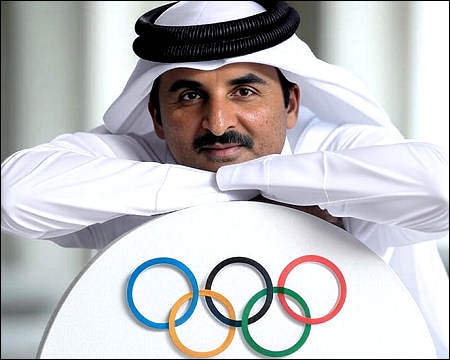
DOHA,— The Qatar Olympic Committee (QOC) has formally launched its bid to host the 2036 Olympic and Paralympic Games, brushing off years of mounting global criticism over its handling of the 2022 FIFA World Cup and its clear, deliberate attempt to turn international sporting events into vehicles for Islamic promotion and state-controlled messaging.
If chosen, Qatar would be the first nation from the Middle East and North Africa to host the Summer Olympics—an achievement some in Doha are portraying as a mark of “progress.” Yet critics warn it may instead become a repeat of the 2022 World Cup, which showcased not global unity, but Qatar’s authoritarianism, religious dominance, and a deep-rooted disregard for basic freedoms.
QOC President Sheikh Joaan bin Hamad Al Thani declared the country’s readiness to host the Games, claiming “95 percent of the needed infrastructure is already complete,” and that the rest would be built according to “a comprehensive national plan.” According to him, the 2036 Olympics would extend the “legacy” built during the World Cup.
Doha, already slated to host the Asian Games in 2030, is banking on its prior experience to bolster its chances.
Yet beneath the shiny stadiums and flashy slogans, critics are raising serious red flags—ranging from Islamic enforcement tactics to corruption scandals and geopolitical entanglements with extremist groups.
World Cup 2022: A Dress Rehearsal for Theocracy
Qatar’s handling of the 2022 FIFA World Cup remains a central concern. The event, originally marketed as a celebration of global sportsmanship, was quickly transformed into a stage for Islamic indoctrination.
The opening ceremony, for the first time in World Cup history, began with verses from the Quran, not the celebration of football. Islamic art was plastered across streets, Hadith murals lined the walkways, and microphones blared the adhan (Islamic call to prayer) into stadium zones. According to reports, even mosque muezzins were handpicked for the beauty of their voices and placed near venues to broadcast religion during game days.

Qatari officials placed restrictions on foreign spectators, enforcing dress codes, suppressing public displays of non-Islamic culture, and suddenly announcing just days before the opening match that alcohol sales would be banned at stadiums—a move that directly contradicted prior agreements with international sponsors and FIFA itself.
Visitors were not merely discouraged from practicing other faiths; in many cases, they were outright denied. Jewish organizations revealed that Qatar refused to offer kosher food, going back on a promise to accommodate Jewish fans. Even Jewish prayer services were blocked, with Qatari authorities citing vague “security risks” as justification. The effect: non-Muslims were sidelined, and a global sports event was manipulated into a cultural-religious spectacle.
Qatar Hijacks Messi’s Moment with Islamic Cloak Stunt
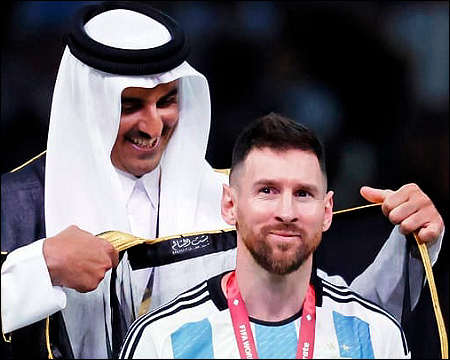
During the 2022 World Cup closing ceremony, Qatar’s obsession with religious symbolism reached an absurd climax when Emir Sheikh Tamim bin Hamad forced Lionel Messi—one of football’s most celebrated figures—to wear a traditional Arab bisht as he lifted the trophy.
What should have been Messi’s defining moment was hijacked by an authoritarian regime desperate to inject Islamic and cultural dominance into a secular, global sport.
The act, widely criticized by Western media, was seen not as a gesture of respect but a calculated attempt to overwrite the athlete’s identity with Qatar’s own. Commentators from around the world condemned the move: ESPN’s Mark Ogden called it a “ruined moment,” likening the bisht to a barber’s cape, while Gary Lineker lamented that Messi’s iconic Argentina jersey was hidden in what looked like a performative display of religious control.
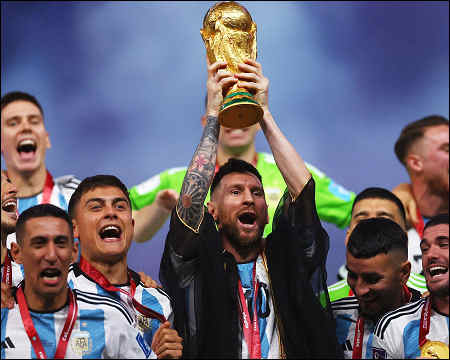
The Daily Mail didn’t mince words either, branding it a selfish and staged PR stunt by Qatar to “steal the spotlight” from the player. Even in victory, the world’s greatest athlete was turned into a prop in Qatar’s image campaign, wrapped—literally—in the fabric of a regime more focused on ideological projection than genuine celebration.
Corruption Claims Never Left Doha
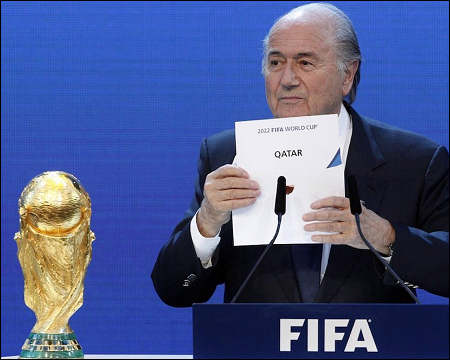
Qatar’s road to hosting the 2022 World Cup was paved in bribery scandals, and the Olympic bid is likely to revive uncomfortable memories.
As early as 2011, then-FIFA vice president Jack Warner accused Qatar of purchasing votes through Mohammed bin Hammam, president of the Asian Football Confederation at the time. Leaked emails and testimony suggested bribes were paid to multiple FIFA Executive Committee members. Several officials, including Theo Zwanziger and Sepp Blatter, later admitted regret in awarding Qatar the World Cup.
The FIFA ethics crisis that followed stained the sport’s global body and revealed a network of cash-for-vote deals, with Doha firmly in the middle.
Olympics in a Police State?
Now, with the Olympic Games in its sights, Qatar is once again presenting a polished exterior to the world. But behind that curtain lies a nation of restrictions, surveillance, and intolerance.

The Qatari government has continued its push to blend Islam into every aspect of its public identity. Islamic exhibitions are being curated and advertised to “introduce the world to Islam,” raising fresh concerns that the 2036 Olympics would not be a neutral venue for global sport, but rather a state-sponsored dawah mission.
Qatar is even integrating religious propaganda into its public architecture, pumping religious messages into fan areas, and controlling the very soundscape of its cities during events.
These actions, far from creating a welcoming environment, alienate foreign visitors and restrict freedoms that are fundamental to the Olympic ethos.
Terror Ties, Still Active

Qatar’s Olympic bid cannot be separated from its long-standing role as a safe haven for Islamist extremists, including leadership figures from Hamas, a group officially designated as a terrorist organization by the United States, European Union, and others.
Doha remains a close ally of the Muslim Brotherhood, and has been accused by multiple intelligence agencies of funding Islamist militias in Libya, Syria, and Gaza. Its broadcasting arm, Al Jazeera, has given airtime to radical preachers advocating for suicide attacks against Westerners and Israelis.
Even now, Qatar shelters individuals under international sanctions, and provides support to groups that threaten the stability of democratic nations. It also maintains cozy relations with the Taliban, facilitating talks and deals that have undermined progress in Afghanistan.
Diplomatic Isolation Not Forgotten
These concerns are not speculative. In 2017, Qatar was subjected to a Gulf Cooperation Council blockade by Saudi Arabia, the United Arab Emirates, Bahrain, and Egypt, who accused Doha of funding terrorism, undermining regional stability, and cultivating dangerous alliances with Iran. Though the embargo was lifted in 2021, the allegations have never been withdrawn.
The Olympic Committee’s Silence
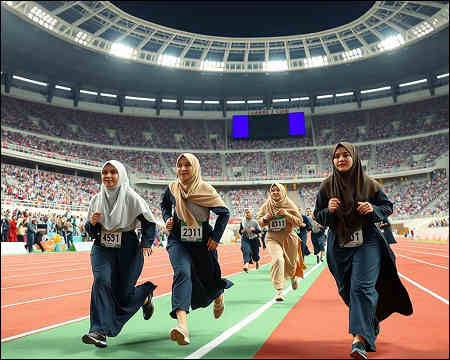
Despite all these realities, the International Olympic Committee (IOC) has remained tight-lipped about Qatar’s record. The same IOC that upholds values of diversity, equality, and open culture has so far not commented on Doha’s restrictions, indoctrination tactics, or extremist connections.
Besides Qatar, other cities bidding for the 2036 Olympics include Istanbul (Turkey), Ahmedabad (India), Nusantara (Indonesia), and Santiago (Chile). Nations reportedly considering entering the race include Germany, Italy, Canada, South Korea, Egypt, and Saudi Arabia.
The 2028 Olympics are scheduled in Los Angeles, followed by Brisbane in 2032.
Conclusion: Olympic Spirit in Danger
Qatar’s bid for the Olympics is more than just a sporting ambition—it’s an attempt to once again wrap Islamic nationalism in a cloak of global legitimacy, while exporting a state ideology that represses dissent, criminalizes other faiths, and emboldens extremism.
The IOC must decide whether it will honor the values it claims to represent, or cave to petro-dollar influence and enable yet another global event to become a platform for political theology and religious censorship.
The world is watching. Again.
The opinions are those of the writer and do not necessarily represent the views of iKurd.net or its editors.
Copyright © 2025 iKurd.net. All rights reserved
Related posts:
 Qatar Misused FIFA For Pushing its Extremist Agenda
 Why Israel’s attack on Hamas in Doha outraged Qatar?
 Saudi Arabia to host 2034 FIFA World Cup
 Paris kicks off summer Olympic Games 2024
 FIFA awards Iraqi Kurdistan’s Zakho SC fans ‘best fan’ for 2025
 Business with ISIS – Updated
 Israel strikes Hamas leadership in Qatar
 Iraq: Revenge and Corruption
 The truth about the war in Libya and the responsibility of UN – Leaked documents from Qatar
 Qatar ends role in Gaza ceasefire mediation, tells Hamas to leave the country