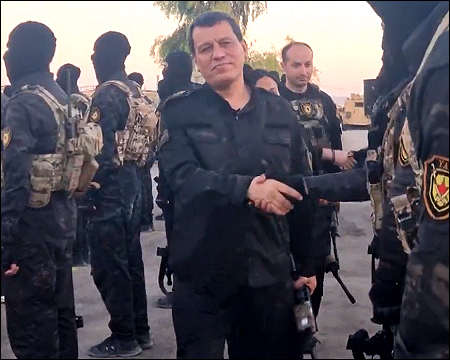
HASAKA,— Syria’s main Kurdish-led forces and the new interim Islamist government in Damascus have reached a preliminary deal to bring the Syrian Democratic Forces (SDF) under the command of the country’s national military, a top Kurdish official said on Thursday.
General Mazloum Abdi, the SDF’s top commander, told AP the sides agreed on a framework for integrating the U.S.-backed Kurdish fighters into the national army as organized units rather than absorbing them as individuals.
He called the decision “a step forward” after months of uncertainty over the fate of the Kurdish-led forces.
“The two sides have reached an understanding on the mechanism for joining,” Abdi said. “We are forming a committee with the Defense Ministry to coordinate the process.”
The deal follows months of talks after the ouster of President Bashar Assad last December. Islamist factions led by Hayat Tahrir al-Sham, or HTS, entered Damascus, removing Assad and ending his family’s 50-year rule.
Ahmad al-Sharaa, who is also known by the name Abu Mohammed al-Golani, a Sunni leader and former HTS commander, has since led the interim government.
In March, al-Sharaa’s administration and the SDF signed an agreement to unify their forces, but the plan was delayed by disagreements over how the SDF would be incorporated.
Damascus had insisted on full absorption, while Kurdish leaders wanted to maintain the force’s existing structure.
Abdi said the new mechanism allows the SDF to enter the army intact as “large military formations” governed by Defense Ministry rules. The integration will also include Kurdish police and internal security units in the northeast, he added.
The SDF, formed with U.S. support during the campaign against the Islamic State group, fought for years alongside the coalition and captured the group’s final territory in eastern Syria in 2019.
Abdi said SDF officers joining the national army will receive senior positions based on their experience.
“They fought for years and gained expertise that can help strengthen Syria’s armed forces,” he said.
He confirmed that meetings held earlier this month in Damascus with President Ahmad al-Sharaa and senior officials resulted in an “agreement in principle” to begin the merger.
The discussions took place amid growing tensions after parliamentary selections excluded the Kurdish Region in Syrian Kurdistan (Rojava) and clashes erupted in Kurdish parts of Aleppo.
Abdi said the move could help resolve broader disputes stemming from Syria’s long civil conflict. “If we can move forward with this plan, we can ease tensions and prevent further sectarian violence,” he said.
He pointed to recent sectarian killings in coastal and southern regions that raised alarm in Syrian Kurdistan, saying they had delayed the agreement’s implementation. “Now, with progress on this mechanism, we believe such incidents can be prevented,” Abdi said.
The Kurdish commander reiterated that the SDF advocates for a decentralized political model, allowing provinces to manage their affairs within a unified state. The central government has opposed such plans, fearing they could lead to fragmentation.
According to Abdi, the current plan calls for merging administrative, military, and economic bodies in the northeast with the national institutions in Damascus, maintaining coordination between local and central authorities.
Turkey’s reaction remains uncertain. Ankara views the SDF as linked to the Kurdistan Workers’ Party, or PKK, which it designates as a banned group.
Abdi expressed optimism about future relations. “If Syrians reach an internal understanding, Turkey will have no grounds for intervention,” he said. “We have seen a softer tone from Turkish officials recently.”
The proposed integration marks one of the most significant political and military developments since Assad’s fall, signaling possible stability after more than a decade of war.
However, implementation details remain unclear, and local skepticism persists in Kurdish-majority regions such as Qamishlo and Hasaka.
The Syrian Kurdish forces number more than 100,000 fighters, nearly half of them women. According to experts, they are highly trained and battle-hardened after years of fighting the Islamic State group and Turkey-backed Syrian Islamist mercenary factions. The force is well-armed, disciplined, and operates under a strong and organized command structure.
The Autonomous Administration, officially formed in 2018, runs the region under a system rooted in democratic confederalism. The framework promotes local self-rule, gender equality, secular governance, and environmental protection. It has gained recognition for expanding women’s roles in political and community leadership.
Diplomats say that while the agreement could reduce internal tensions, regional powers including Turkey and Iran will watch closely how the merger unfolds and whether it strengthens Damascus’s control across Syria’s fractured landscape.
(With files from AP | Agencies)
Copyright © 2025 iKurd.net. All rights reserved
Related posts:
 Business with ISIS – Updated
 What makes a good NATO ally? The Case of Turkey
 The Resurrection (Ba’ath) Party – Before the Iran-Iraq War
 Sabotaging Syria
 Turkey: Nato’s Islamic State Member
 Syria: A ‘Caliphate’ by Any Other Name — Would Smell the Same
 Syria: Revisiting The Caesar Torture Victim Photographs
 The SDF–Damascus deal: A gamble over keys to Kurdish homeland
 Martyrs for Millionaires: The Black-Market Politics behind the Theft of Syria’s Oil
 Damascus, Kurdish SDF agree to de-escalate after Aleppo clashes