ALEPPO,— Syrian administration forces and their allied Islamist factions halted military operations on Monday after days of clashes with Kurdish-led forces in Aleppo, violence that Kurdish officials said was triggered by Damascus-backed attacks and direct political pressure from Turkey aimed at reshaping Syria’s internal power balance.
The fighting broke out as the Syrian Islamist administration in Damascus, with strong backing from Ankara, intensified efforts to force the integration of the Kurdish-led Syrian Democratic Forces SDF, the de facto army of Syrian Kurdistan (Rojava Kurdistan) into state structures under terms that Kurdish leaders say undermine local autonomy and ignore earlier understandings.
At least three people were killed in the clashes, according to local reports, as artillery, rockets, and tank fire hit densely populated Kurdish neighborhoods in Aleppo.
The violence came just weeks before a deadline to implement a March 10 agreement that was supposed to regulate the relationship between Damascus and the Kurdish-led administration in Rojava Kurdistan.
State news agency SANA quoted the Syrian defense ministry as saying the army’s general staff ordered units to stop firing and to cease targeting what it described as hostile positions. The order came only after sustained clashes and mounting civilian casualties in northern Aleppo.
The US-backed Kurdish-led SDF said they had issued instructions to their units to stop responding to attacks, adding that the decision was made to prevent further civilian harm despite what the group described as continued provocations by Damascus government-aligned militias.
Both sides traded accusations, but Kurdish officials placed responsibility squarely on Damascus and its Islamist allies.
SANA claimed that two civilians were killed and eight wounded by SDF shelling on Aleppo neighborhoods. Kurdish authorities rejected the claim and said government-aligned factions were responsible for the escalation.
According to the SDF, one woman was killed and 17 civilians were wounded after heavy weapons fire struck the Sheikh Maqsoud and Ashrafieh neighborhoods, two Kurdish-majority districts of Aleppo that have repeatedly come under pressure from Damascus since the political transition earlier this year.
Sheikh Maqsoud and Ashrafieh have remained under Kurdish control despite repeated attempts by Syrian authorities to assert military presence in the areas.
Kurdish security forces have maintained control under a disengagement arrangement reached in April, an agreement Kurdish officials say Damascus has repeatedly violated.
Syria’s interior ministry accused Kurdish fighters of attacking government personnel stationed at joint checkpoints.
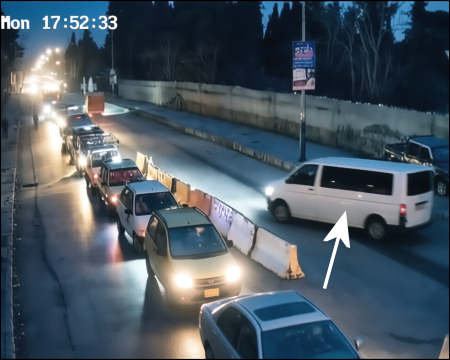
The SDF dismissed the accusation and said factions affiliated with the interim government launched the attack after withdrawing from a checkpoint in preparation for shelling.
Video released by the SDF showed Syrian government Islamist militias pulling back from a checkpoint shortly before heavy weapons fire struck Kurdish residential areas.
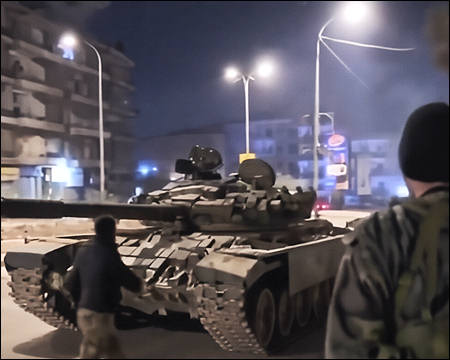
Separate footage aired by Arabic television channels, including Al Hadath and al Jazeera, showed Damascus-aligned fighters using tanks and artillery against the Kurdish neighborhoods, contradicting official denials from the defense ministry.
Despite the visual evidence, the Syrian defense ministry denied attacking SDF positions, while the Kurdish-led force denied firing on Aleppo neighborhoods, calling the accusations an attempt to deflect responsibility for civilian harm.
The clashes followed a similar pattern seen in October, when government forces announced a ceasefire only after days of fighting left multiple casualties.
Kurdish officials say such ceasefires have repeatedly been used to pause fighting without addressing underlying political disputes.
The latest violence unfolded against the backdrop of stalled negotiations over the March agreement. The deal was intended to integrate Kurdish civil and military institutions in Rojava Kurdistan into the Syrian state by the end of the year.
Kurdish leaders say Damascus has delayed implementation while advancing proposals that weaken Kurdish command structures.
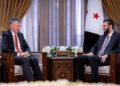
In Damascus, Turkish Foreign Minister Hakan Fidan met with Syrian interim President Ahmed al-Sharaa alongside Defense Minister Yasar Guler and intelligence chief Ibrahim Kalin, according to a presidency statement.
The meetings underscored Ankara’s expanding influence over Syria’s new authorities.
Turkey has deepened its involvement in Syrian affairs since the removal of Bashar al-Assad last year, positioning itself as a key power broker.
Kurdish officials accuse Ankara of dictating security policy to Damascus and using the integration process to dismantle Kurdish-led institutions along the border.
Speaking alongside Syrian Foreign Minister Asaad al-Shaibani, Fidan said the Syrian Democratic Forces must be absorbed into the state in a way that eliminates what Turkey views as a threat to its national security.
He said the SDF should no longer act independently or control territory near Turkey’s border.
Fidan claimed Kurdish forces were not serious about implementing the March agreement, a charge Kurdish officials reject, saying Ankara is attempting to impose conditions that were never part of the original deal.
Shaibani confirmed that Damascus received a formal response from the SDF to a defense ministry proposal on integration. He said the government is reviewing whether the response aligns with what he described as the national interest and the goal of a unified Syrian state.
A Kurdish official told AFP last week that Damascus proposed dividing the SDF into three divisions and several brigades, including a women’s unit.
The official said the plan would leave Kurdish forces nominally under state authority while stripping them of real decision-making power.
According to the official, the proposal marked the first written offer from Damascus since March and came amid international and regional pressure to finalize the agreement before the end of the year.
Since 2016, Ankara has launched three military incursions into Syrian Kurdistan, capturing hundreds of kilometers of territory and advancing up to 30 kilometers into the country and occupying the Kurdish Afrin region. The operations have primarily targeted the U.S.-backed Syrian Kurdish forces.
Fidan said Syria’s stability was inseparable from Turkey’s stability, a statement Kurdish officials interpret as justification for Ankara’s continued involvement.
The Autonomous Administration, established in 2018, governs Kurdish-led areas of northeastern Syria under a system based on democratic confederalism. Kurdish officials say the model prioritizes local governance, gender equality, secularism, and environmental sustainability, principles they say are increasingly threatened by pressure from Damascus and Ankara.
(With files from AFP | Agencies)
Copyright © 2025 iKurd.net. All rights reserved.
Related posts:
 Business with ISIS – Updated
 Sabotaging Syria
 What makes a good NATO ally? The Case of Turkey
 The Resurrection (Ba’ath) Party – Before the Iran-Iraq War
 Turkey: Nato’s Islamic State Member
 Syria: A ‘Caliphate’ by Any Other Name — Would Smell the Same
 The SDF–Damascus deal: A gamble over keys to Kurdish homeland
 Syria: Revisiting The Caesar Torture Victim Photographs
 Syria bombs Kurdish neighborhoods in Aleppo city
 Syrian government militias shell Kurdish areas in Aleppo after civilians flee