

Kurdistan’s Hollow Democracy: A Political System in Paralysis
Sartip Jawhar | Exclusive to iKurd.net
Translated from Kurdish Awene
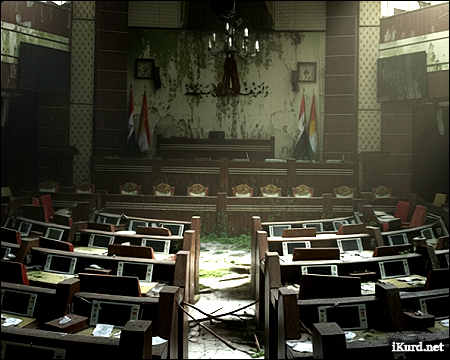
One year has passed since the elections in Iraq’s Kurdistan Region, yet no new government has been formed. The parliament, once intended to embody the people’s will, now resembles a dead institution that has completely lost its function.
In any country with even a modest degree of democracy, post-election periods are marked by intense debate, negotiation, and anticipation of change, such as a reshuffling of cabinet members, a renewal of governing policies, or a shift in direction.
But in Kurdistan, nearly 35 years have gone by without a single election being held on schedule, and none have been conducted without widespread doubts about their fairness or outcome.
For the past decade, the Kurdistan Parliament has been effectively paralyzed. Since 2015, its doors have remained closed, its legislative authority suspended. Oversight institutions that are meant to monitor corruption within government and public administration have also fallen silent.
Many of them now operate outside the law, becoming part of the very system they were supposed to hold accountable. These watchdog bodies, once symbols of transparency, have instead become accomplices in a failing order.
The same can be said for most civil society organizations and professional unions. Once active, they have now lost their legitimacy under the law. Unions representing journalists, lawyers, human rights defenders, and even parliamentarians have all but vanished from the public sphere.
Meanwhile, the political opposition has failed to offer a meaningful alternative. It lacks a coherent vision, a concrete project, or any serious initiative for reform. Its criticism is largely confined to social media, full of rhetoric but absent from the streets.
If another year passes without real change, and if citizens do not take to the streets to demand accountability, the least that can be done is to take the matter to the Federal Supreme Court in Baghdad.
A legal boundary must be set to end these endless political delays that have turned government formation into a bargaining chip for party and personal interests. Governance must return to its rightful place under the authority of parliament and the will of the people.
If elections are held but no government is formed, if parliament exists but its doors remain shut, and if opposition parties exist but are voiceless, then what is the point of holding elections at all? What kind of democracy does Kurdistan claim to have?
Judging by the current political climate, even after Iraq’s national elections, forming a new Kurdistan Regional Government will not be easy. The road ahead is steep and uncertain, and the process may again take years.
Any political party that chooses to participate in the current system will face enormous challenges. Power in the region has been centralized and monopolized by a few hands. Beyond the formal institutions of government, a shadow network of influence has taken root, operating outside legal authority yet wielding real control. It is this invisible system that prevents genuine governance from functioning.
Unless this parallel structure is dismantled, and unless ministers and institutions are empowered to exercise their legal responsibilities openly, no party will be able to govern effectively. Those who have joined the administration so far have gained little; their authority has been stripped away.
Even when a party holds ministerial positions, real power often lies elsewhere, and decisions are made not in offices but in circles of influence that operate beyond the Council of Ministers.
The result is a hollow democracy, one where elections are held without purpose, institutions exist without power, and governance continues without legitimacy.
The Kurdish version of the article was publish in Awene Newspaper. Translated by iKurd.net.
The views expressed are solely those of the author and do not necessarily reflect the opinions of iKurd.net or its editorial team.
Copyright © 2025 iKurd.net. All rights reserved
Barzani’s party wins Iraqi Kurdistan parliamentary election, commission says
Related posts:
 The Resurrection (Ba’ath) Party – Before the Iran-Iraq War
 Iraq in the Shadow of Khomeinism – Part III: Iraq is NOT Iran!
 The Kurdish Diplomacy: Historical, Political, and Legal Explanation – Book Review
 Iraq – The Cynical Swindle
 Iraqi Kurdistan – “Sold Out!” – Part II
 Global Democracy is in Jeopardy!
 Kurdistan Parliament: Empty Seats, Stolen Salaries
 Business with ISIS – Updated
 Kirkuk – Wars of Deception And Elections
 The Mustashar and the Jash – A View from the Position of ‘Iraqi National Unity’ on the ‘Descendants of Treason’