

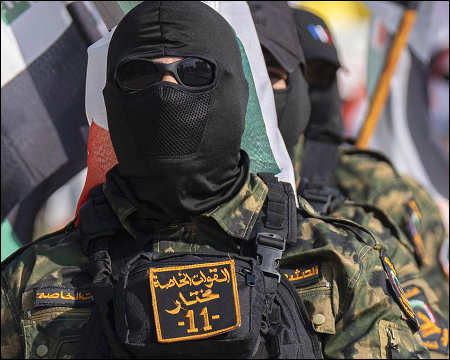
BAGHDAD,— Iran’s Islamic Revolutionary Guard Corps (IRGC) has established covert new cells inside Iraq to conduct attacks against Gulf countries that host American forces while bypassing existing militia networks in an effort to avoid detection, eight Iraqi sources told Reuters.
Three or four cells, each made up of about 10 elite Iraqi Shiite fighters, carried out at least seven drone strikes from desert areas near the southern cities of Basra and Samawa.
The attacks targeted sites in Kuwait, Saudi Arabia and the United Arab Emirates between April 20 and May 17, according to three of the sources.
Some members were recruited from Islamic Resistance in Iraq, an umbrella network of hardline Shiite factions with thousands of fighters.
However, the new cells operate outside that command structure and report directly to the IRGC, the sources said. The sources included two Iraqi military officials, one security official and five militia commanders.
The establishment of these previously unreported Iraqi cells indicates a change in IRGC tactics intended to maintain Iran’s ability to project influence across the region as its proxy forces weaken and financial and military resources come under pressure, the five militia commanders said.
Iraq, a Shiite-majority nation, hosts numerous militias, many aligned with Tehran, and they form part of Iran’s Axis of Resistance stretching across Gaza, Lebanon, Yemen and Iraq.
Groups operating under Islamic Resistance in Iraq have claimed responsibility for dozens of drone and rocket attacks on U.S. assets in Iraq since the United States and Israel attacked Iran on February 28, prompting retaliatory airstrikes.
However, there has been no large-scale mobilization of Iranian proxy forces inside Iraq.
Several Shiite factions have recently signaled willingness to disarm and concentrate on domestic politics to avoid escalation with U.S. President Donald Trump’s administration, a shift that may have encouraged the IRGC to create directly controlled units, according to Jasim al-Bahadli, a retired Iraqi general, and two lawmakers from the Shiite governing alliance.
Two factions, Asaib Ahl al-Haq and the Imam Ali Brigades, announced plans this month to surrender weapons to state authorities after repeated U.S. warnings urging Baghdad to disband armed groups operating outside state control.
Bahadli said the newer formations appear smaller, more ideologically hardened and more tightly controlled, reflecting Iran’s need to conserve resources amid economic strain.
The United States and Iran signed an interim agreement on Wednesday to end the war, with further negotiations expected on nuclear issues, though Iranian officials say support for resistance groups is not included. Iran’s foreign ministry and its United Nations missions in New York and Geneva did not respond.
The U.S. State Department said Iraq must dismantle all tools of Iran’s destabilizing activity, including the IRGC and Iran-aligned militias.
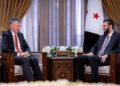
Iraq’s Prime Minister Ali al-Zaidi met U.S. envoy Tom Barrack on Monday to discuss disarmament plans. Kuwait, Saudi Arabia and the United Arab Emirates did not comment.
New Iraqi groups conducted at least three attacks on Kuwait, two on Saudi Arabia and two on the UAE.
Targets included Kuwait’s Ali Al Salem Air Base and a military terminal at its airport. Some attacks were intercepted. Iraqi officials said investigations are ongoing, including into a May 17 drone incident at a nuclear facility.
Zaidi condemned the attacks and pledged joint investigations with Gulf states, while his spokesman Sabah al-Numan declined to comment on the inquiry.
Kuwait, Saudi Arabia and the UAE summoned Iraqi envoys in April over the strikes.
(With files from Reuters)
Copyright © 2026 iKurd.net. All rights reserved.
Related posts:
 Saddam Hussein’s Enemies: Paving the Road to the Invasion of Iraq
 Saddam Hussein was a Friend to the West
 The Resurrection (Ba’ath) Party – Before the Iran-Iraq War
 Iraq: Revenge and Corruption
 The Suffocation of Iraq Kurdistan
 Iraq in the Shadow of Khomeinism – Part I: Baghdad And Erbil Under Threat
 Iran’s Grip on Kirkuk
 Saudi warplanes hit pro-Iran Shiite militias in Iraq during war: Reuters
 The Suffering of Halabja
 The Truth About The Saddam Hussein Affair